

Union Home Minister Amit Shah announced a "360-degree assault" on organised crime.
GK and monthly revision
Planning a 360-degree assault on organised crime, says Amit Shah at anti-terror conference
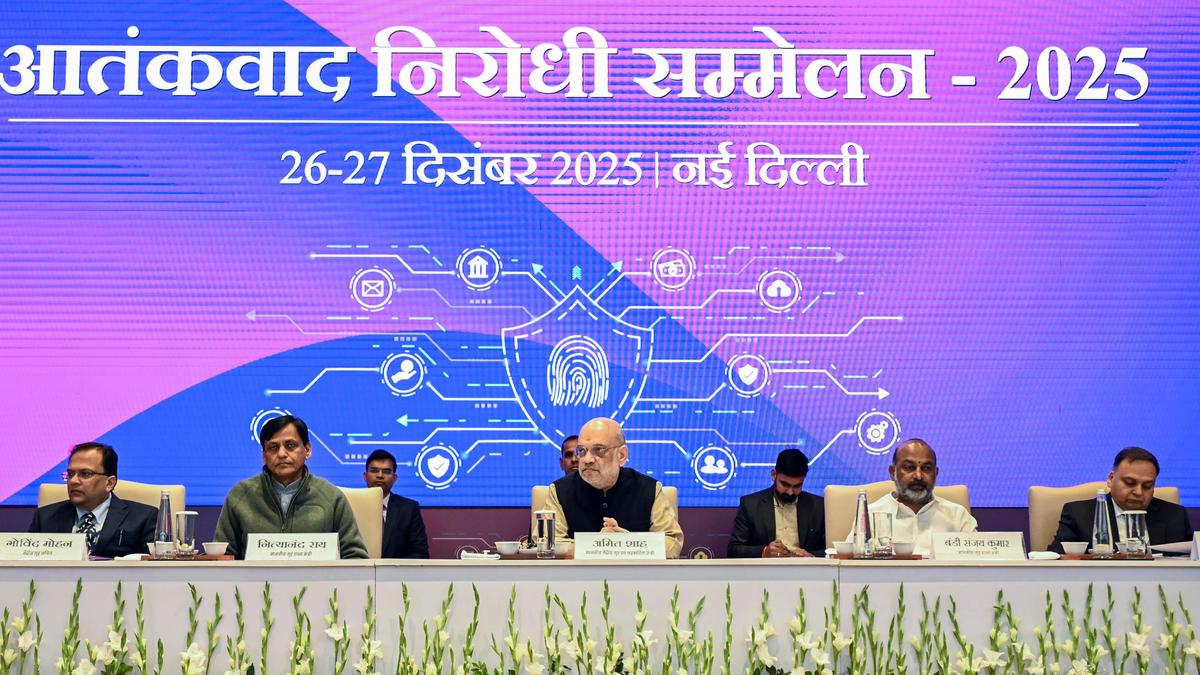
Union Home Minister Amit Shah announced a "360-degree assault" on organised crime at an anti-terror conference. During the event, he also unveiled the National Investigation Agency's (NIA) updated crime manual. This signifies a governmental push to enhance law enforcement capabilities against complex criminal networks, crucial for internal security topics in competitive exams.
Revision structure
Monthly events and exam calendar context
Static GK and one-liner notes
Quiz and mock-test revision path
Key points
Exam-ready takeaways
The statement was made during an anti-terror conference.
Minister Shah unveiled the National Investigation Agency's (NIA) updated crime manual.
The updated manual aims to enhance investigative capabilities against organised crime and terrorism.
This initiative highlights the government's focus on strengthening national security apparatus.
Detailed analysis
Full exam-oriented breakdown
Union Home Minister Amit Shah's announcement of a "360-degree assault" on organised crime, coupled with the unveiling of the National Investigation Agency's (NIA) updated crime manual at an anti-terror conference, signals a significant strategic shift in India's approach to national security. This initiative underscores the government's resolve to combat complex criminal networks that often have deep linkages with terrorism, drug trafficking, and other illicit activities, posing a multifaceted threat to the nation's stability and development. The background context for this intensified focus is rooted in the evolving nature of crime. In recent decades, organised crime has transcended traditional boundaries, becoming increasingly sophisticated, technology-driven, and transnational. From terror financing and narcotics smuggling to cybercrime and human trafficking, these networks exploit global interconnectedness and technological advancements. India, with its long borders, diverse population, and strategic geopolitical location, has historically been vulnerable to various forms of organised crime and cross-border terrorism. Major incidents like the 1993 Mumbai bombings and the 2008 Mumbai attacks highlighted the devastating impact of such networks and the imperative for a robust, coordinated response. The realisation that organised crime often provides the financial and logistical backbone for terrorist activities necessitates a holistic approach that targets both. At the heart of this "360-degree assault" are key stakeholders. The Union Home Minister, as the political head of internal security, sets the policy direction. The National Investigation Agency (NIA), established in 2008 in the aftermath of the 26/11 Mumbai attacks, is India's primary federal counter-terrorism law enforcement agency. Its updated crime manual is crucial for standardising and enhancing investigative protocols, incorporating modern forensic techniques, cybercrime investigation methodologies, and intelligence-sharing mechanisms. Beyond the NIA, other critical stakeholders include state police forces, various central intelligence agencies like the Intelligence Bureau (IB) and Research and Analysis Wing (RAW), financial intelligence units like the Enforcement Directorate (ED) and Financial Intelligence Unit-India (FIU-IND), and agencies involved in border management such as the Border Security Force (BSF) and Customs. International cooperation through bodies like Interpol and bilateral agreements is also vital, given the transnational nature of these threats. This initiative matters immensely for India. From an internal security perspective, dismantling organised crime networks directly contributes to peace and public order, reducing the incidence of violence, extortion, and other criminal activities. Economically, organised crime distorts markets, facilitates money laundering, and drains resources from the legitimate economy, deterring foreign investment and impacting national growth. For instance, the hawala network, often used by criminal and terrorist organisations, undermines the formal financial system. Socially, the presence of organised crime erodes public trust in institutions, fosters a culture of fear, and can even lead to the radicalisation and recruitment of vulnerable youth into criminal gangs. Strengthening India's capacity to combat these threats also enhances its international standing as a responsible global partner in the fight against terrorism and transnational crime. Historically, India's legal framework against organised crime and terrorism has evolved significantly. Early attempts included the Terrorist and Disruptive Activities (Prevention) Act (TADA) in 1985, which was controversial and allowed to lapse. This was followed by the Prevention of Terrorism Act (POTA) in 2002, which was repealed in 2004. The Unlawful Activities (Prevention) Act (UAPA), 1967, has since been strengthened through several amendments, notably in 2004, 2008, 2012, and 2019, making it the principal anti-terror law. The NIA Act of 2008 granted the agency concurrent jurisdiction across states without requiring prior state permission, a crucial step in federalising the counter-terror response. Furthermore, the Prevention of Money Laundering Act (PMLA), 2002, provides a robust framework to trace and seize assets derived from criminal activities, cutting off financial lifelines for organised crime. Constitutional provisions are also relevant: 'Public Order' and 'Police' fall under the State List (List II) of the Seventh Schedule, while 'Criminal Law' and 'Criminal Procedure' are on the Concurrent List (List III). The Union Parliament derives its power to legislate on national security matters, including the NIA Act and UAPA, from entries in the Union List (List I), such as 'Defence of India' and 'Foreign Affairs'. The balance between national security and fundamental rights, particularly Article 21 (Right to Life and Personal Liberty) and Article 22 (Protection against arrest and detention), remains a critical aspect of judicial scrutiny for such laws. The future implications of this "360-degree assault" are profound. It suggests a future where intelligence gathering, investigation, and prosecution will be more integrated and technology-driven. We can expect enhanced inter-agency cooperation, both domestically and internationally, improved capacity building for law enforcement personnel, and greater emphasis on cyber forensics and financial intelligence. The focus will likely extend to disrupting the entire ecosystem of organised crime, including their funding, logistics, and recruitment networks. This comprehensive strategy aims not just to apprehend criminals but to dismantle the structures that enable them, fostering a more secure and stable environment for India's growth and development. However, maintaining a careful balance between robust enforcement and the protection of civil liberties will be an ongoing challenge that requires constant vigilance and judicial oversight.
How to study
Turn news into exam marks
Revise monthly events by exam family instead of reading random updates.
Pair one-liners with mock tests so mistakes become the next revision list.
Keep state job pages, calendar pages and GK packs connected in one path.