

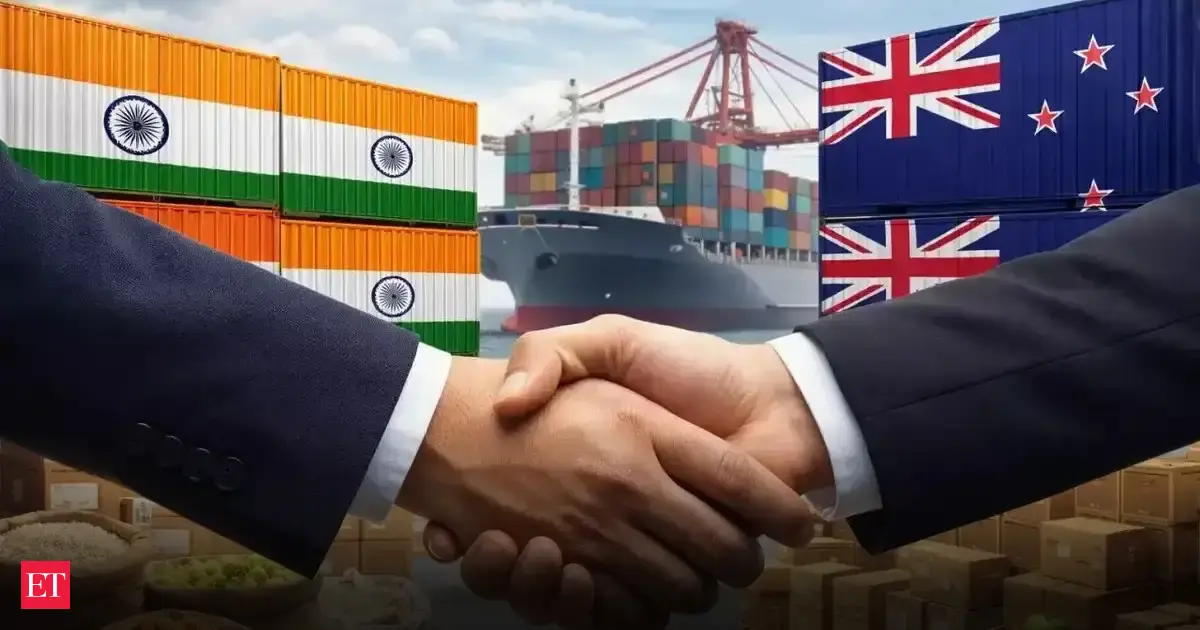
India and New Zealand have signed a Free Trade Agreement (FTA).
GK and monthly revision
New Zealand pact a booster for financial services
India and New Zealand have signed a Free Trade Agreement (FTA) specifically aimed at enhancing cooperation in financial services. This pact is significant as it includes new rules for digital payments, fintech, data transfer, and back-office services, positioning India to become a global fintech hub. This boosts bilateral investment and trade, crucial for economic growth and international relations for competitive exams.
Revision structure
Monthly events and exam calendar context
Static GK and one-liner notes
Quiz and mock-test revision path
Key points
Exam-ready takeaways
The agreement specifically focuses on boosting cooperation in the financial services sector.
Key areas covered include new rules for digital payments, fintech, data transfer, and back-office services.
A primary objective of the pact is to help India become a global fintech hub.
The FTA aims to encourage increased investment and business presence between the two nations.
Detailed analysis
Full exam-oriented breakdown
The recently signed Free Trade Agreement (FTA) between India and New Zealand, with a specific focus on boosting cooperation in financial services, marks a significant stride in India's economic diplomacy and its ambition to become a global fintech hub. This pact is not merely about traditional trade in goods; it delves into the modern intricacies of the digital economy, covering areas like digital payments, fintech innovations, data transfer protocols, and back-office services. **Background Context and What Happened:** India, a rapidly growing economy, has been increasingly engaging in bilateral and multilateral trade agreements to integrate further into the global economy. This strategy aligns with its 'Act East' policy and broader efforts to diversify trade partnerships beyond traditional blocs. New Zealand, a developed nation with a strong services sector and advanced financial infrastructure, presents a valuable partner. The discussions for such an agreement have been ongoing, reflecting a mutual interest in leveraging each other's strengths. The culmination into this FTA signifies a strategic alignment to capitalize on India's robust digital public infrastructure (DPI) – exemplified by the Unified Payments Interface (UPI) – and its vast talent pool, alongside New Zealand's expertise and market access. The agreement specifically outlines new rules and frameworks to facilitate seamless operations in critical digital financial domains, moving beyond conventional goods tariffs to focus on service liberalization. **Key Stakeholders Involved:** On the Indian side, the primary stakeholders include the Ministry of Commerce and Industry, which spearheads trade negotiations, and the Ministry of External Affairs, managing diplomatic relations. The Reserve Bank of India (RBI) and other financial regulators like SEBI will play crucial roles in implementing and harmonizing regulatory frameworks for digital payments and fintech. Indian financial institutions, from large public and private sector banks to burgeoning fintech startups, stand to gain from expanded market access and collaboration opportunities. Similarly, New Zealand's government, its financial services industry, and tech companies are key players. Consumers in both nations are also vital stakeholders, benefiting from potentially more efficient and diverse financial services. **Why This Matters for India:** This FTA holds immense significance for India across multiple dimensions. Economically, it promises to stimulate Foreign Direct Investment (FDI) into India's financial services sector, fostering innovation and job creation. By facilitating cross-border data transfer, it supports India's burgeoning IT and IT-enabled services (ITES) sector, particularly in back-office operations, which are a major foreign exchange earner. The explicit goal of making India a 'global fintech hub' is critical. India's UPI has garnered international acclaim, demonstrating its capability in digital payments. This pact provides a structured pathway for Indian fintech solutions to penetrate the New Zealand market and potentially serve as a template for similar agreements with other nations. Strategically, it strengthens India's economic ties with a key partner in the Indo-Pacific region, aligning with India's broader foreign policy objectives of fostering regional stability and economic cooperation. **Historical Context and Constitutional Linkages:** India's journey towards liberalized trade policies gained momentum after the economic reforms of 1991. Since then, India has actively pursued FTAs with various countries and blocs, including the UAE, Australia, Japan, and ASEAN. These agreements reflect a shift from an inward-looking economy to one seeking global integration. While there isn't a specific constitutional article solely for FTAs, the Executive's power to enter into international treaties and agreements is derived from Article 73 of the Constitution, which states that the executive power of the Union extends to matters with respect to which Parliament has power to make laws. This power is exercised by the President, typically through the Cabinet. Furthermore, the pact aligns with overarching government policies like 'Digital India,' which promotes digital literacy and infrastructure, and 'Make in India,' by boosting domestic service capabilities. Aspects related to data transfer and digital security would also be governed by existing legal frameworks such as the Information Technology Act, 2000, and its subsequent amendments, ensuring data protection and privacy. **Future Implications:** This financial services-focused FTA could serve as a blueprint for India's future trade negotiations, emphasizing services and digital trade rather than solely goods. It could lead to greater regulatory convergence between India and New Zealand, fostering a more predictable and transparent environment for businesses. The agreement has the potential to significantly boost India's service exports, contributing to its current account balance. However, future challenges include harmonizing data protection standards, ensuring cyber security across borders, and preventing regulatory arbitrage. Success in this pact could solidify India's position as a reliable and innovative partner in the global digital economy, attracting further investment and talent, and propelling its journey towards becoming a 5 trillion-dollar economy.
How to study
Turn news into exam marks
Revise monthly events by exam family instead of reading random updates.
Pair one-liners with mock tests so mistakes become the next revision list.
Keep state job pages, calendar pages and GK packs connected in one path.