

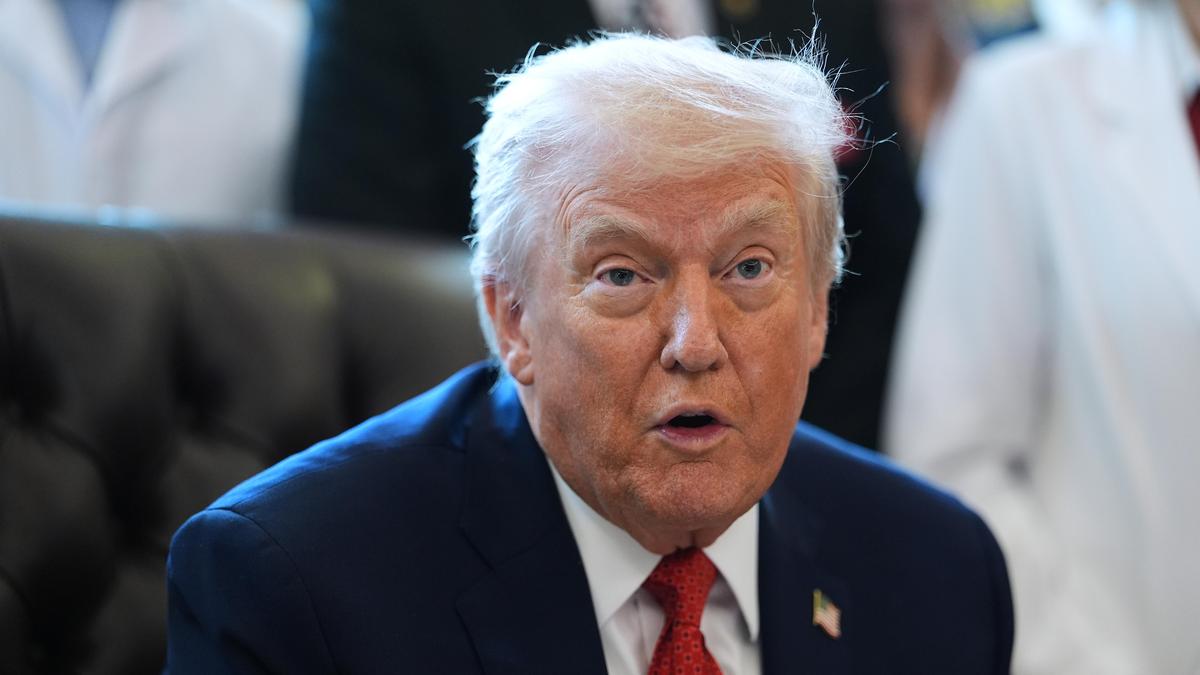
U.S. President Donald Trump stated he was not ruling out war with Venezuela.
GK and monthly revision
Trump says he is not ruling out war with Venezuela, NBC News reports
Former U.S. President Donald Trump indicated he was not ruling out military action against Venezuela, as reported by NBC News. This statement underscores the volatile geopolitical situation between the U.S. and Venezuela, marked by ongoing sanctions and political tensions. For competitive exams, this highlights the importance of understanding international relations, U.S. foreign policy, and the political landscape of Latin America.
Revision structure
Monthly events and exam calendar context
Static GK and one-liner notes
Quiz and mock-test revision path
Key points
Exam-ready takeaways
The statement also included a threat of additional seizures of oil tankers.
These potential seizures were specified to occur near Venezuelan waters.
The information was reported by NBC News, citing an interview with the U.S. President.
The context relates to ongoing geopolitical tensions between the United States and Venezuela.
Detailed analysis
Full exam-oriented breakdown
The statement by former U.S. President Donald Trump, indicating that he was not ruling out military action against Venezuela and threatening the seizure of oil tankers, underscored a deeply volatile geopolitical situation. This rhetoric reflects years of escalating tensions between the United States and Venezuela, rooted in ideological clashes, economic interests, and a struggle for regional influence. **Background Context and Historical Roots:** The animosity between the U.S. and Venezuela intensified significantly with the rise of Hugo Chávez in 1999. Chávez, a charismatic socialist leader, implemented policies that challenged U.S. hegemony in Latin America, nationalized key industries (especially oil), and fostered alliances with anti-U.S. nations like Cuba, Russia, and Iran. His 'Bolivarian Revolution' openly opposed U.S. foreign policy, leading to a steady deterioration of diplomatic relations. After Chávez's death in 2013, his handpicked successor, Nicolás Maduro, inherited a nation heavily reliant on oil revenue but plagued by corruption and economic mismanagement. As global oil prices fell, Venezuela's economy spiraled into hyperinflation, severe shortages of food and medicine, and a massive humanitarian crisis, prompting millions to flee the country. **Escalation and Key Stakeholders:** Under the Trump administration, the U.S. significantly ratcheted up pressure on the Maduro regime, labeling it a dictatorship and a threat to regional stability. The U.S. recognized opposition leader Juan Guaidó as the legitimate interim president of Venezuela in January 2019, urging other nations to follow suit. This move was accompanied by a series of crippling economic sanctions targeting Venezuela's oil sector – its primary source of income – as well as individuals within the Maduro government. The threat of military action and the seizure of oil tankers represented a significant rhetorical escalation, reflecting the U.S.'s frustration with the endurance of the Maduro regime despite intense pressure. Key stakeholders in this complex dynamic include: * **The United States:** Driven by objectives to restore democracy, ensure regional stability, and counter the influence of adversaries like Russia and China in Latin America. Economic interests related to global oil supply also play a role. * **Nicolás Maduro Regime:** Fights for its survival, sovereignty, and control over Venezuela's vast oil reserves. It relies on internal security forces and international allies (Russia, China, Cuba, Iran) for support. * **Venezuelan Opposition (led by Juan Guaidó):** Seeks international recognition and support to oust Maduro, establish a transitional government, and restore democratic institutions. * **Regional Actors (e.g., Colombia, Brazil, Peru):** Grapple with the immense humanitarian crisis, including millions of Venezuelan refugees, and the potential for regional instability or conflict. * **Russia, China, Iran, and Cuba:** Provide crucial economic, military, and diplomatic support to the Maduro regime, viewing U.S. intervention as a violation of sovereignty and an opportunity to challenge U.S. influence. **Significance for India:** This geopolitical tension has direct implications for India, a major global oil importer. Venezuela possesses the world's largest proven oil reserves, and while U.S. sanctions have severely curtailed India's direct oil imports from Venezuela, any major disruption, especially military conflict or further tanker seizures, would significantly impact global oil prices and supply chains. This directly affects India's energy security and its economic stability. Higher crude oil prices translate to increased import bills, potentially fueling inflation and impacting India's current account deficit. India, guided by its foreign policy principles enshrined in **Article 51 of the Constitution** (promotion of international peace and security, respect for international law, and peaceful settlement of international disputes), generally advocates for non-intervention and upholding national sovereignty. While balancing its strategic partnership with the U.S. and its commitment to these principles, India would closely monitor any actions that could undermine international law or lead to broader regional instability. **Future Implications:** The future implications are profound. A military intervention, while perhaps unlikely, would lead to a catastrophic humanitarian crisis and regional destabilization. Even without direct conflict, continued U.S. sanctions and pressure, coupled with support from Venezuela's allies, create a persistent geopolitical flashpoint. This situation highlights the broader themes of national sovereignty versus humanitarian intervention, the effectiveness of sanctions as a foreign policy tool, and the increasing multipolarity of global power dynamics where nations like Russia and China actively counter U.S. influence. For India, ensuring stable energy supplies and navigating complex diplomatic waters will remain crucial as the Venezuela crisis evolves. The situation also underscores the fragility of international law when confronted with great power rivalries and internal political struggles.
How to study
Turn news into exam marks
Revise monthly events by exam family instead of reading random updates.
Pair one-liners with mock tests so mistakes become the next revision list.
Keep state job pages, calendar pages and GK packs connected in one path.