

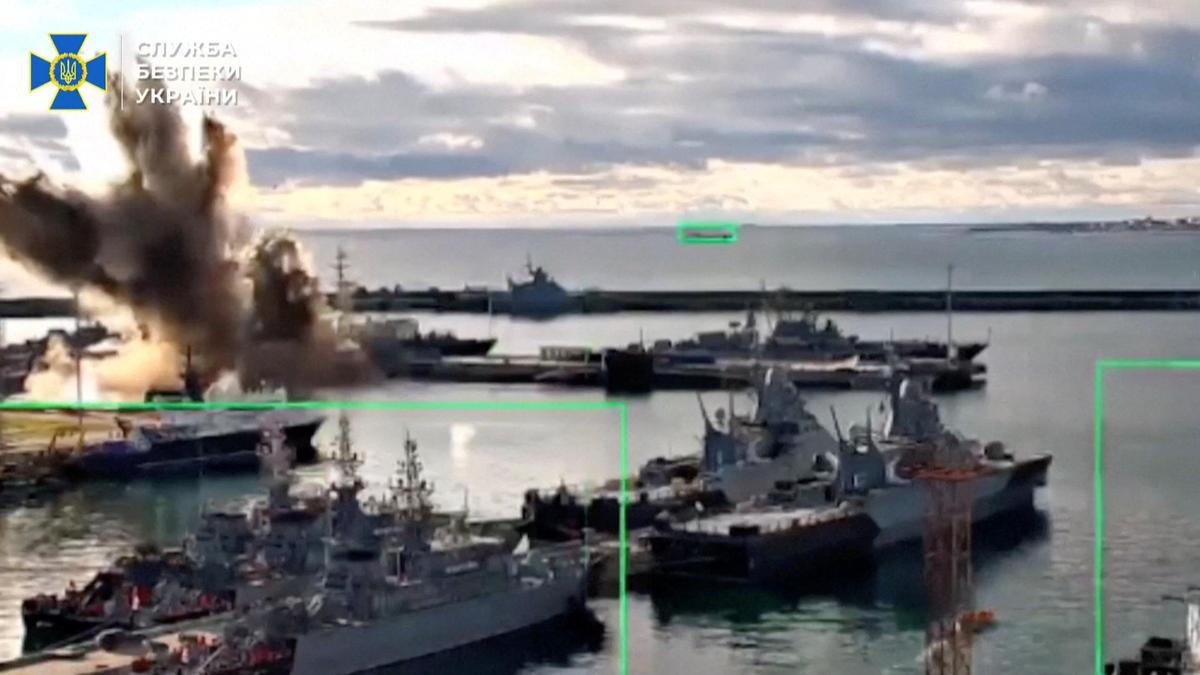
The attack was carried out by the Security Service of Ukraine (SBU).
GK and monthly revision
Ukraine hits Russian submarine in first underwater drone attack
Ukraine's Security Service (SBU) conducted the first reported underwater drone attack, targeting a Russian submarine in the port of Novorossiysk using its "Sub Sea Baby" drones. This marks a significant development in naval warfare, showcasing Ukraine's innovative use of technology to counter Russian naval assets. For competitive exams, this highlights advancements in military technology, geopolitical conflict dynamics, and the strategic importance of Black Sea ports.
Revision structure
Monthly events and exam calendar context
Static GK and one-liner notes
Quiz and mock-test revision path
Key points
Exam-ready takeaways
Ukraine utilized its specialized "Sub Sea Baby" underwater drones for the strike.
The target of the attack was a Russian submarine.
The incident occurred in the port of Novorossiysk, Russia.
This strike is notable as the first reported underwater drone attack against a naval vessel.
Detailed analysis
Full exam-oriented breakdown
The recent attack by Ukraine's Security Service (SBU) on a Russian submarine in the port of Novorossiysk, utilizing its 'Sub Sea Baby' underwater drones, marks a pivotal moment in modern naval warfare. This incident, reported as the first successful underwater drone attack against a naval vessel, underscores the rapidly evolving landscape of military technology and its profound implications for international security and defence strategies. **Background Context: A War of Innovation and Attrition** The Russia-Ukraine conflict, which escalated significantly with Russia's full-scale invasion in February 2022, has been characterized by both conventional warfare and innovative tactical responses. Ukraine, facing a numerically and technologically superior Russian military, has consistently sought asymmetric advantages. The Black Sea has been a crucial theatre, with Russia's Black Sea Fleet playing a significant role in supporting ground operations, blockading Ukrainian ports, and launching missile strikes. Ukraine, despite lacking a traditional navy capable of directly confronting the Russian fleet, has employed ingenuity, notably through the extensive use of unmanned surface and underwater vehicles (USVs and UUVs). Previous Ukrainian attacks using surface drones have severely damaged Russian naval assets, forcing the Black Sea Fleet to relocate many vessels from its primary base in Sevastopol (Crimea) to seemingly safer ports like Novorossiysk on Russia's mainland, precisely to evade such strikes. This underwater drone attack is a direct response to Russia's relocation strategy, demonstrating Ukraine's expanding reach and technological prowess. **What Happened: The 'Sub Sea Baby' Strikes** The attack involved Ukraine's Security Service (SBU) deploying its indigenously developed 'Sub Sea Baby' underwater drones. These unmanned underwater vehicles (UUVs) successfully navigated to the port of Novorossiysk, a major Russian naval base and commercial port on the Black Sea, and targeted a Russian submarine. While the full extent of the damage to the submarine is not yet publicly confirmed by independent sources, the very act of a successful underwater drone infiltration and strike against a high-value naval asset in a supposedly secure port represents a significant operational achievement for Ukraine. It highlights the vulnerability of traditional naval defences against sophisticated, low-signature autonomous systems. **Key Stakeholders Involved** * **Ukraine (Security Service of Ukraine - SBU)**: The primary actor, responsible for developing and deploying the 'Sub Sea Baby' drones. This showcases Ukraine's commitment to indigenous defence innovation and asymmetric warfare tactics. Their objective is to degrade Russia's naval capabilities and disrupt its Black Sea operations. * **Russia (Black Sea Fleet)**: The target of the attack. This incident exposes vulnerabilities in Russia's naval defence posture, even in ports considered relatively safe. It necessitates a reassessment of their anti-drone strategies and port security measures. * **Global Defence Industry**: This event will undoubtedly spur further research and development in UUV technology, counter-drone systems, and naval defence. It validates the potential of autonomous systems in modern warfare. * **Maritime Nations (including NATO members)**: They are closely observing these developments to understand future threats to their own naval assets and maritime security. **Significance for India** This incident carries substantial implications for India, particularly in its defence planning, strategic autonomy, and geopolitical calculus: * **Defence Modernization and 'Aatmanirbhar Bharat'**: India, with its vast coastline and growing naval ambitions, must keenly observe the efficacy of UUVs. The attack underscores the need for robust indigenous research and development in drone technology, both for offensive and defensive applications. India's 'Make in India' and 'Aatmanirbhar Bharat' initiatives in defence gain further urgency, emphasizing self-reliance in cutting-edge technologies like UUVs and counter-drone systems. The Defence Acquisition Procedure (DAP) 2020 already prioritizes indigenous procurement, and this event reinforces the strategic imperative to develop local capabilities. * **Naval Strategy and Maritime Security**: The vulnerability of large, expensive naval assets to relatively inexpensive drones will force a re-evaluation of naval doctrines globally, including for the Indian Navy. Protecting ports, naval bases, and ships against swarm attacks or stealthy underwater threats becomes paramount. India's maritime security architecture, particularly along its critical sea lanes and strategic chokepoints, needs to adapt. * **Geopolitical Balancing Act**: India maintains close ties with both Russia (a key defence partner) and Western nations. The evolving nature of the conflict, driven by technological innovation, adds another layer of complexity to India's foreign policy. While India advocates for peaceful resolution, it must analyze the military lessons without alienating its partners. This incident also impacts global energy markets and supply chains, which are critical for India's economic stability. **Historical Context and Broader Themes** Naval warfare has continually evolved from sailing ships to dreadnoughts, aircraft carriers, and now, autonomous underwater vehicles. The concept of asymmetric warfare, where a weaker force uses unconventional means to counter a stronger adversary, is ancient but has been revolutionized by technology. Drones, both aerial and maritime, represent a paradigm shift, enabling precision strikes, reconnaissance, and even swarm attacks with reduced risk to human life. This incident is a stark reminder of the 'democratization' of military technology, where relatively smaller nations or non-state actors can pose significant threats to conventional military powers. **Future Implications** * **Proliferation of UUV Technology**: The success of 'Sub Sea Baby' will likely accelerate the development and proliferation of similar UUV technologies globally, including for non-state actors, raising concerns about maritime security and potential misuse. * **Changing Naval Doctrines**: Navies worldwide will be compelled to invest heavily in advanced sensor technologies, artificial intelligence for threat detection, and active/passive counter-drone measures. The balance between manned and unmanned vessels will shift, with UUVs potentially taking on more dangerous reconnaissance, mine clearance, and even combat roles. * **Underwater Domain Awareness**: Enhancing capabilities for detecting, tracking, and neutralizing underwater threats will become a critical area of focus for maritime nations. * **Ethical and Legal Questions**: The increasing autonomy of weapons systems raises complex ethical and legal questions regarding accountability and the rules of engagement. While direct constitutional articles of India might not apply to this specific international event, India's response to such developments is guided by its constitutional mandate for national security and foreign policy. Article 51 of the Constitution, which directs the state to promote international peace and security, implicitly supports actions that enhance India's defence capabilities to safeguard its interests in a volatile global environment. Furthermore, the allocation of defence budgets and strategic planning fall under the Union List (Seventh Schedule), highlighting the central government's responsibility to adapt to new threats and acquire cutting-edge technologies, as exemplified by this incident.
How to study
Turn news into exam marks
Revise monthly events by exam family instead of reading random updates.
Pair one-liners with mock tests so mistakes become the next revision list.
Keep state job pages, calendar pages and GK packs connected in one path.