

SEBI highlighted strong consumer demand and proactive government spending as pillars of India's resilient economy
GK and monthly revision
India's resilient economy to support markets but global risks remain elevated: Sebi
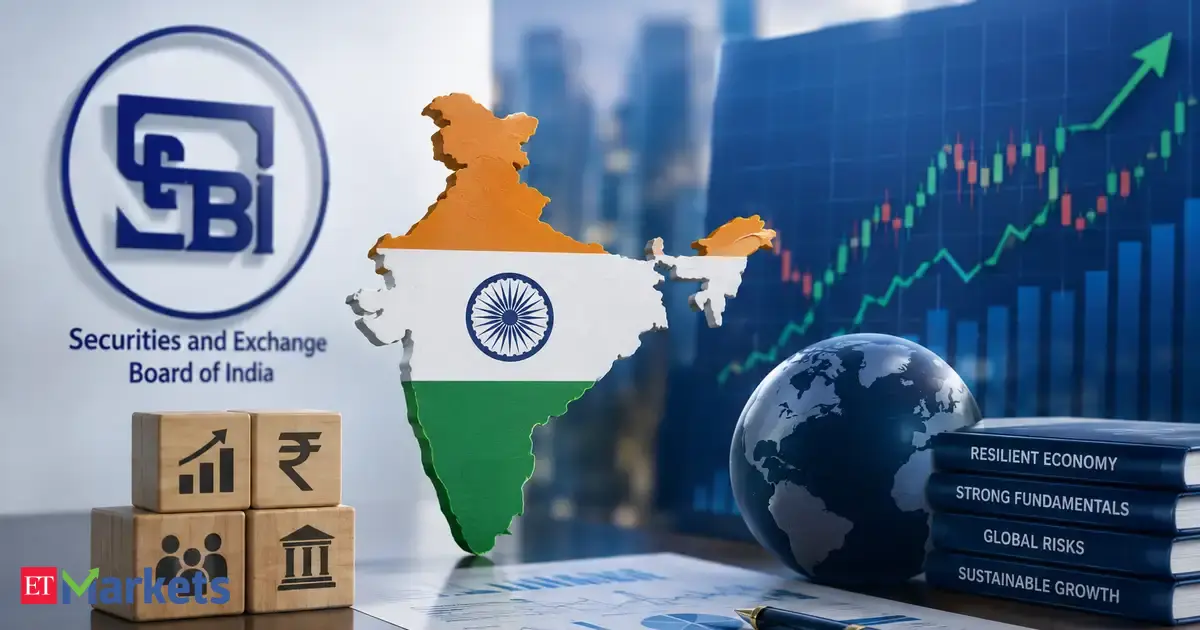
SEBI has expressed optimism about India's financial markets, citing strong domestic fundamentals such as robust consumer demand and proactive government spending as key growth drivers. However, the regulator cautioned that elevated global risks, including geopolitical tensions and volatile commodity prices, could lead to fluctuations in foreign capital inflows, potentially impacting market stability. Despite these external headwinds, SEBI believes India is well-positioned to outperform global peers. This assessment is significant for exams as it reflects the current regulatory outlook on macroeconomic resilience and capital flow dynamics.
Revision structure
Monthly events and exam calendar context
Static GK and one-liner notes
Quiz and mock-test revision path
Key points
Exam-ready takeaways
Global geopolitical tensions and fluctuating commodity prices identified as key external risks to market stability
Foreign capital inflows may face volatility due to elevated international uncertainties
SEBI remains optimistic about India outperforming global markets despite external challenges
Assessment reflects regulator's view on macroeconomic stability and capital flow sensitivity for 2024-25 outlook
Detailed analysis
Full exam-oriented breakdown
India's financial markets stand at a critical juncture where domestic resilience meets global volatility, a dynamic that SEBI's latest assessment captures with nuanced optimism. To understand this moment, we must trace the journey from the post-1991 liberalization era that opened India to global capital flows, through the 2008 financial crisis that tested our regulatory frameworks, to the present where India has emerged as the world's fifth-largest economy with a GDP of approximately $3.7 trillion in 2023-24. The Securities and Exchange Board of India (SEBI), established under the SEBI Act, 1992 and empowered by the Securities Contracts (Regulation) Act, 1956, serves as the primary guardian of market integrity and investor protection under Article 246 of the Constitution which places stock exchanges and futures markets in the Union List. The current optimism stems from concrete domestic fundamentals. Private Final Consumption Expenditure (PFCE) grew at 7.5% in Q3 FY24, reflecting robust consumer demand driven by a demographic dividend where 65% of India's 1.4 billion population is under 35 years. Government capital expenditure surged to ₹10 lakh crore in FY24, a 33% increase over FY23, targeting infrastructure under the PM Gati Shakti National Master Plan and the National Infrastructure Pipeline (NIP) worth ₹111 lakh crore. These twin engines — consumption and capex — create a virtuous cycle: infrastructure spending generates employment, boosting consumption, which in turn attracts private investment. Key stakeholders form a complex ecosystem. SEBI, under Chairperson Madhabi Puri Buch, balances regulation with market development. The Reserve Bank of India (RBI), governed by the RBI Act, 1934, manages monetary policy and foreign exchange reserves (currently over $640 billion). The Ministry of Finance steers fiscal policy through the Union Budget, while Foreign Portfolio Investors (FPIs) — holding approximately ₹55 lakh crore in Indian equities as of March 2024 — provide crucial liquidity but also transmit global shocks. Domestic Institutional Investors (DIIs) including mutual funds and insurance companies have emerged as stabilizing counterweights, with SIP inflows crossing ₹19,000 crore monthly. Global risks, however, remain elevated. The Russia-Ukraine conflict (since February 2022) and Israel-Hamas war (since October 2023) disrupt energy and commodity supply chains. The US Federal Reserve's interest rate trajectory — holding rates at 5.25-5.50% as of May 2024 — influences global capital flows through the "carry trade" mechanism. China's property sector crisis and slowing growth add further uncertainty. These factors could trigger FPI outflows, as witnessed in FY22 when FPIs withdrew ₹1.4 lakh crore, pressuring the rupee and widening the Current Account Deficit (CAD) to 2% of GDP in Q3 FY24. Constitutionally, this interplay touches multiple provisions. Article 265 mandates that no tax shall be levied except by authority of law — relevant for Securities Transaction Tax (STT) and capital gains taxation affecting investor behavior. Article 266 governs the Consolidated Fund of India, into which market-related revenues flow. Article 300A protects property rights, underpinning investor confidence. The Fiscal Responsibility and Budget Management (FRBM) Act, 2003 (amended 2018) mandates fiscal consolidation targets, currently targeting a fiscal deficit of 4.5% of GDP by FY26. Broader themes emerge: cooperative federalism in GST Council decisions affecting corporate earnings; India's G20 presidency (2023) showcasing digital public infrastructure (UPI, Account Aggregator) as a global template; the shift from "Washington Consensus" to "Beijing Consensus" to an emerging "New Delhi Consensus" of democratic development. Climate finance needs — estimated at $2.5 trillion by 2030 per India's NDC under the Paris Agreement — will require deepening green bond markets, where SEBI's Business Responsibility and Sustainability Reporting (BRSR) framework plays a pivotal role. Future implications are profound. India's inclusion in JP Morgan's Government Bond Index-Emerging Markets (GBI-EM) from June 2024 could attract $25-30 billion in passive inflows. The proposed T+0 settlement cycle (from current T+1) and optional T+1 for FPIs could enhance liquidity. However, the "impossible trinity" — free capital mobility, independent monetary policy, and stable exchange rate — remains a binding constraint. SEBI's challenge is to deepen markets (corporate bond market at just 17% of GDP vs 120% in US) while building resilience against "sudden stops" in capital flows. For aspirants, this encapsulates the enduring tension in emerging market economics: leveraging global integration for growth while insulating against its volatility — a challenge that will define India's journey toward Viksit Bharat@2047.
How to study
Turn news into exam marks
Revise monthly events by exam family instead of reading random updates.
Pair one-liners with mock tests so mistakes become the next revision list.
Keep state job pages, calendar pages and GK packs connected in one path.