

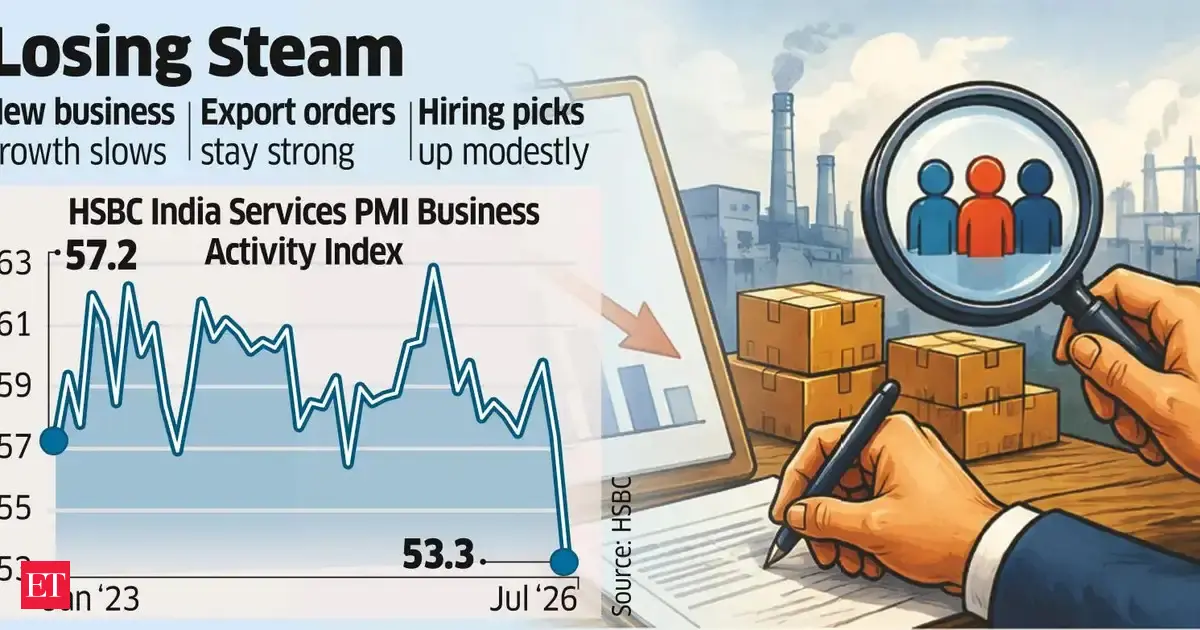
Services PMI fell to 52.5 in July 2024 — lowest since February 2020 (53-month low), down from 60.5 in June 2024
GK and monthly revision
India's services growth slows to 4½-year low in July as demand weakens
India's services sector growth hit a 53-month low in July 2024 as per S&P Global PMI data, with the Services PMI falling to 52.5 from 60.5 in June. New business orders weakened across domestic and export markets, while manufacturing PMI also slipped to 57.7. The Composite PMI declined to 54.5, indicating broader economic moderation. Despite the slowdown, firms remained optimistic about the 12-month outlook and hiring saw a modest recovery as input cost inflation eased to a near four-year low.
Revision structure
Monthly events and exam calendar context
Static GK and one-liner notes
Quiz and mock-test revision path
Key points
Exam-ready takeaways
Manufacturing PMI declined to 57.7 in July 2024 from 58.3 in June 2024
Composite PMI Output Index dropped to 54.5 in July 2024 from 59.2 in June 2024
Input cost inflation for services firms eased to a near four-year low in July 2024
Survey conducted by S&P Global; covers ~400 services and manufacturing companies across India
Detailed analysis
Full exam-oriented breakdown
India's services sector, the powerhouse of the country's economic growth contributing over 54% to GDP, has hit a significant speed bump. The S&P Global India Services Purchasing Managers' Index (PMI) plummeted to 52.5 in July 2024, marking a 53-month low since February 2020 — the onset of the COVID-19 pandemic. This sharp decline from June's robust 60.5 signals a notable moderation in demand conditions, both domestically and internationally. For UPSC and other competitive exam aspirants, this isn't just a number; it's a critical indicator of the health of the Indian economy's largest sector. To understand the gravity, we must look at the context. Post-pandemic, the services sector led India's V-shaped recovery, driven by pent-up demand, digital transformation, and strong export performance in IT, financial services, and business process management. The PMI had consistently remained in expansion territory (above 50) for over three years, often touching multi-year highs. The July 2024 dip, therefore, breaks a powerful momentum. The Manufacturing PMI also softened to 57.7 from 58.3, pulling the Composite PMI Output Index down to 54.5 from 59.2. This broad-based slowdown suggests the economy is losing steam across sectors, not just in services. Key stakeholders include the Reserve Bank of India (RBI), the Ministry of Statistics and Programme Implementation (MoSPI), the Ministry of Commerce and Industry, and private sector enterprises surveyed by S&P Global (covering ~400 companies). The RBI's Monetary Policy Committee (MPC), mandated under the RBI Act, 1934 (as amended in 2016 to adopt Flexible Inflation Targeting), closely watches such high-frequency indicators. With input cost inflation easing to a near four-year low, the MPC gains room to maintain its 'withdrawal of accommodation' stance without immediate rate hikes, supporting growth. This aligns with the government's focus on 'Viksit Bharat @2047' and the Economic Survey's projection of 6.5-7% GDP growth for FY25. Constitutionally, economic policy falls under the Union List (Seventh Schedule, Entries 33, 34, 43, 52, etc.), empowering Parliament to legislate on banking, insurance, trade, and commerce. The GST Council (Article 279A) also influences services taxation. The slowdown may reignite debates on fiscal stimulus vs. consolidation under the FRBM Act, 2003 (amended 2018). Significantly, despite the July slump, business optimism for the 12-month outlook remained strong, and hiring saw a modest rebound — a silver lining. This reflects confidence in structural drivers: digital public infrastructure (UPI, ONDC, Account Aggregator), rising formalization, and global capability centers (GCCs) expansion. Future implications? If the slowdown persists, it could pressure Q2 FY25 GDP growth, prompting RBI to consider rate cuts earlier than expected (currently priced for late FY25). For aspirants, track the August PMI, IIP data, and RBI's August/October policy reviews. The interplay between global headwinds (geopolitical tensions, slowdown in advanced economies) and domestic resilience (festive demand, government capex push) will define the trajectory. This episode underscores a core lesson: high-frequency indicators like PMI are 'nowcasts', not forecasts — essential tools for policymakers and analysts alike in navigating India's complex growth dynamics.
How to study
Turn news into exam marks
Revise monthly events by exam family instead of reading random updates.
Pair one-liners with mock tests so mistakes become the next revision list.
Keep state job pages, calendar pages and GK packs connected in one path.