

Ecommerce export reforms target MSMEs in small towns like Bhadohi for global market access
GK and monthly revision
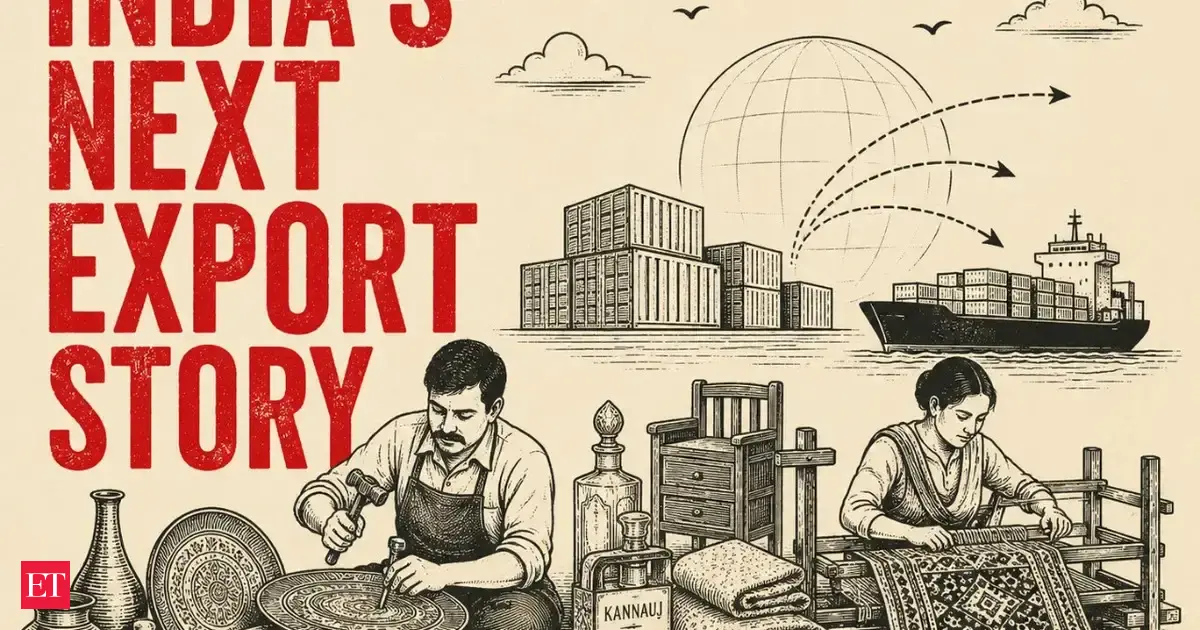
From Bhadohi to Brooklyn: India's small towns are set to go global
India's new ecommerce export reforms aim to transform thousands of MSMEs into global exporters by linking small-town manufacturers with overseas buyers via platforms like Amazon and Flipkart. The policy integrates with Districts as Export Hubs, ODOP, and FTAs to broaden India's export base and create the next export growth story. This initiative targets inclusive export-led growth by empowering grassroots enterprises.
Revision structure
Monthly events and exam calendar context
Static GK and one-liner notes
Quiz and mock-test revision path
Key points
Exam-ready takeaways
Platforms involved: Amazon and Flipkart to connect manufacturers with overseas buyers
Policy integrates with Districts as Export Hubs initiative and One District One Product (ODOP) scheme
Free Trade Agreements (FTAs) leveraged to broaden India's export base and growth
Aims to create India's next export growth story through inclusive, grassroots-driven exports
Detailed analysis
Full exam-oriented breakdown
India's latest ecommerce export reforms represent a watershed moment in the country's trade policy evolution, marking a strategic shift from traditional export models dominated by large corporations and metropolitan hubs toward a decentralized, inclusive framework that empowers Micro, Small and Medium Enterprises (MSMEs) in Tier-2 and Tier-3 towns. The genesis of this policy lies in the recognition that India's export potential remains vastly underutilized — despite being the world's fifth-largest economy, India's merchandise exports hovered around $450 billion in FY2023-24, far below its capacity. The COVID-19 pandemic exposed vulnerabilities in global supply chains and accelerated digital adoption, creating a unique window for India to reposition itself as a reliable alternative manufacturing and sourcing destination. The reform package, spearheaded by the Department of Commerce under the Ministry of Commerce and Industry, leverages the Digital India infrastructure and the Open Network for Digital Commerce (ONDC) to onboard small-town artisans, weavers, and manufacturers onto global ecommerce platforms like Amazon Global Selling and Flipkart Samarth. This is not merely a technological upgrade but a structural intervention: it addresses the classic "last-mile" problem where MSMEs lack market intelligence, logistics support, and compliance capacity for cross-border trade. By integrating with the Districts as Export Hubs initiative (launched in 2019) and the One District One Product (ODOP) scheme (initiated in Uttar Pradesh in 2018 and scaled nationally), the policy creates a district-level export ecosystem — identifying products with comparative advantage, building capacity, and linking them to international demand. Key stakeholders include the Directorate General of Foreign Trade (DGFT), which has simplified export documentation through the Advance Authorisation and EPCG schemes; the Ministry of MSME, which provides credit support via the Credit Guarantee Fund Trust for Micro and Small Enterprises (CGTMSE); and state governments, which play a pivotal role in district-level implementation. Private platforms act as force multipliers — Amazon's Global Selling programme alone enabled over 1.25 lakh Indian exporters by 2023, while Flipkart's Samarth initiative focuses on artisans and women-led enterprises. Constitutionally, this aligns with Article 19(1)(g) — the right to practice any profession or carry on any trade — and Article 39(b) and (c) of the Directive Principles, which mandate equitable distribution of material resources and prevention of concentration of wealth. The reforms also resonate with the Atmanirbhar Bharat vision and the Production Linked Incentive (PLI) schemes, creating a continuum from domestic manufacturing to global integration. India's expanding FTA network — including the India-UAE CEPA (2022), India-Australia ECTA (2022), and ongoing negotiations with the UK, EU, and Canada — provides preferential market access, reducing tariff barriers for these newly empowered exporters. The significance is multidimensional: economically, it diversifies India's export basket beyond traditional sectors like petroleum, gems, and IT services; socially, it generates employment in backward districts, curbing distress migration; politically, it strengthens federalism by making districts active participants in foreign trade. However, challenges remain — quality standardization, intellectual property protection, digital literacy, and logistics costs (currently ~14% of GDP) must be addressed. The future hinges on effective convergence: if ONDC, ODOP, Districts as Export Hubs, and FTAs operate in sync, India could unlock a $1 trillion merchandise export target by 2030, writing a new chapter of inclusive globalization — from Bhadohi's carpets to Brooklyn's doorsteps.
How to study
Turn news into exam marks
Revise monthly events by exam family instead of reading random updates.
Pair one-liners with mock tests so mistakes become the next revision list.
Keep state job pages, calendar pages and GK packs connected in one path.