

Agreement name: India-UK Comprehensive Economic and Trade Agreement (FTA)
GK and monthly revision
India-UK FTA takes off with tariff cuts, London targets $100 bn trade from 'gold standard' deal
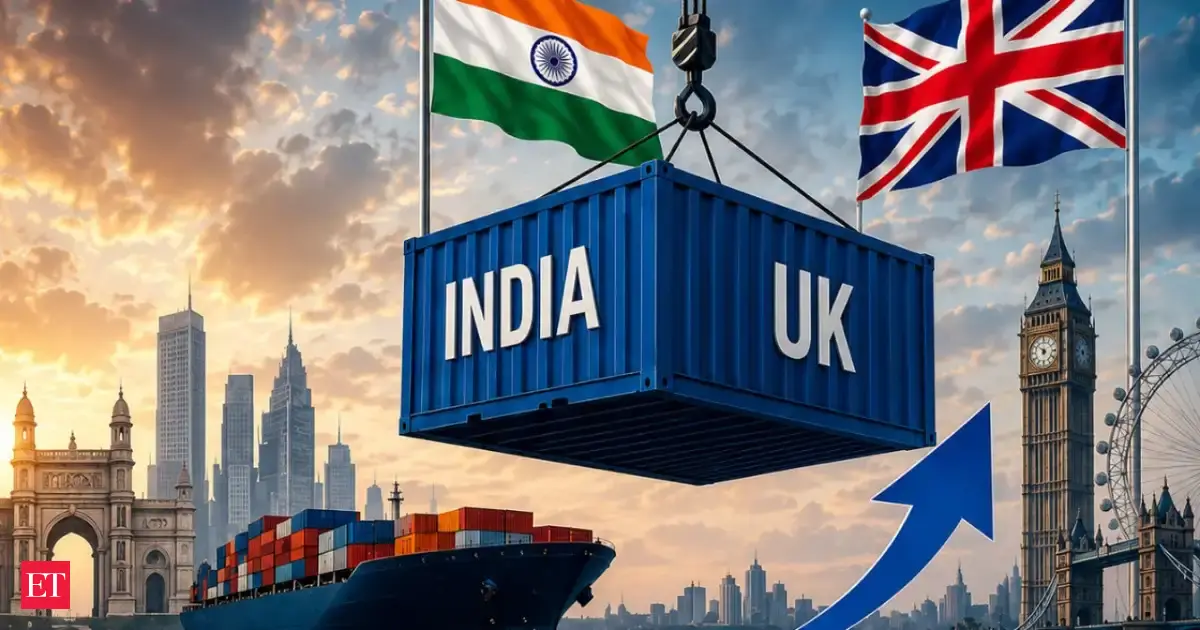
The India-UK Comprehensive Economic and Trade Agreement (FTA) has officially come into force, marking a landmark 'gold standard' deal. Nearly 99% of Indian exports will gain zero-duty access to the UK market, while British goods will face reduced or zero tariffs in India. The agreement targets $100 billion bilateral trade and is expected to boost investment, services, and technology cooperation. This is a major current affairs topic for economy and international relations sections across all competitive exams.
Revision structure
Monthly events and exam calendar context
Static GK and one-liner notes
Quiz and mock-test revision path
Key points
Exam-ready takeaways
Status: Officially come into force (operationalized)
Market access: Nearly 99% of India's exports to get zero-duty access to UK
Trade target: London aims to achieve $100 billion bilateral trade from this deal
Tariff benefit: British exports to India also get lower or zero tariffs
Detailed analysis
Full exam-oriented breakdown
The India-UK Comprehensive Economic and Trade Agreement (CETA), often referred to as the India-UK Free Trade Agreement (FTA), represents a watershed moment in India's economic diplomacy and its post-Brexit engagement with the United Kingdom. After over two years of intensive negotiations spanning 14 formal rounds since January 2022, the agreement officially came into force, marking the most ambitious trade deal India has signed with a developed economy and the UK's most significant post-Brexit trade pact. The historical context is crucial: following the UK's exit from the European Union in 2020, London sought to pivot towards the Indo-Pacific, identifying India as a strategic partner under its "Global Britain" vision. For India, the deal aligns with its "Act East" and "Neighbourhood First" policies, while diversifying export markets beyond traditional partners. The agreement's architecture is built on three pillars: goods, services, and investment. On goods, nearly 99% of India's tariff lines will enjoy zero-duty access to the UK market over a phased period, with immediate elimination on 90% of lines. Key Indian sectors benefiting include textiles and apparel (currently facing 8-12% duties), leather goods, footwear, marine products, processed foods, and engineering goods. Conversely, India has offered tariff concessions on 90% of UK exports, including Scotch whisky (phased reduction from 150% to 40% over 10 years), premium automobiles, advanced manufacturing machinery, and medical devices. Crucially, India secured a "safeguard mechanism" allowing temporary tariff hikes if import surges threaten domestic industries, and maintained its sensitive list protecting dairy, certain agricultural products, and automobiles. In services — where the UK runs a surplus — India negotiated landmark market access for professionals. The agreement includes a dedicated "Annex on Movement of Natural Persons" facilitating short-term business visits, contractual service suppliers, and independent professionals. This addresses India's long-standing demand for Mode 4 (movement of natural persons) liberalization under GATS. The UK committed to streamlining visa processes for Indian professionals in IT, healthcare, engineering, and financial services. Additionally, the deal establishes a "Digital Trade Chapter" — India's first — covering e-commerce, data flows, electronic signatures, and consumer protection, aligning with India's Digital Personal Data Protection Act, 2023. Constitutionally, the agreement derives legitimacy from Article 246 read with Entry 14 of the Union List (Schedule VII), empowering Parliament to legislate on "entering into treaties and agreements with foreign countries." The ratification process followed the executive's treaty-making power under Article 73, though Parliament's oversight role via the Committee on External Affairs ensures democratic accountability. The deal also intersects with the Customs Act, 1962, and the Foreign Trade (Development & Regulation) Act, 1992, for operationalizing tariff schedules and rules of origin. Strategically, the FTA deepens the "Comprehensive Strategic Partnership" upgraded in 2021. It complements the India-UK Roadmap 2030, covering defence (joint maritime exercises, technology transfer), climate (Green Grids Initiative), science (UK-India Newton-Bhabha Fund), and people-to-people ties (3+ million strong diaspora). The $100 billion bilateral trade target by 2030 — up from ~$38 billion in FY24 — signals ambition. For India, the deal enhances "Make in India" by integrating into UK supply chains, attracts FDI (UK is India's 6th largest investor), and strengthens its negotiating position in ongoing FTAs with EU, Canada, and EFTA. Future implications are profound. Successful implementation could make India a gateway for UK firms accessing the Indo-Pacific. The deal sets a template for labour, environment, and gender chapters in future Indian FTAs. However, challenges remain: rules of origin compliance, non-tariff barriers (UK sanitary/phytosanitary standards), and domestic political resistance in both countries. For aspirants, this FTA is a living case study in economic diplomacy, federalism (state-level export readiness), and the intersection of trade law with constitutional governance — essential for UPSC GS-II, GS-III, and Essay papers.
How to study
Turn news into exam marks
Revise monthly events by exam family instead of reading random updates.
Pair one-liners with mock tests so mistakes become the next revision list.
Keep state job pages, calendar pages and GK packs connected in one path.