

Union Minister Piyush Goyal held meetings with Belgian Deputy PM David Clarinval and EU Commissioners to strengthen India-EU economic cooperation
GK and monthly revision
India-EU FTA key to boosting India-Belgium economic ties, says Piyush Goyal
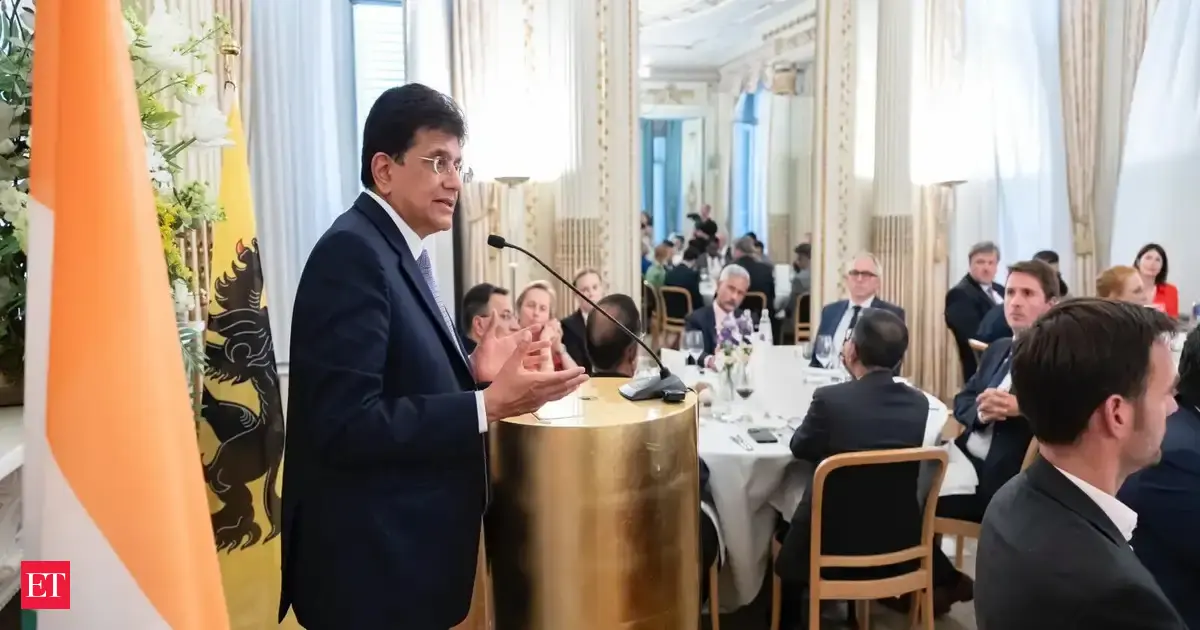
Union Minister Piyush Goyal emphasized the strategic importance of the India-EU Free Trade Agreement (FTA) for enhancing India-Belgium economic ties during meetings with Belgian Deputy Prime Minister David Clarinval and EU Commissioners. Discussions focused on expanding cooperation in agriculture, clean energy, and sustainable industrial development. The engagement aims to deepen the strategic economic partnership between India and the European Union, with Belgium serving as a key gateway for Indian trade and investment in Europe.
Revision structure
Monthly events and exam calendar context
Static GK and one-liner notes
Quiz and mock-test revision path
Key points
Exam-ready takeaways
India-EU Free Trade Agreement (FTA) identified as key driver for enhancing India-Belgium bilateral trade and investment
Key sectors discussed: agriculture, clean energy, and sustainable industrial development
Belgium positioned as strategic gateway for India's market access to the European Union
Meetings aimed at deepening strategic economic partnership between India and the European Union
Detailed analysis
Full exam-oriented breakdown
The recent high-level engagement between India and the European Union, spearheaded by Union Minister of Commerce and Industry Piyush Goyal, marks a pivotal moment in India's trade diplomacy. The meetings held in Brussels with Belgian Deputy Prime Minister David Clarinval and senior EU Commissioners underscore the strategic centrality of the India-EU Free Trade Agreement (FTA) negotiations, which were relaunched in June 2022 after a nine-year hiatus. This renewed momentum follows the 2021 India-EU Leaders' Meeting in Porto, where both sides agreed to resume negotiations for a balanced, ambitious, and comprehensive trade agreement, alongside separate agreements on investment protection and geographical indications (GIs). Historically, India-EU trade relations have been governed by the 1994 Cooperation Agreement, with the EU emerging as India's largest trading partner in goods (€120 billion in 2023) and a major source of foreign direct investment (FDI). However, the absence of a comprehensive FTA has limited the full potential of this partnership. Belgium, as the host of EU institutions and a major logistics hub (Antwerp port handles significant India-EU cargo), serves as a natural gateway for Indian businesses. In 2023, India-Belgium bilateral trade stood at approximately $18 billion, with diamonds, pharmaceuticals, and chemicals dominating the basket. The key stakeholders in this engagement include the Ministry of Commerce and Industry (India), the European Commission's Directorate-General for Trade, and Belgium's Federal Public Service for Foreign Affairs. The involvement of EU Commissioners for Agriculture (Janusz Wojciechowski), Energy (Kadri Simson), and Industry (Thierry Breton) signals a sectoral approach to negotiations. For India, the Department of Commerce leads negotiations under the strategic guidance of the Cabinet Committee on Security (CCS) and the National Security Council Secretariat (NSCS), reflecting the geopolitical weight of the partnership. The significance for India is multifaceted. Economically, an FTA could unlock market access for Indian labor-intensive sectors (textiles, leather, footwear) and services (IT, healthcare, professional services) in the EU's single market of 450 million consumers. It aligns with the "Atmanirbhar Bharat" vision by integrating Indian manufacturing into global value chains. Politically, it strengthens India's strategic autonomy by diversifying partnerships beyond traditional allies, complementing the India-EU Strategic Partnership (2004) and the India-EU Connectivity Partnership (2021). Socially, it could enhance labor standards and sustainability certifications in Indian export sectors. Constitutionally, Article 246 read with Entry 41 of the Union List ("Trade and commerce with foreign countries") empowers Parliament to legislate on international trade agreements. Article 253 enables Parliament to make laws for implementing international treaties. The negotiation process itself is guided by the Foreign Trade (Development and Regulation) Act, 1992, and the Customs Act, 1962. Any final agreement will require Cabinet approval and may necessitate legislative amendments, particularly on intellectual property rights (TRIPS compliance), investment dispute settlement (post-White Industries case), and data localization norms. Broader themes connect this to India's "Act East" and "Neighbourhood First" policies, as an EU FTA creates a template for engagements with UK, Canada, and EFTA. It also intersects with the WTO reform agenda, where India and EU share interests in special and differential treatment (S&DT) and dispute settlement reform. The clean energy cooperation discussed aligns with India's Panchamrit commitments at COP26 and the International Solar Alliance (ISA). Future implications are profound. A successful FTA could double bilateral trade to €200 billion by 2030. However, sticking points remain: EU's carbon border adjustment mechanism (CBAM), data adequacy decision, agricultural market access, and mobility of professionals (Mode 4 services). The next round of negotiations (scheduled for 2024) must resolve these. Belgium's EU Council Presidency (Jan-Jun 2024) offers a unique political window. For aspirants, tracking the negotiation text, sectoral annexes, and ratification timelines in both the European Parliament and Indian Parliament will be crucial.
How to study
Turn news into exam marks
Revise monthly events by exam family instead of reading random updates.
Pair one-liners with mock tests so mistakes become the next revision list.
Keep state job pages, calendar pages and GK packs connected in one path.