

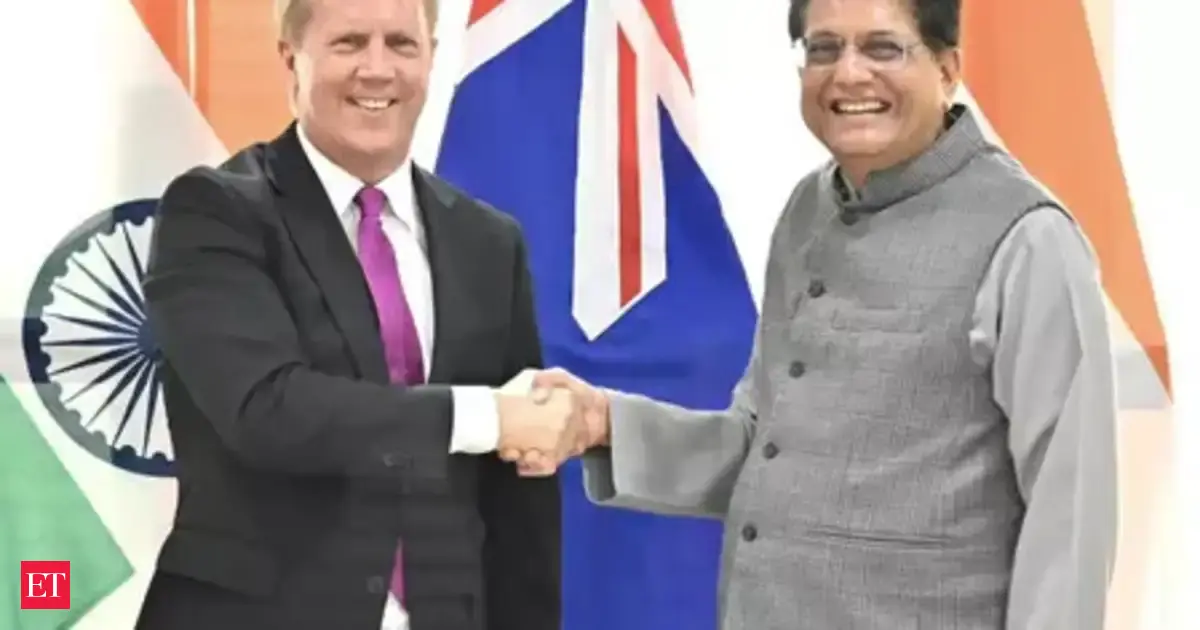
India and New Zealand have finalized a Free Trade Pact (FTA) with an investment arrangement.
GK and monthly revision
India-New Zealand FTA: NZ can bring in dairy inputs, process and export 100% products
India and New Zealand have finalized a Free Trade Pact, including an investment arrangement. This allows New Zealand dairy firms to process raw materials in India for 100% re-export, aiming to significantly boost India's exports. The pact also features a fast-track mechanism for New Zealand products and commitment to future consultations on dairy access, marking a strategic economic collaboration.
Revision structure
Monthly events and exam calendar context
Static GK and one-liner notes
Quiz and mock-test revision path
Key points
Exam-ready takeaways
The FTA allows New Zealand dairy firms to process raw materials in India for 100% re-export.
The primary objective of this initiative is to boost India's exports.
The pact includes a fast-track mechanism specifically for New Zealand products.
India has committed to future consultations on dairy access for comparable economies under this agreement.
Detailed analysis
Full exam-oriented breakdown
The finalization of a Free Trade Pact (FTA) between India and New Zealand, particularly its innovative investment arrangement concerning the dairy sector, marks a significant development in India's evolving trade policy landscape. This agreement allows New Zealand dairy firms to establish processing units in India, utilizing raw materials for 100% re-export, a strategic move aimed at bolstering India's export capabilities. **Background Context and Historical Perspective:** India has historically maintained a cautious stance on opening its sensitive agricultural and dairy sectors to international competition, a position clearly demonstrated by its withdrawal from the Regional Comprehensive Economic Partnership (RCEP) in November 2019. The primary concern was the potential inundation of the Indian market by cheaper dairy products from major producers like Australia and New Zealand, which could severely impact the livelihoods of millions of small and marginal Indian dairy farmers. India is the world's largest milk producer, and dairy farming is a crucial source of income for a vast rural population. This new FTA with New Zealand, however, presents a nuanced approach, seeking to leverage New Zealand's dairy expertise without directly exposing the domestic market to import competition. **What Happened and Key Provisions:** The core of this agreement is an investment arrangement within the FTA that permits New Zealand dairy companies to set up processing facilities in India. Crucially, these facilities are intended for processing raw materials and then re-exporting 100% of the finished products. This mechanism is designed to benefit India by boosting its manufacturing and processing capabilities, creating employment, and enhancing its position in the global supply chain, all while safeguarding its domestic dairy sector. The pact also includes a fast-track mechanism for New Zealand products, streamlining their entry and exit, and a commitment from India for future consultations on dairy access for comparable economies. This signals India's openness to exploring similar models with other trading partners. **Key Stakeholders Involved:** 1. **Indian Government (Ministry of Commerce and Industry):** The primary driver behind the FTA, aiming to boost exports, attract foreign investment, and integrate India into global value chains. It balances trade liberalization with protection of domestic interests. 2. **New Zealand Government:** Seeking to expand market access for its highly competitive dairy industry and deepen economic ties with India, a rapidly growing economy. 3. **New Zealand Dairy Firms (e.g., Fonterra):** These companies gain a strategic foothold in India, a large consumer market, and a cost-effective manufacturing base for re-exporting products to other Asian, African, or Middle Eastern markets. This allows them to utilize India's geographical advantage and burgeoning infrastructure. 4. **Indian Dairy Farmers:** Directly protected by the 100% re-export clause, as their domestic market share is not threatened by direct imports from New Zealand. This addresses a major historical concern. 5. **Indian Manufacturing and Food Processing Sector:** Stands to gain significantly from new investments, technology transfer, skill development, and increased production volumes, aligning with the 'Make in India' initiative. 6. **Indian Exporters:** Will benefit from improved logistics, infrastructure, and potentially new export avenues created by the enhanced trade relationship. **Significance for India and Broader Themes:** This FTA model is highly significant for India for several reasons. Economically, it aligns perfectly with the 'Make in India' initiative by attracting foreign investment into the food processing sector. It promotes value addition within India, creating jobs and fostering technological advancements. By positioning India as a processing and re-export hub, it boosts India's overall export basket and diversifies its trade partnerships. Strategically, this agreement strengthens India's economic diplomacy, especially within the Indo-Pacific region, and demonstrates a pragmatic approach to FTAs, where specific sectors are opened under controlled conditions rather than blanket liberalization. It reflects India's ambition to become a major player in global supply chains, moving beyond being just a consumer market. **Constitutional Provisions and Policy References:** While there isn't a single constitutional article directly governing every aspect of an FTA, several provisions are relevant. **Article 253** of the Indian Constitution empowers Parliament to make any law for implementing any international treaty, agreement, or convention. This provides the constitutional basis for India to enter into and implement such trade pacts. The agreement also falls under the purview of India's **Foreign Trade Policy (FTP)**, which outlines the government's strategy for promoting exports and regulating imports. The investment aspects are governed by India's **Foreign Direct Investment (FDI) Policy** and the **Foreign Exchange Management Act (FEMA)**. Furthermore, the emphasis on boosting manufacturing and exports resonates with flagship government initiatives like 'Make in India' and the **Production Linked Incentive (PLI) schemes** for various sectors, including food processing, which aim to make India a global manufacturing hub. **Future Implications:** This unique model of allowing processing for 100% re-export could serve as a blueprint for India's future FTA negotiations with other countries, particularly in sensitive sectors. It demonstrates a creative solution to balance domestic protection with international trade engagement. It could lead to increased FDI in India's food processing and logistics sectors, transforming India into a regional manufacturing and export hub for various products. This deal could also pave the way for deeper economic integration with New Zealand and other Indo-Pacific nations, fostering greater geopolitical alignment and economic resilience in the region.
How to study
Turn news into exam marks
Revise monthly events by exam family instead of reading random updates.
Pair one-liners with mock tests so mistakes become the next revision list.
Keep state job pages, calendar pages and GK packs connected in one path.