

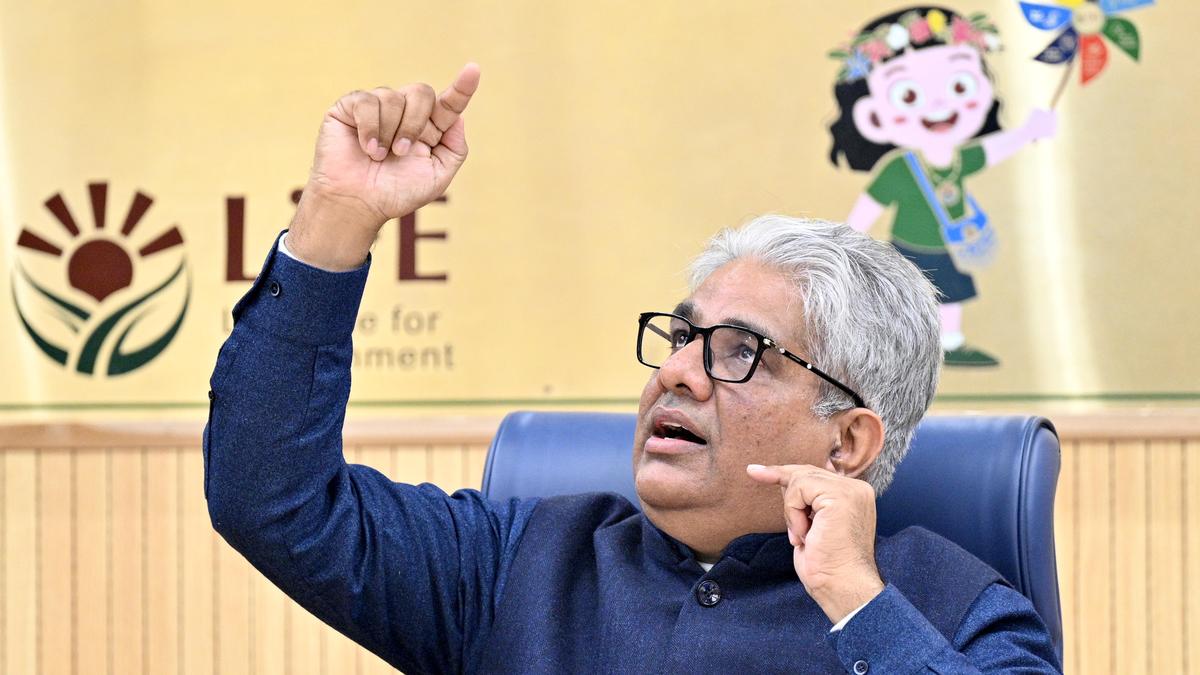
Union Environment Minister Bhupender Yadav clarified the government's stance on mining in the Aravalli Range.
GK and monthly revision
District-wise plan to demarcate mining areas in Aravalli Range in the works: Environment Minister
Union Environment Minister Bhupender Yadav clarified that no new mining licenses would be awarded in the Aravalli Range, addressing concerns from environmental activists and a social media storm. This statement is crucial as the Aravallis are a vital ecological zone, and any policy changes regarding mining have significant environmental implications. For competitive exams, this highlights government policy on environmental protection and resource management, focusing on a critical geographical feature.
Revision structure
Monthly events and exam calendar context
Static GK and one-liner notes
Quiz and mock-test revision path
Key points
Exam-ready takeaways
The Minister stressed that no new mining licenses would be awarded in the Aravalli Range.
A district-wise plan is currently in the works to demarcate existing mining areas in the Aravalli Range.
The clarification came amidst allegations from environmental activists and a social media storm.
The Aravalli Range is a significant ecological region, making its protection a key environmental concern.
Detailed analysis
Full exam-oriented breakdown
The Union Environment Minister Bhupender Yadav's recent clarification regarding mining in the Aravalli Range is a significant development, reflecting the intricate balance India seeks to strike between economic development and environmental conservation. This statement, promising no new mining licenses and a district-wise plan to demarcate existing mining areas, comes amidst a growing chorus of environmental concerns and public outcry, making it a critical topic for competitive exam aspirants. **Background Context and What Happened:** The Aravalli Range, one of the oldest fold mountains in the world, stretches approximately 692 km across Gujarat, Rajasthan, Haryana, and Delhi. It acts as a vital ecological barrier, preventing the eastward spread of the Thar Desert, recharging groundwater, and serving as a crucial green lung and biodiversity corridor for the National Capital Region (NCR). Historically, the Aravallis have been subjected to extensive mining for minerals like marble, granite, quartzite, and feldspar. This activity, often unregulated or illegal, has led to severe environmental degradation, including deforestation, loss of biodiversity, soil erosion, and depletion of groundwater resources. The recent uproar, fueled by environmental activists and a social media storm, stemmed from fears that vast tracts of this ecologically sensitive zone might be opened up for fresh mining, potentially exacerbating the existing environmental damage. In response, Minister Bhupender Yadav unequivocally stated that no *new* mining licenses would be awarded in the Aravalli Range. Crucially, he also mentioned that a district-wise plan is underway to demarcate *existing* mining areas, implying a move towards better regulation and monitoring of current operations rather than a complete halt to all mining activities. **Key Stakeholders Involved:** Several key stakeholders are deeply invested in the Aravalli mining issue. The **Union Ministry of Environment, Forest and Climate Change (MoEFCC)**, along with the **state governments** of Rajasthan, Haryana, Delhi, and Gujarat, are primary actors responsible for policy formulation, environmental regulation, and enforcement. The **mining industry and individual companies** represent the economic interests, seeking access to mineral resources. **Environmental activists and Non-Governmental Organizations (NGOs)**, such as the Aravalli Bachao Andolan and various citizen groups, act as watchdogs, advocating for conservation and challenging ecologically destructive practices. **Local communities and tribal populations** residing in and around the Aravallis are directly impacted by mining activities, facing issues related to livelihood, displacement, health, and access to natural resources. Finally, the **Judiciary**, particularly the Supreme Court and various High Courts, has played a pivotal role, issuing landmark judgments to curb illegal mining and protect the Aravallis over the past two decades. **Significance for India and Historical Context:** The protection of the Aravallis holds immense significance for India. Ecologically, it is indispensable for the environmental health of a vast region, including the densely populated Delhi-NCR. Its role in groundwater recharge is critical for water security, and its forest cover helps mitigate air pollution. The government's stance reflects a broader commitment to environmental governance and the challenging task of balancing economic development with ecological preservation. Historically, the issue of Aravalli mining has been a subject of intense legal and environmental battles. The Supreme Court, in landmark judgments, notably in 2002, 2009, and 2018, had issued directives to state governments to prevent illegal mining and ensure the reclamation of mined areas. These judgments often referred to the Aravallis as a 'protected area' and emphasized the need for sustainable resource management. The current statement builds on this historical context, acknowledging the judicial interventions and public pressure. **Future Implications and Related Constitutional Provisions:** The Minister's announcement signals a potential shift towards more stringent regulation and monitoring of mining activities in the Aravallis. The proposed district-wise demarcation plan could lead to better transparency, accountability, and the eventual closure or reclamation of illegally mined or exhausted sites. It also sets a precedent for how the government intends to handle similar environmental flashpoints in other ecologically sensitive zones across India. For instance, the **Environment (Protection) Act, 1986**, provides the framework for such regulatory actions. The **Forest (Conservation) Act, 1980**, also plays a crucial role in preventing the diversion of forest land for non-forest activities like mining. Constitutionally, the state's obligation to protect the environment is enshrined in **Article 48A (Directive Principles of State Policy)**, which states that "The State shall endeavour to protect and improve the environment and to safeguard the forests and wild life of the country." Furthermore, **Article 51A(g) (Fundamental Duties)** mandates every citizen "to protect and improve the natural environment including forests, lakes, rivers and wild life, and to have compassion for living creatures." These provisions underscore the constitutional imperative behind such environmental protection measures. The issue also links to broader themes of sustainable development and India's commitments under international agreements, including the Sustainable Development Goals (SDGs), particularly SDG 15 (Life on Land). Future efforts will likely focus on enforcing environmental clearances, promoting sustainable mining practices, and ensuring ecological restoration of degraded areas.
How to study
Turn news into exam marks
Revise monthly events by exam family instead of reading random updates.
Pair one-liners with mock tests so mistakes become the next revision list.
Keep state job pages, calendar pages and GK packs connected in one path.