

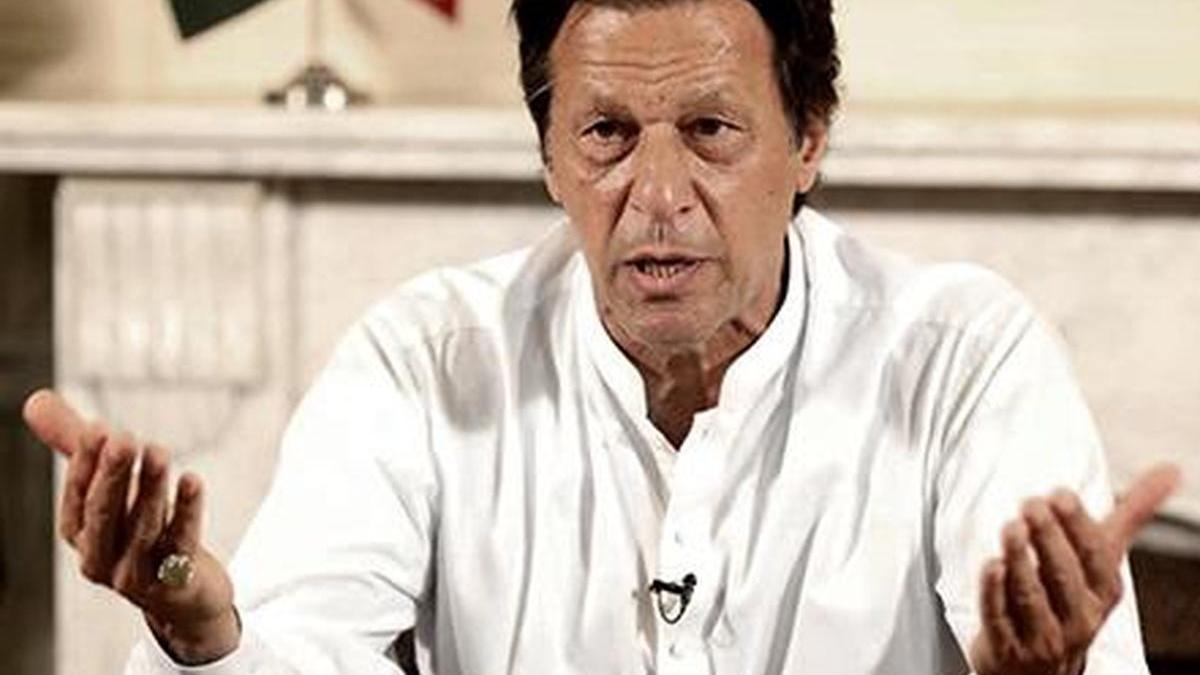
Former Pakistan Prime Minister Imran Khan received a 17-year jail sentence.
GK and monthly revision
Imran Khan calls for nationwide protests after 17-year jail sentence
Former Pakistan Prime Minister Imran Khan was sentenced to 17 years in jail following a "military-style trial decision." From Adiala Jail, Khan urged his supporters to initiate nationwide protests against the verdict, communicated via his X account. This development signifies escalating political instability in Pakistan, holding significance for India's regional foreign policy and general awareness sections in competitive exams.
Revision structure
Monthly events and exam calendar context
Static GK and one-liner notes
Quiz and mock-test revision path
Key points
Exam-ready takeaways
The sentence followed a "military-style trial decision" as described by Khan.
Imran Khan is currently incarcerated in Adiala Jail.
He called for nationwide protests from his supporters against the court's decision.
The protest call was issued via a midnight statement posted on Khan’s X account.
Detailed analysis
Full exam-oriented breakdown
The sentencing of former Pakistan Prime Minister Imran Khan to 17 years in jail, following what his party described as a "military-style trial decision," marks a significant escalation in Pakistan's ongoing political crisis. This development, coupled with Khan's call for nationwide protests from Adiala Jail, has profound implications for the internal stability of Pakistan and, by extension, for India's regional security and foreign policy. **Background Context and What Happened:** Imran Khan, a former cricket star turned politician, founded the Pakistan Tehreek-e-Insaf (PTI) party and rose to power, becoming Prime Minister in 2018. His tenure was marked by an anti-corruption agenda and a populist appeal. However, his relationship with the powerful Pakistani military, often considered the true power brokers in the country, reportedly deteriorated over key appointments and policy matters. In April 2022, Khan was ousted from power through a no-confidence vote, becoming the first Prime Minister in Pakistan's history to suffer such a fate. Since his removal, Khan has faced numerous legal challenges, including charges of corruption, sedition, and revealing state secrets (the 'cipher case'). The recent 17-year sentence, which is likely a cumulative sentence from multiple convictions or a specific conviction in a case like the cipher case or Toshakhana case, adds to his woes. The term "military-style trial decision" used by Khan's party suggests a lack of due process and an expedited judicial proceeding, reflecting deep mistrust between the civilian leadership and the military establishment. **Key Stakeholders Involved:** Several powerful actors are at play in this unfolding drama. **Imran Khan and the PTI** represent a significant political force with a dedicated support base, particularly among the youth and urban middle class. Their demand for protests indicates a strategy to leverage public discontent. The **Pakistan Army/Establishment** remains the most influential institution, historically shaping political outcomes, and is widely perceived as being at odds with Khan. The **Pakistani Judiciary** is under intense scrutiny, with critics alleging it is often swayed by the establishment. Rival political parties, notably the **Pakistan Muslim League-Nawaz (PML-N)** led by Nawaz Sharif and the **Pakistan Peoples Party (PPP)** led by Bilawal Bhutto Zardari, stand to benefit or be challenged by Khan's political marginalization. Finally, the **Pakistani Electorate**, a largely young and increasingly aware population, plays a crucial role, with their reactions determining the scale and impact of any protests. **Significance for India:** Political instability in Pakistan is a perennial concern for India. Firstly, **regional stability** is directly impacted. A volatile Pakistan, grappling with internal strife, increases the risk of cross-border tensions and can destabilize the broader South Asian region. Secondly, **India's foreign policy** towards its western neighbor is intricately linked to Pakistan's internal dynamics. While India has largely maintained a policy of non-interference, it closely monitors developments that could affect its security interests. Thirdly, **cross-border terrorism** remains a primary concern. A weakened or distracted civilian government in Pakistan, or an overly dominant military preoccupied with internal control, could create a vacuum exploited by non-state actors and terror groups operating from Pakistani soil, potentially increasing threats to India. India's national security doctrine prioritizes combating terrorism, and instability in Pakistan complicates these efforts. While direct **economic implications** are minimal due to strained trade relations, regional instability can deter foreign investment in the subcontinent. Furthermore, any major political upheaval in Pakistan can have indirect repercussions on sensitive issues like the **Kashmir dispute**, potentially leading to renewed rhetoric or escalation. **Historical Context and Future Implications:** Pakistan has a long history of military interventions and political instability, with the military directly ruling for significant periods (e.g., Ayub Khan, Zia-ul-Haq, Pervez Musharraf). Civilian governments have often struggled to complete their full terms, frequently clashing with the powerful military establishment. This historical pattern suggests that the current targeting of Imran Khan is part of a broader struggle for power and control. Looking ahead, the immediate future holds the prospect of **general elections** in Pakistan. Khan's imprisonment and the suppression of PTI could significantly alter the electoral landscape, potentially leading to a less representative outcome and further public discontent. This could exacerbate Pakistan's already severe **economic crisis**, as political uncertainty deters investment and hinders policy implementation. For India-Pakistan relations, continued instability is likely to maintain the current state of **strained ties**, with little prospect for meaningful dialogue or improvement. India, guided by principles like those enshrined in **Article 51 of its Constitution** (Directive Principles of State Policy), which advocates for the promotion of international peace and security, will continue to observe the situation closely, prioritizing its national security interests amidst a volatile neighborhood. In essence, Imran Khan's sentencing is not merely a legal event but a political earthquake with wide-ranging aftershocks that will be felt across Pakistan and resonate throughout South Asia, demanding careful monitoring by India's strategic planners.
How to study
Turn news into exam marks
Revise monthly events by exam family instead of reading random updates.
Pair one-liners with mock tests so mistakes become the next revision list.
Keep state job pages, calendar pages and GK packs connected in one path.