

India-Bangladesh relations have experienced a 'visible cooling' recently.
GK and monthly revision
Connectivity at a crossroads: India-Bangladesh ties after regime change
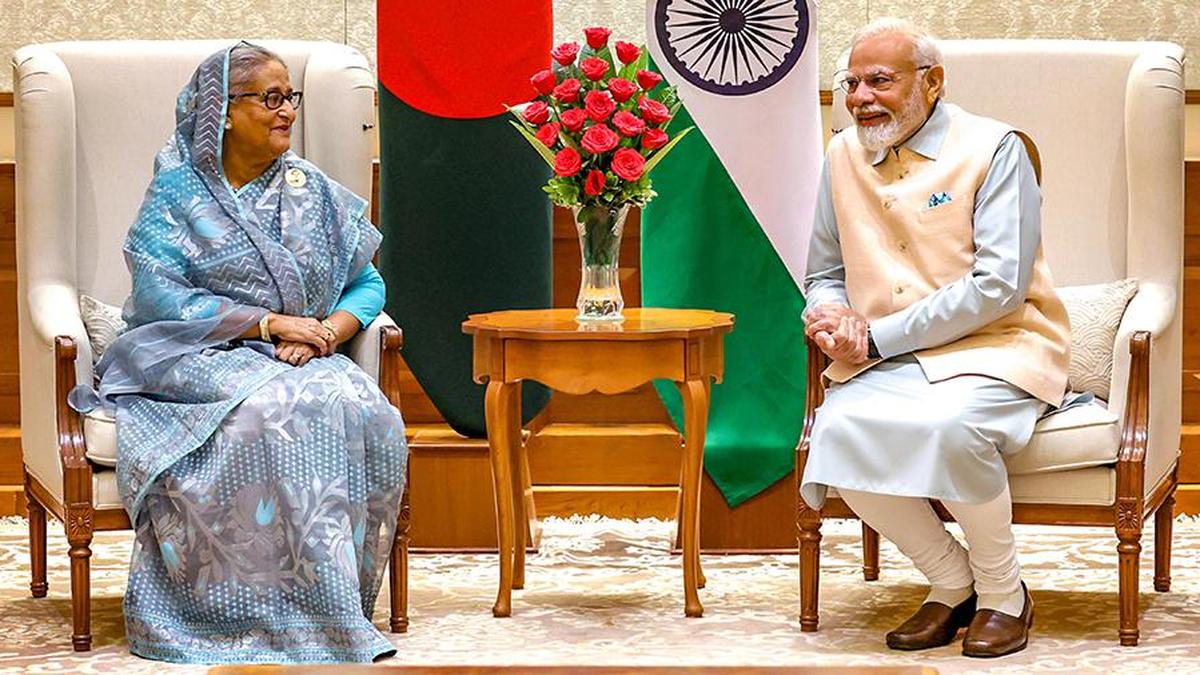
India-Bangladesh relations have reportedly witnessed a visible cooling following the ouster of Sheikh Hasina in August 2024. This development is significant for India's 'Neighbourhood First' policy and regional stability, as Bangladesh is a crucial strategic partner. The change in regime and its impact on bilateral ties is a key current affairs topic for competitive exams, highlighting geopolitical shifts in South Asia.
Revision structure
Monthly events and exam calendar context
Static GK and one-liner notes
Quiz and mock-test revision path
Key points
Exam-ready takeaways
The cooling of ties occurred after the ouster of former Prime Minister Sheikh Hasina.
The regime change and Sheikh Hasina's ouster took place in August 2024.
This development significantly impacts India's 'Neighbourhood First' policy.
Bangladesh is a crucial geopolitical partner for India in South Asia.
Detailed analysis
Full exam-oriented breakdown
India-Bangladesh relations, often described as a cornerstone of India's 'Neighbourhood First' policy, have reportedly entered a phase of 'visible cooling' following the dramatic ouster of former Prime Minister Sheikh Hasina in August 2024. This development marks a significant geopolitical shift in South Asia and presents both challenges and opportunities for India, demanding a nuanced understanding for competitive exam aspirants. **1. Background Context: A Legacy of Friendship and Strategic Alignment** India and Bangladesh share a unique bond forged during the 1971 Liberation War, where India played a crucial role in Bangladesh's independence. This historical camaraderie laid the foundation for deep cultural, economic, and strategic ties. Over the decades, relations have seen fluctuations, but under the leadership of Sheikh Hasina's Awami League government (2009-2024), bilateral ties reached unprecedented levels of cooperation. Hasina, daughter of Bangabandhu Sheikh Mujibur Rahman, consistently prioritized strong relations with India, viewing it as essential for Bangladesh's stability and development. This era saw significant advancements in connectivity, trade, and security cooperation, aligning perfectly with India's 'Neighbourhood First' policy, which emphasizes strong, friendly ties with immediate neighbours. **2. What Happened: The August 2024 Regime Change** The 'visible cooling' of ties is directly attributed to the regime change in Bangladesh in August 2024. Sheikh Hasina, who had been in power for over 15 years, faced widespread student-led protests, dubbed the 'Student-People's Uprising', against government policies, corruption, and alleged authoritarianism. The protests, initially focused on quota reforms in government jobs, escalated into a broader movement demanding Hasina's resignation. Amid intense pressure, a breakdown of law and order, and intervention by the Bangladesh Army, Sheikh Hasina resigned and subsequently fled the country. An interim government, led by Nobel laureate Muhammad Yunus, was established with a mandate to hold free and fair elections. This sudden and dramatic transition has inevitably led to a re-evaluation of Bangladesh's foreign policy priorities, including its relationship with India. **3. Key Stakeholders Involved** Several key stakeholders are impacted and involved in this evolving scenario. **India**, through its Ministry of External Affairs and various security agencies, is a primary stakeholder, navigating the implications for its regional strategy. The **new interim government in Bangladesh** is a critical player, as its policies and rhetoric will shape future bilateral engagements. **Political parties within Bangladesh**, including the Awami League (now in opposition) and the Bangladesh Nationalist Party (BNP), will also influence public sentiment and policy. The **Bangladesh Army** played a pivotal role in the transition, and its stance on foreign policy matters will be significant. **China**, a major economic and strategic competitor to India in South Asia, closely observes and seeks to leverage any perceived vacuum or shift in alliances. Other regional and global powers like the **United States** and **Japan** also have vested interests in Bangladesh's stability and geopolitical alignment. **4. Why This Matters for India: Geopolitical, Security, and Economic Implications** The cooling of ties with Bangladesh carries profound significance for India across multiple dimensions. Geopolitically, Bangladesh is a crucial partner for India's 'Neighbourhood First' policy and its 'Act East Policy', providing a land bridge to Southeast Asia and access to its northeastern states. A less friendly government in Dhaka could complicate India's regional aspirations and potentially pave the way for increased Chinese influence, challenging India's strategic space in its immediate neighbourhood. From a security perspective, Bangladesh has been a reliable partner in counter-terrorism efforts and border management, particularly against insurgent groups operating in India's Northeast. Any weakening of this cooperation could pose significant security challenges. Economically, Bangladesh is India's largest trade partner in South Asia, with bilateral trade exceeding USD 16 billion. Numerous connectivity projects, including rail, road, and inland waterways, are underway or planned, vital for boosting regional trade and economic integration, especially benefiting India's landlocked northeastern states. Disruptions to these projects or a slowdown in economic engagement would have tangible consequences for India's regional economic ambitions. **5. Historical Context of India-Bangladesh Relations** Beyond the 1971 Liberation War, the relationship has seen periods of warmth and strain. Post-1975, following the assassination of Sheikh Mujibur Rahman, military rule and subsequent BNP governments often adopted a more cautious or even adversarial stance towards India, driven by domestic politics and perceptions of Indian dominance. Issues like illegal immigration, border disputes, and water sharing (e.g., Teesta River) have historically been points of contention. However, the Land Boundary Agreement (LBA) of 2015, ratified by India through the **100th Constitutional Amendment Act**, marked a historic resolution of long-standing border disputes, symbolizing the peak of cooperative diplomacy under Hasina's leadership. This historical context underscores the fragility and importance of stable, friendly relations. **6. Future Implications: Navigating Uncertainty** The future of India-Bangladesh relations is now at a crossroads. The interim government's primary mandate is to conduct elections, but its foreign policy orientation and that of any future elected government remain uncertain. There is a possibility that the new regime might seek to rebalance its foreign policy, potentially distancing itself from India to address domestic perceptions of over-reliance or to foster broader international relations. This could lead to a slowdown or re-evaluation of ongoing bilateral projects, including those under the BBIN (Bangladesh, Bhutan, India, Nepal) initiative. India will need to engage with the new leadership cautiously but proactively, emphasizing shared interests, historical ties, and mutual benefits from cooperation. The challenge for India will be to maintain its influence and partnership without being perceived as interfering in Bangladesh's internal affairs, while simultaneously countering any efforts by rival powers to fill the vacuum created by the cooling of ties. The stability of Bangladesh itself, a nation of over 170 million people, is intrinsically linked to regional stability, making India's diplomatic efforts crucial in the coming months.
How to study
Turn news into exam marks
Revise monthly events by exam family instead of reading random updates.
Pair one-liners with mock tests so mistakes become the next revision list.
Keep state job pages, calendar pages and GK packs connected in one path.