


Relevant for Exams
Aravalli Hills: Part of ancient Aravalli-Delhi orogenic belt, one of world's oldest fold mountains.
Summary
The Aravalli Hills are geologically understood as part of the ancient Aravalli-Delhi orogenic belt, characterized by very old rocks. This understanding is crucial for comprehending India's physiography and geological history. For competitive exams, knowledge of the Aravallis' formation, age, and geographical extent is vital for questions in Indian Geography and Environment sections.
Key Points
- 1The Aravalli Hills are geologically understood as part of the Aravalli-Delhi orogenic belt.
- 2This orogenic belt is composed of ancient rocks, indicating its significant geological age.
- 3The Aravalli Range is recognized as one of the oldest fold mountain ranges in the world.
- 4It primarily extends across the states of Rajasthan, Haryana, Delhi, and Gujarat in India.
- 5Guru Shikhar, located in Mount Abu, Rajasthan, is the highest peak of the Aravalli Range.
In-Depth Analysis
The Aravalli Hills, often perceived as a series of low, eroded hills, hold a profound significance in understanding India's geological past, present ecology, and future sustainability. Far from being mere geographical features, they represent the remnants of one of the world's oldest fold mountain ranges, a veritable 'geological fossil' that has profoundly influenced the subcontinent's climate, biodiversity, and human habitation for billions of years.
**Background Context: A Journey Through Time**
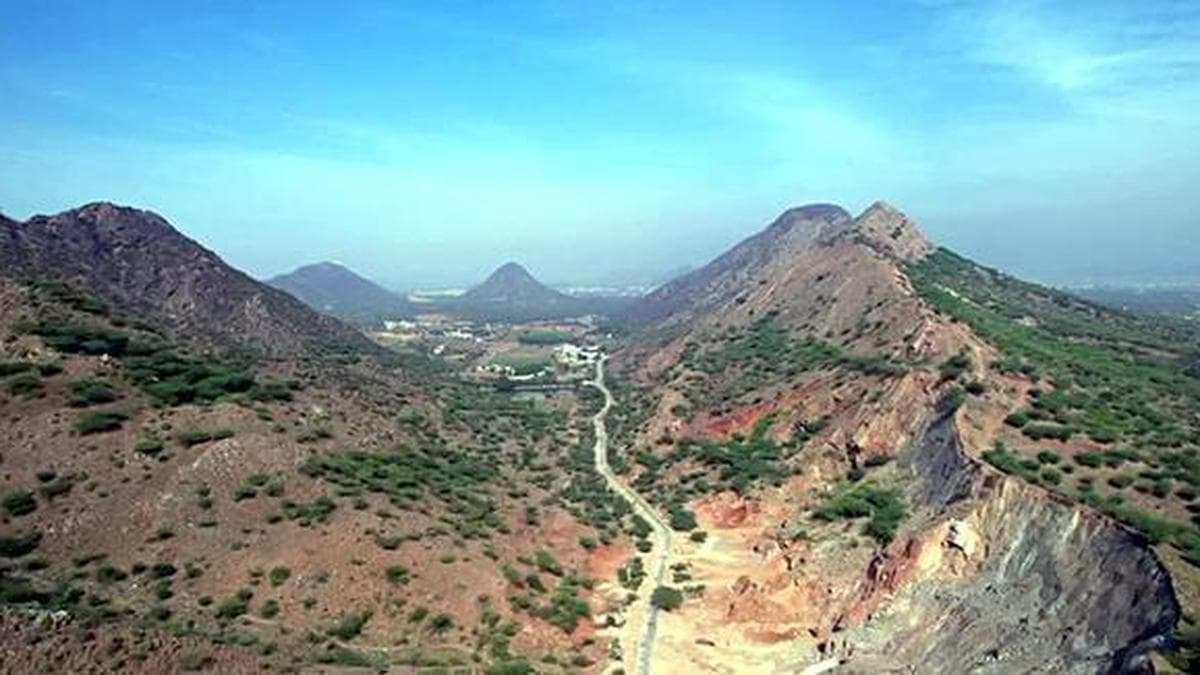
The Aravallis are not just hills; they are the exposed face of the ancient Aravalli-Delhi orogenic belt. An orogenic belt is essentially a region of the Earth's crust that has been folded and deformed by continental collisions, leading to the formation of mountains. The Aravalli-Delhi orogenic belt dates back to the Precambrian era, with rocks recorded as old as 2.5 billion years, and the main mountain-building events occurring between 1.8 to 0.7 billion years ago. This makes them significantly older than the Himalayas, which are relatively young, still-forming mountains. Over eons, relentless weathering and erosion by wind, water, and ice have worn down these once towering peaks, leaving behind the subdued, rounded forms we see today, extending approximately 692 km from Palanpur in Gujarat, through Rajasthan and Haryana, to the Delhi Ridge.
**What Happened: The Shaping of a Continent**
The formation of the Aravallis involved massive tectonic plate movements. During the Precambrian, ancient continental plates collided, compressing and uplifting vast swathes of sedimentary and igneous rocks. This intense pressure and heat transformed the original rocks into metamorphic varieties like gneiss, schist, and quartzite, which are characteristic of the Aravalli range. Post-formation, for hundreds of millions of years, these mountains have been subjected to continuous denudation. This prolonged erosion has stripped away softer layers, exposing the harder, more resistant cores, which now stand as the Aravalli Hills. Guru Shikhar, at Mount Abu in Rajasthan, standing at 1,722 meters, is the highest peak, a testament to the original grandeur of this ancient range.
**Key Stakeholders: Guardians of an Ancient Legacy**
Several entities play crucial roles concerning the Aravallis. The **Geological Survey of India (GSI)** is a primary stakeholder, responsible for geological mapping, research, and understanding the mineral resources within the range. State governments of **Rajasthan, Haryana, Gujarat, and the National Capital Territory of Delhi** are critical, as they manage land use, mining leases, forest protection, and urban development within their respective stretches of the Aravallis. The **Ministry of Environment, Forest and Climate Change (MoEFCC)** at the central level sets environmental policies and oversees conservation efforts, often involving the **National Green Tribunal (NGT)** for adjudicating environmental disputes. Local communities, including tribal populations, depend on the Aravallis for livelihoods and cultural practices, while environmental NGOs like the Aravalli Bachao Andolan advocate for their protection against unchecked development and illegal mining.
**Significance for India: A Lifeline for Western India**
The Aravallis are far more than just hills; they are a vital ecological and economic lifeline for Western India. Ecologically, they act as a crucial barrier against the eastward expansion of the Thar Desert, protecting fertile plains. They are a significant watershed, replenishing groundwater tables, especially critical for the arid and semi-arid regions of Rajasthan and Haryana. The range supports a unique biodiversity, including various flora and fauna, some endemic. Economically, the Aravallis are rich in mineral resources such as copper, lead, zinc, marble, and granite, which have historically driven mining industries. However, uncontrolled mining has also been a major source of environmental degradation. Culturally, the range is dotted with ancient temples, forts, and tribal settlements, reflecting a rich historical tapestry.
**Historical Context and Broader Themes**
Historically, the Aravallis have influenced settlement patterns and trade routes. Their rugged terrain provided natural defenses for kingdoms and shielded early civilizations. The presence of water sources and mineral wealth attracted human activity for millennia. In contemporary India, the Aravallis exemplify the tension between development and environmental preservation. Rapid urbanization in the National Capital Region (NCR) and surrounding areas puts immense pressure on the Aravalli forests and groundwater reserves, leading to deforestation, illegal construction, and water scarcity.
**Future Implications and Constitutional Protections**
The future of the Aravallis hinges on effective governance and sustainable practices. Continued degradation threatens not only biodiversity but also the water security of millions. Conservation efforts, including reforestation, strict regulation of mining, and declaring parts of the range as protected areas, are imperative. Policies like the **National Forest Policy, 1988**, aim to maintain environmental stability and ecological balance. The Indian Constitution, through **Article 48A** (Directive Principle of State Policy) mandates the State to 'endeavour to protect and improve the environment and to safeguard the forests and wild life of the country.' Furthermore, **Article 51A(g)** (Fundamental Duty) enjoins every citizen 'to protect and improve the natural environment including forests, lakes, rivers and wild life, and to have compassion for living creatures.' The **Environment (Protection) Act, 1986**, and the **Forest (Conservation) Act, 1980**, provide legal frameworks for environmental protection, which are frequently invoked to safeguard the Aravallis. Future strategies must involve integrated land-use planning, community participation, and enforcement of environmental laws to ensure this ancient range continues to sustain life and regulate climate for generations to come.
Exam Tips
This topic primarily falls under 'Indian Geography (Physical Features)' and 'Environment & Ecology' sections of competitive exams. Be prepared for questions on the Aravallis' geological age, highest peak (Guru Shikhar), states covered (Gujarat, Rajasthan, Haryana, Delhi), and its role as a barrier to the Thar Desert.
Study related topics like the Peninsular Plateau, other major mountain ranges (Himalayas, Western & Eastern Ghats), and the concept of orogenesis. Understand the impact of mountain ranges on climate, particularly the Indian Monsoon and desertification.
Common question patterns include direct factual questions (e.g., 'Which is the oldest fold mountain range in India?'), matching questions (e.g., 'Match the peak with its mountain range'), and analytical questions on the environmental significance of the Aravallis (e.g., 'Discuss the ecological importance of the Aravalli Range for Western India').
Focus on the environmental challenges faced by the Aravallis, such as illegal mining, deforestation, and urban encroachment. Relate these to relevant environmental acts and constitutional provisions like Article 48A and Article 51A(g).
Understand the distinction between the Aravallis and the Himalayas in terms of age, formation process (relict vs. young fold mountains), and their respective ecological roles.
Related Topics to Study
Full Article
The Hills’ features are better understood as part of a belt of ancient rocks that many scholars have called the Aravalli-Delhi orogenic belt