


Relevant for Exams
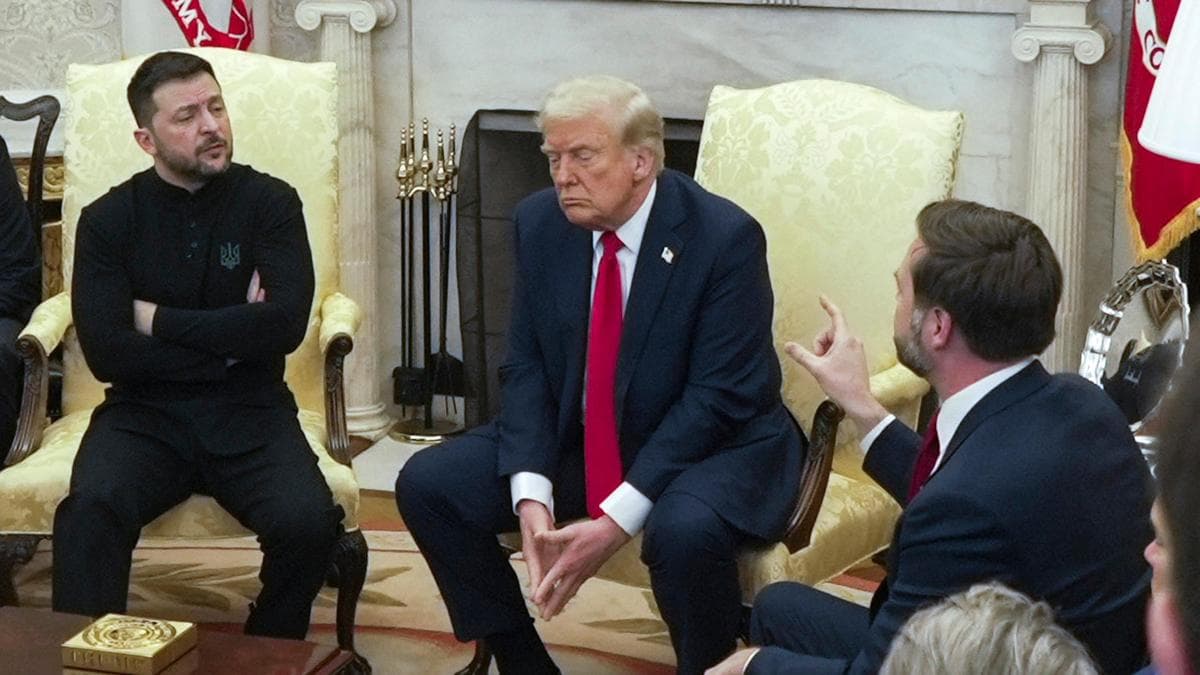
Zelenskyy to meet Trump in Florida to discuss Ukraine's territorial issues.
Summary
Ukrainian President Volodymyr Zelenskyy is scheduled to meet former US President Donald Trump in Florida to discuss critical territorial issues concerning Russia's war in Ukraine. This meeting is significant as Trump's potential influence on future US foreign policy towards Ukraine could heavily impact the ongoing conflict and global geopolitical dynamics. For competitive exams, this highlights key international diplomatic interactions and major global conflicts.
Key Points
- 1Ukrainian President Volodymyr Zelenskyy is scheduled to meet former US President Donald Trump.
- 2The meeting between Zelenskyy and Trump will take place in Florida, USA.
- 3The primary discussion point is 'territorial issues' related to Russia's ongoing war in Ukraine.
- 4Donald Trump stated ahead of the meeting that Zelenskyy 'doesn’t have anything until I approve it'.
- 5Territorial issues are identified as the 'main stumbling block' in talks to end Russia's war in Ukraine.
In-Depth Analysis
The upcoming meeting between Ukrainian President Volodymyr Zelenskyy and former US President Donald Trump in Florida, to discuss critical 'territorial issues' related to the Russia-Ukraine war, represents a pivotal moment in international diplomacy. This interaction is not merely a bilateral discussion but a barometer for the future trajectory of the conflict, global alliances, and the very principles of international law.
**Background Context:** The Russia-Ukraine war, which escalated into a full-scale invasion in February 2022, has roots stretching back to 2014 with Russia's annexation of Crimea and support for separatists in eastern Ukraine. The conflict is fundamentally about Ukraine's sovereignty, territorial integrity, and its aspirations towards Western integration, clashing with Russia's security concerns and historical claims. The United States, under President Joe Biden, has been Ukraine's staunchest ally, providing substantial military, financial, and humanitarian aid, while rallying NATO and European partners to impose sanctions on Russia. However, Donald Trump, a potential presidential candidate for 2024, has often expressed skepticism about the extent of US involvement in foreign conflicts and has previously questioned NATO's utility, advocating an "America First" foreign policy. His past rhetoric suggests a potential shift away from the current administration's unwavering support for Ukraine.
**What Happened and Key Stakeholders:** The core of the discussion revolves around 'territorial issues,' which are the main stumbling block in any peace talks. These include the status of Crimea, annexed by Russia, and the territories in eastern and southern Ukraine currently occupied by Russian forces. Zelenskyy's objective is likely to secure continued, robust US support, irrespective of future US leadership, to push back Russian aggression and restore Ukraine's territorial integrity. Donald Trump, on the other hand, indicated his assertive stance with the statement, "Zelenskyy doesn't have anything until I approve it." This reflects his transactional approach to foreign policy and suggests a potential willingness to leverage US aid as a bargaining chip. Key stakeholders include: **Volodymyr Zelenskyy** (representing Ukraine's fight for survival and sovereignty); **Donald Trump** (representing a significant, potentially future, shift in US foreign policy and aid to Ukraine); **Vladimir Putin** (whose Russia benefits from any perceived weakening of Western unity); and by extension, the **United States** (as the primary aid provider), **NATO**, and the **European Union** (whose collective security and economic stability are directly impacted).
**Significance for India:** For India, this meeting and its potential outcomes carry significant geopolitical, economic, and strategic implications. India maintains a delicate balancing act in its foreign policy, rooted in its principle of 'strategic autonomy.' Historically, India has strong defence and economic ties with Russia, while simultaneously forging a robust strategic partnership with the United States. A potential shift in US policy towards Ukraine under a future Trump administration could put India in a more difficult position. Economically, the war has already caused global commodity price volatility, particularly for crude oil, natural gas, and fertilizers, impacting India's import bill and inflation. Any prolonged or intensified conflict, or major changes in Western sanctions regimes, would further affect India's energy and food security. Strategically, India's reliance on Russian military hardware, though diversifying, means it closely watches the impact of Western sanctions on Russia's defence industry. India's consistent call for a peaceful resolution through dialogue and diplomacy, in line with its foreign policy principles, underscores its commitment to international law and sovereignty, principles also at stake in the Ukraine conflict.
**Historical Context and Broader Themes:** India's foreign policy, guided by principles like Non-Alignment during the Cold War, has evolved but still emphasizes multilateralism and peaceful dispute resolution. The current situation tests this doctrine, forcing India to navigate a multipolar world where traditional alliances are being redefined. This event connects to broader themes of global governance, the future of international institutions like the UN, the effectiveness of international law in preventing aggression, and the evolving dynamics of great power competition. The outcome of the Russia-Ukraine war, influenced by key players like the US, will reshape the global order for decades.
**Future Implications:** The future implications are profound. A potential reduction or withdrawal of US aid under a future Trump presidency could severely undermine Ukraine's ability to defend itself, potentially leading to a frozen conflict or even further territorial losses, which Russia would view as a victory. This could embolden other revisionist powers and challenge the international rules-based order. For Europe, it would necessitate a re-evaluation of its defence capabilities and reliance on the US. For India, it might mean increased pressure to align more definitively with one bloc or another, challenging its strategic autonomy. The meeting highlights the uncertainty surrounding the US commitment to global leadership and its impact on ongoing conflicts, making it a critical event for international relations students to track.
Exam Tips
This topic falls under GS Paper-II (International Relations) for UPSC CSE, and General Awareness/Current Affairs for SSC, State PSC, and Defence exams. Focus on the geopolitical implications, India's foreign policy stance, and the role of international organizations.
Study related topics such as the history of the Russia-Ukraine conflict (2014-present), the role of NATO and the EU, global energy security, and the impact of international sanctions. Understand the concept of 'strategic autonomy' in India's foreign policy.
Common question patterns include analytical questions on the impact of global conflicts on India's economy and foreign policy, the role of major powers (US, Russia, China) in shaping international relations, and India's position on sovereignty and territorial integrity in international disputes. Be prepared for map-based questions on the region.
Related Topics to Study
Full Article
Mr. Zelenskyy will discuss territorial issues, the main stumbling block in talks to end Russia's war in Ukraine, with Mr. Trump in Florida on Sunday