


Relevant for Exams
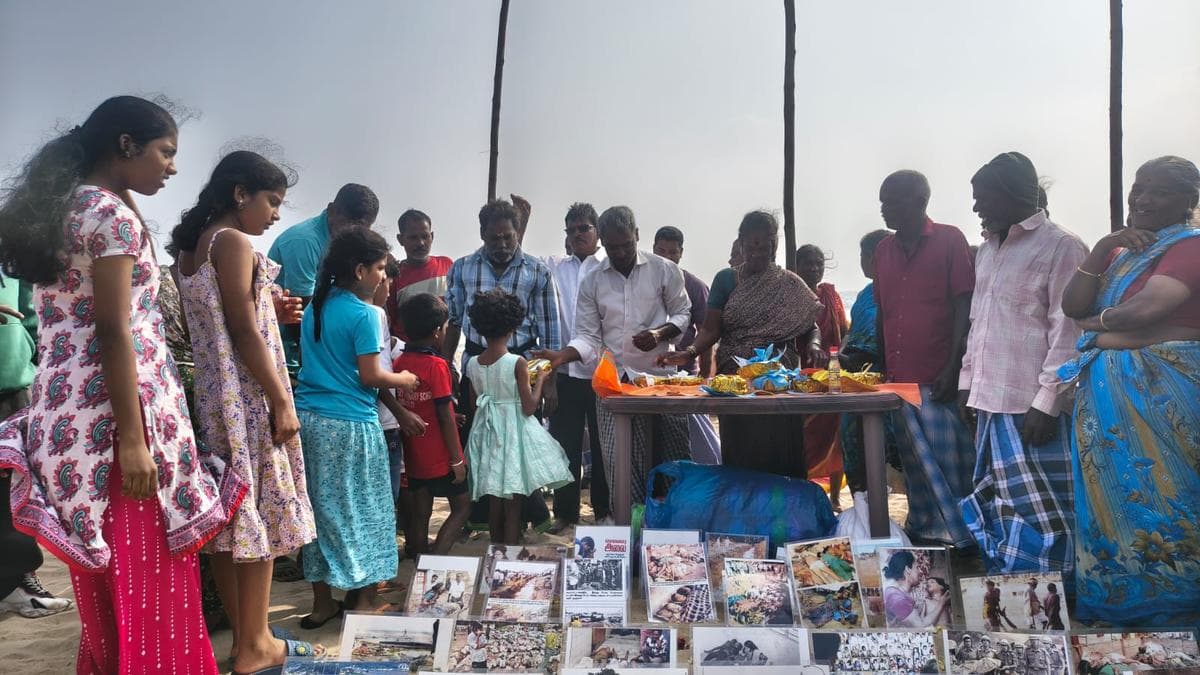
TN fishermen demand Scheduled Tribe status on Tsunami anniversary, citing backwardness.
Summary
Tamil Nadu fishermen reiterated their long-standing demand for Scheduled Tribe (ST) status on the Tsunami anniversary. Community leader Durai Mahendran emphasized their social and educational backwardness, citing a lack of representation in higher services like IAS and judiciary. This demand highlights critical issues of social justice and reservation policies, making it significant for competitive exams focusing on governance and societal structures.
Key Points
- 1The Tamil Nadu fishermen community reiterated their demand for Scheduled Tribe (ST) status.
- 2The demand was made on the occasion of the Tsunami anniversary.
- 3Community leader Durai Mahendran highlighted the community's social and educational backwardness.
- 4The community cited a lack of reservation as the reason for their backwardness.
- 5Specific examples of underrepresentation included no IAS officers or judges from their community.
In-Depth Analysis
The demand by Tamil Nadu fishermen for Scheduled Tribe (ST) status, reiterated on the solemn occasion of the Tsunami anniversary, casts a spotlight on India's complex landscape of social justice, affirmative action, and the enduring quest for equitable development. This long-standing demand reflects a critical aspiration for upward social mobility and access to opportunities, echoing the struggles of numerous communities across the nation.
**Background Context: Understanding Reservation in India**
India's reservation policy, enshrined in its Constitution, is a powerful tool designed to address historical injustices and ensure representation for socially and educationally backward classes. It categorizes communities into Scheduled Castes (SCs), Scheduled Tribes (STs), and Other Backward Classes (OBCs). Scheduled Tribes are typically defined by criteria such as primitive traits, distinctive culture, geographical isolation, shyness of contact with the community at large, and backwardness. The process for including a community in the ST list is stringent, requiring recommendations from the State government, extensive ethnographic studies by the Registrar General of India (RGI), consultation with the National Commission for Scheduled Tribes (NCST), and finally, approval by the Union Cabinet and an Act of Parliament amending the existing list under **Article 342** of the Constitution.
The fishermen community in Tamil Nadu, particularly the 'Meenavar' or 'Parvatharajakulam' sub-sects, have long argued that they meet these criteria. They highlight their traditional occupation, distinct cultural practices, and economic vulnerability, which often keeps them at the periphery of mainstream development. Their demand is not new; it has been a recurring theme in state politics for decades, often gaining momentum during elections or significant public events, such as the Tsunami anniversary, which poignantly reminds them of their community's struggles and vulnerabilities.
**What Happened: A Demand Rearticulated**
On the Tsunami anniversary, community leader Durai Mahendran eloquently articulated the fishermen's predicament. He emphasized their profound social and educational backwardness, directly attributing it to the lack of reservation benefits. His stark examples – "no IAS officers or judges from among its members" – serve as powerful indicators of systemic underrepresentation in crucial spheres of governance and justice. This lack of access to higher education and coveted government jobs perpetuates a cycle of disadvantage, hindering their ability to break free from traditional economic limitations and participate fully in the nation's progress.
**Key Stakeholders Involved**
Several key players are central to this issue. The **Fishermen Community** itself, through its leaders and associations, is the primary stakeholder, advocating for its rights and recognition. The **Tamil Nadu State Government** plays a pivotal role, as it is responsible for initiating the proposal for ST status and conducting preliminary ethnographic studies. The **Union Ministry of Tribal Affairs** is the nodal ministry at the Centre, overseeing the process. The **Registrar General of India (RGI)** is crucial for conducting detailed ethnographic surveys to verify claims of tribal characteristics. The **National Commission for Scheduled Tribes (NCST)**, a constitutional body established under **Article 338A**, advises the government on matters pertaining to the welfare, protection, and development of STs. Finally, the **Parliament of India** holds the ultimate authority to amend the Scheduled Tribes list.
**Why This Matters for India: Social Justice and Inclusive Growth**
This demand holds immense significance for India's commitment to social justice and inclusive development. Granting ST status would unlock a range of affirmative action benefits for the community, including reservations in educational institutions (**Article 15(4)** and **15(5)**), public employment (**Article 16(4)**), and political representation. This can lead to significant improvements in literacy rates, health outcomes, and economic opportunities, fostering greater social equity. From a broader perspective, such demands test the efficacy and fairness of India's reservation policy. It highlights the ongoing need to identify and uplift genuinely backward communities, ensuring that the benefits of development reach all sections of society, in line with the Directive Principle of State Policy outlined in **Article 46**, which mandates the promotion of educational and economic interests of weaker sections.
**Historical Context and Future Implications**
The history of reservation in India is replete with debates over inclusion and exclusion. Since independence, various communities have sought inclusion in the SC, ST, or OBC lists, leading to numerous commissions and policy adjustments. The Mandal Commission, though focused on OBCs, underscored the complexity of identifying backwardness. The current demand from Tamil Nadu fishermen is part of this larger narrative. If granted, it could set a precedent for other fishing communities or similar occupational groups across India, potentially leading to a re-evaluation of criteria for ST status. However, it also raises concerns among existing ST communities about the potential dilution of their reserved seats and benefits. The future implications involve rigorous ethnographic studies, political will, and careful balancing of competing demands to ensure that genuine backwardness is addressed without undermining the interests of already recognized tribal groups. The process demands transparency and adherence to constitutional principles to maintain public trust in the system of affirmative action.
In essence, the Tamil Nadu fishermen's demand is more than just a local issue; it is a microcosm of India's ongoing journey towards a more equitable and inclusive society, constantly challenging and refining its mechanisms for social justice.
Exam Tips
This topic falls under GS Paper 1 (Indian Society, Social Issues) and GS Paper 2 (Indian Polity & Governance, Social Justice). Focus on the constitutional provisions, the process of granting ST status, and the socio-economic implications.
Study related topics like the history of reservation policy in India (Mandal Commission, various constitutional amendments), the roles and functions of National Commissions (NCST, NCSC, NCBC), and the challenges faced by marginalized communities in India.
Expect questions on: 1) Specific constitutional articles related to STs and reservation (e.g., Art. 342, 15, 16, 338A). 2) The criteria and process for including a community in the ST list. 3) The socio-economic impacts and challenges of reservation policies. 4) Analytical questions comparing the demands of various communities for ST/SC/OBC status.
Related Topics to Study
Full Article
Community leader Durai Mahendran said that without reservation, the community has remained socially and educationally backward, with no IAS officers or judges from among its members