


Relevant for Exams
U.S. airstrikes hit foreign IS fighters' staging grounds in Nigeria, rattling villagers.
Summary
U.S. airstrikes were conducted in Nigeria, targeting areas identified by the Nigerian government as "staging grounds" for foreign IS fighters. These fighters reportedly infiltrated Nigeria from the Sahel region. This event highlights ongoing international efforts against terrorism and regional instability, crucial for understanding global security dynamics in competitive exams.
Key Points
- 1U.S. forces conducted airstrikes in Nigeria.
- 2The strikes targeted areas used as "staging grounds" by foreign IS fighters.
- 3The Nigerian government confirmed the purpose of these strikes.
- 4The targeted IS fighters had reportedly sneaked into Nigeria from the Sahel region.
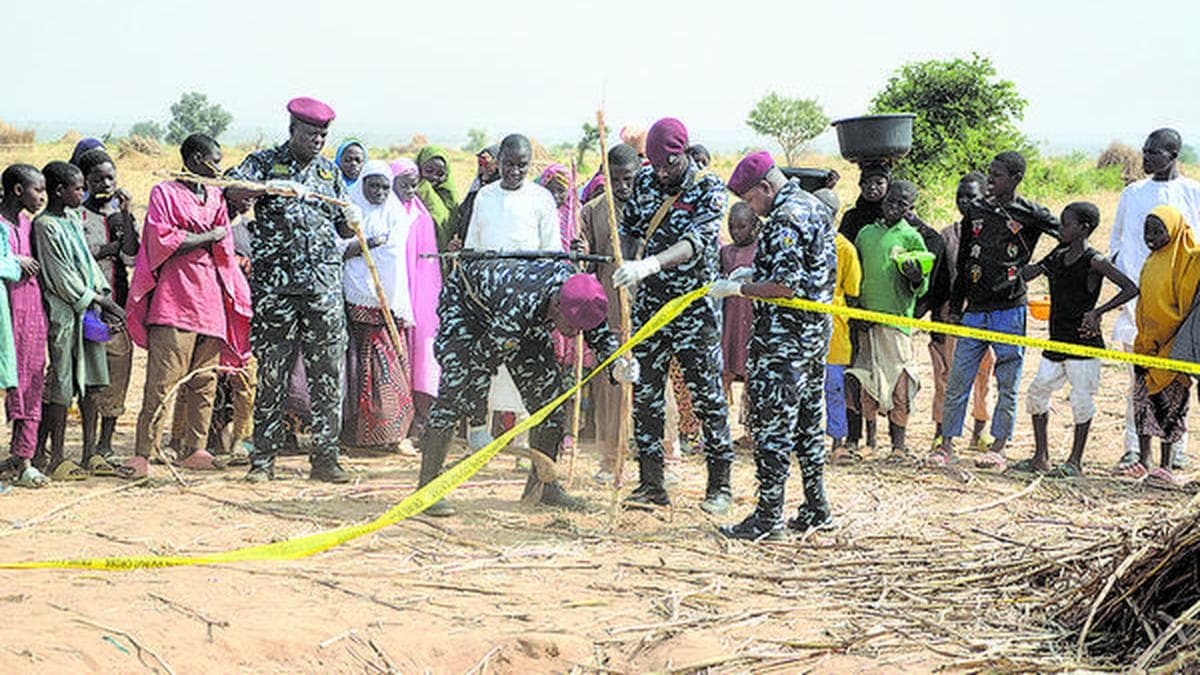
- 5Villagers reported their homes shook and the sky glowed red due to the airstrikes.
In-Depth Analysis
The recent U.S. airstrikes in Nigeria, targeting areas identified by the Nigerian government as "staging grounds" for foreign IS fighters, represent a critical development in the global fight against terrorism and highlight the escalating instability in the Sahel and West African regions. This event, where villagers reported their homes shaking and the sky glowing red, underscores the tangible impact of such military actions on local populations.
To truly grasp the significance, let's delve into the background. Nigeria, Africa's most populous nation and largest economy, has been grappling with a severe insurgency for over a decade. The Boko Haram militant group, which emerged in the early 2000s, intensified its attacks from 2009, aiming to establish an Islamic caliphate. In 2015, a faction of Boko Haram pledged allegiance to the Islamic State (ISIS), rebranding itself as the Islamic State's West Africa Province (ISWAP). ISWAP has since grown to become a formidable force, often considered more dangerous than the original Boko Haram, with a focus on controlling territory and governance, particularly around Lake Chad and in Nigeria's North-East. The Sahel region, a vast semi-arid belt stretching across Africa, serves as a hotbed for various militant groups, fueled by poverty, weak governance, porous borders, and inter-communal conflicts. The infiltration of foreign IS fighters from this region into Nigeria indicates the transnational nature of this threat.
Key stakeholders in this complex scenario include the United States, Nigeria, and the various militant groups. The **United States**, through its Africa Command (AFRICOM), plays a role in supporting counter-terrorism efforts of partner nations, providing intelligence, training, and sometimes direct military assistance. Its involvement reflects a broader strategy to contain and degrade transnational terrorist organizations that could pose a threat to U.S. interests or global stability. **Nigeria**, as the primary affected nation, is fighting for its territorial integrity and the safety of its citizens. The Nigerian government's confirmation of the strikes and their purpose indicates a level of cooperation and shared intelligence with the U.S., highlighting its reliance on international partners in combating a sophisticated enemy. The **Islamic State (IS) fighters**, whether local ISWAP members or foreign elements, represent the core threat. Their ability to cross borders and establish "staging grounds" underscores the regional challenge and the difficulty in containing such groups.
For India, these developments in Nigeria and the broader West African region carry significant implications. Firstly, **energy security** is paramount. Nigeria has historically been one of India's largest crude oil suppliers. Instability and conflict in the region can disrupt supply chains, impact global oil prices, and consequently affect India's energy import bill and economic stability. Secondly, **diaspora safety** is a concern, as a substantial Indian community resides and works in Nigeria, involved in various sectors from manufacturing to services. Their safety and well-being are directly impacted by the security situation. Thirdly, India has growing **strategic and economic interests** in Africa, exemplified by initiatives like the India-Africa Forum Summits and policies like SAGAR (Security and Growth for All in the Region). Regional instability can hinder trade, investment, and diplomatic engagement. Fourthly, from a **counter-terrorism perspective**, India, having its own long-standing battle against terrorism, shares a common interest with Nigeria and the U.S. in degrading transnational terror networks. This provides avenues for intelligence sharing and multilateral cooperation on counter-terrorism platforms, including within the United Nations. The increasing maritime insecurity in the Gulf of Guinea, sometimes linked to regional instability, also poses a threat to Indian shipping and trade routes.
Historically, the rise of extremist groups in Africa can be traced back to a confluence of factors including post-colonial state fragility, socio-economic grievances, and the global spread of radical ideologies, particularly after the rise of Al-Qaeda and later ISIS. The Sahel region, in particular, has seen a security vacuum exploited by various groups, leading to a complex web of conflict. This current situation is a continuation of a protracted struggle against non-state actors that exploit ungoverned spaces and local grievances.
Looking ahead, the future implications are multi-faceted. These targeted strikes, while potentially degrading immediate capabilities, might also lead to a dispersal of fighters, pushing them into new areas and exacerbating regional instability. The challenge remains to address the root causes of extremism – poverty, lack of education, and governance deficits – alongside military interventions. Continued international cooperation, sustained security assistance, and integrated development strategies will be crucial. For India, this means a continued focus on its Act East and Act Africa policies, ensuring robust diplomatic engagement, securing its economic interests, and actively participating in global counter-terrorism efforts, upholding principles of international law and sovereignty. India's foreign policy, guided by Directive Principles like Article 51 of the Constitution, which advocates for international peace and security, just relations between nations, and respect for international law, will continue to shape its approach to such global security challenges, emphasizing multilateral solutions and comprehensive conventions against terrorism like the CCIT at the UN.
Exam Tips
This topic primarily falls under UPSC GS Paper-II (International Relations - Bilateral, regional and global groupings and agreements involving India and/or affecting India's interests; Effect of policies and politics of developed and developing countries on India's interests) and GS Paper-III (Internal Security - Linkages between development and spread of extremism; Role of external state and non-state actors in creating challenges to internal security).
When studying, link this event to broader themes like global terrorism (its evolution, funding, and impact), the geopolitics of energy (how regional conflicts affect oil prices), and India's foreign policy objectives (e.g., India-Africa relations, counter-terrorism diplomacy, diaspora protection).
Common question patterns include analytical questions on the implications of West African instability for India, the role of external powers in regional conflicts, challenges in combating transnational terrorism, and the effectiveness of military interventions versus socio-economic development in addressing extremism.
Pay attention to the geographical context of the Sahel region and West Africa, identifying key countries and their strategic importance. Understand the distinction between groups like Boko Haram and ISWAP.
Prepare for questions that require you to critically evaluate the balance between national sovereignty and international counter-terrorism efforts, especially in cases involving foreign military operations on another country's soil.
Related Topics to Study
Full Article
Nigerian government says that the strikes targeted areas used as "staging grounds by foreign" IS fighters who had sneaked into Nigeria from the Sahel