


Relevant for Exams
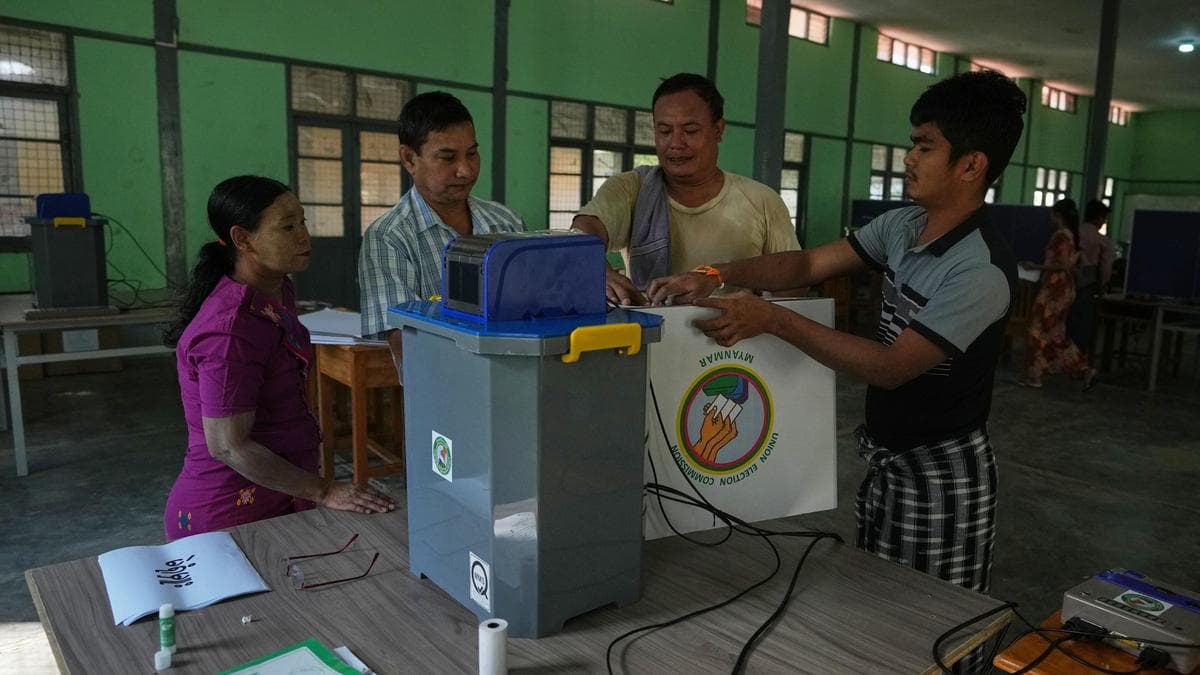
Myanmar holds polls amid 2021 military coup aftermath, civil war, and humanitarian crisis.
Summary
Myanmar is grappling with a severe conflict and humanitarian crisis, stemming from a 2021 military coup that overthrew the elected civilian government led by Nobel Peace Prize laureate Aung San Suu Kyi. The nation is now attempting to hold elections amidst this ongoing civil war, highlighting the deep political instability. This situation is crucial for competitive exams, particularly for understanding international relations, regional geopolitics, and current global conflicts.
Key Points
- 1Myanmar's current conflict was triggered by a military coup in 2021.
- 2The 2021 coup ousted an elected civilian government in Myanmar.
- 3The ousted civilian government was led by Nobel Peace Prize winner Aung San Suu Kyi.
- 4Myanmar is currently experiencing a civil war and a humanitarian crisis.
- 5The country is attempting to go to polls despite the ongoing internal conflict.
In-Depth Analysis
The ongoing crisis in Myanmar, marked by a brutal civil war and a profound humanitarian catastrophe, is a critical issue with significant geopolitical ramifications, especially for India. This turmoil stems directly from the military coup on February 1, 2021, when the Tatmadaw (Myanmar's armed forces) overthrew the democratically elected civilian government led by Nobel Peace Prize laureate Aung San Suu Kyi and her National League for Democracy (NLD) party.
To understand the current situation, it's essential to delve into Myanmar's complex political history. After gaining independence from British rule in 1948, Myanmar (then Burma) experienced a brief period of parliamentary democracy before a military coup in 1962 ushered in decades of authoritarian rule. The military's grip on power was challenged by pro-democracy movements, notably the 8888 Uprising in 1988 and the Saffron Revolution in 2007, both brutally suppressed. A gradual, albeit carefully controlled, transition towards a 'discipline-flourishing democracy' began in the early 2010s, culminating in the 2008 Constitution, which enshrined significant political power for the military, including 25% of parliamentary seats and control over key ministries. Aung San Suu Kyi's NLD won landslide victories in the 2015 and 2020 general elections, signaling a strong public mandate for civilian rule, despite the military's constitutional prerogatives.
The 2021 coup was justified by the Tatmadaw on unsubstantiated claims of widespread electoral fraud in the November 2020 elections, where the NLD secured an even larger majority. The military detained Aung San Suu Kyi, President Win Myint, and other NLD leaders, imposing a state of emergency. This act sparked widespread peaceful protests across the country, which the military met with extreme violence, leading to thousands of deaths, detentions, and a massive displacement of people. In response, a parallel National Unity Government (NUG) was formed by ousted lawmakers and pro-democracy activists, advocating for a federal democracy. The conflict quickly escalated into a full-blown civil war, as the NUG's People's Defence Forces (PDFs) allied with various long-standing ethnic armed organizations (EAOs) to resist the junta. This has plunged Myanmar into a deep humanitarian crisis, with millions requiring aid, and widespread displacement and food insecurity.
Several key stakeholders are involved. Domestically, the **Tatmadaw** remains the primary power holder, attempting to consolidate control through brutal force. The **National Unity Government (NUG)** represents the pro-democracy aspirations and is seeking international recognition and support. **Ethnic Armed Organizations (EAOs)**, some of whom have fought the central government for decades, now play a crucial role, often aligning with the NUG. Regionally, the **Association of Southeast Asian Nations (ASEAN)** has attempted mediation through its 'Five-Point Consensus' but has been largely ineffective due to internal divisions and the junta's non-compliance. **China**, a major neighbor and investor, prioritizes stability and its economic interests, maintaining a complex relationship with the junta. The **United Nations** and various international NGOs are focused on humanitarian aid and advocating for a return to democracy and human rights.
For **India**, the crisis in Myanmar carries profound significance. Geopolitically, it undermines stability in India's immediate neighborhood, directly impacting its 'Act East' Policy, which aims to enhance economic and strategic ties with Southeast Asian nations. India shares a 1,600 km porous land border with Myanmar, making it highly vulnerable to spillover effects. Security concerns are paramount: the influx of refugees, particularly into states like Mizoram and Manipur, poses humanitarian and administrative challenges. India has historically dealt with insurgent groups operating from Myanmar territory, and the current instability could embolden such groups and increase cross-border illicit activities like drug trafficking and arms smuggling. Economically, crucial infrastructure projects like the Kaladan Multi-modal Transit Transport Project and the India-Myanmar-Thailand Trilateral Highway, vital for connecting India's Northeast with Southeast Asia, face significant delays and threats due to the ongoing conflict. India's foreign policy has had to perform a delicate balancing act, engaging with the military junta to protect its strategic interests while also expressing concern for democracy and human rights. India's approach often emphasizes non-interference in internal affairs but is guided by national security and regional stability imperatives.
The future implications are dire. The conflict shows no signs of abating, threatening to further destabilize the region. The humanitarian crisis is likely to worsen, potentially leading to larger refugee flows and increased pressure on neighboring countries, including India. The prospects for a swift return to democracy appear bleak, with the military showing no willingness to concede power. This situation also tests the efficacy of regional bodies like ASEAN and international norms of non-intervention versus the responsibility to protect. India's ability to navigate this complex scenario will be crucial for its regional standing and security.
While specific Indian constitutional articles don't directly govern the Myanmar crisis, India's response is shaped by its foreign policy doctrines, particularly the **'Act East' Policy** (which evolved from the 'Look East' Policy in 2014) and its national security imperatives. India's humanitarian aid efforts and its management of refugee influx, though not governed by a specific Indian refugee law, are guided by international principles and domestic policy considerations for border states.
Exam Tips
This topic falls under 'International Relations' (GS-II for UPSC Civil Services Exam) and 'Current Affairs' for all competitive exams (SSC, Banking, Railways, State PSCs, Defence). Focus on understanding the geopolitical implications, India's foreign policy response, and the roles of international organizations.
Study related topics such as ASEAN's role in regional security, India's 'Act East' Policy and its key projects (Kaladan Multi-modal Transit Transport Project, India-Myanmar-Thailand Trilateral Highway), the concept of refugee crisis and international humanitarian law, and the geopolitics of the Indo-Pacific region. Understand the historical context of military rule and democratic transitions in Southeast Asia.
Common question patterns include factual questions on the date of the coup, names of key figures (Aung San Suu Kyi), and major projects (Kaladan). For UPSC and State PSCs, expect analytical questions on the implications for India's national security, economic interests, and foreign policy challenges. Questions might also cover the effectiveness of ASEAN's response or the role of external powers like China.
Related Topics to Study
Full Article
Myanmar has been hammered by a conflict triggered by a 2021 coup in which the military ousted an elected civilian government led by Nobel Peace Prize winner Aung San Suu Kyi.