


Relevant for Exams
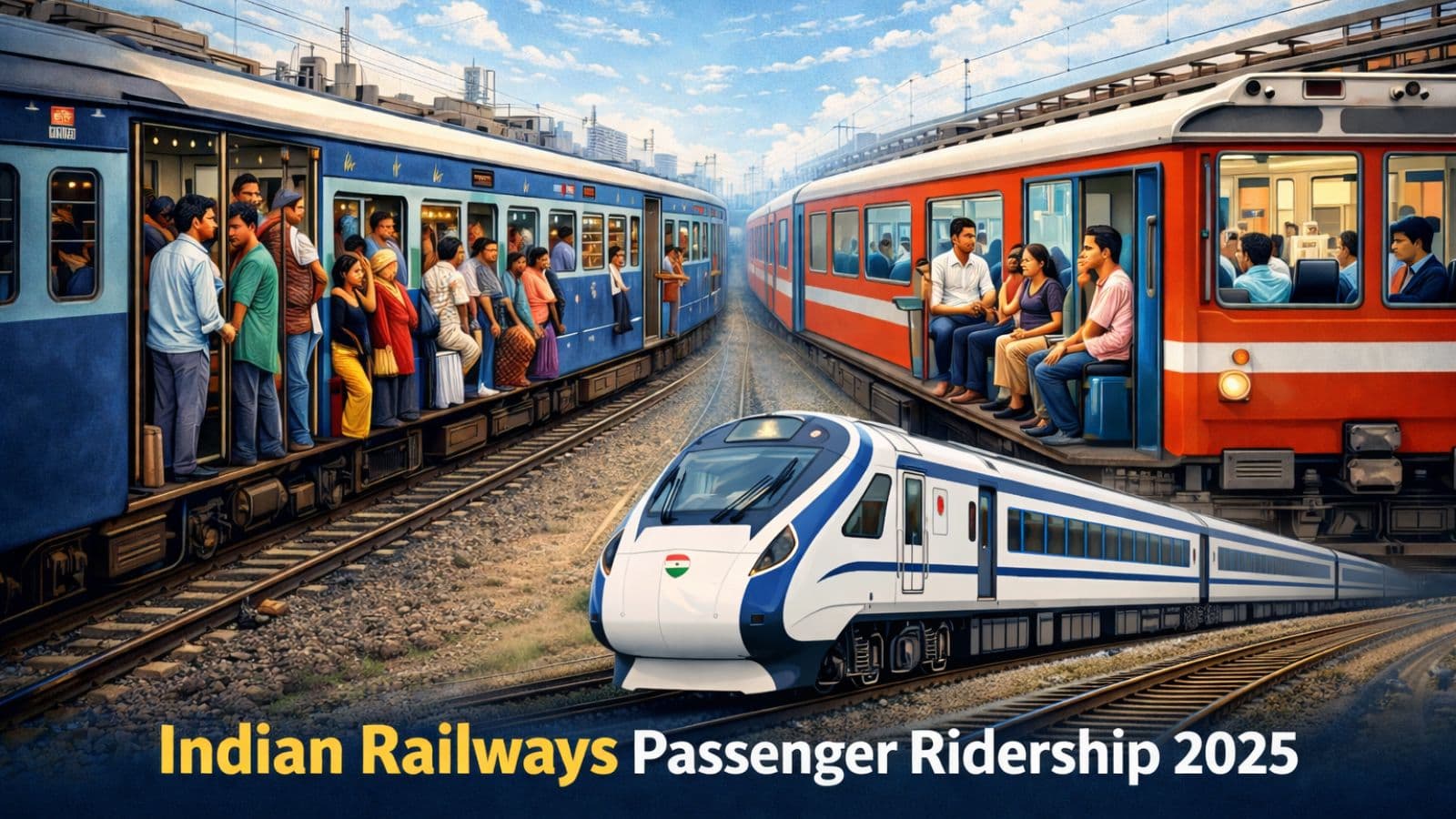
Indian Railways records over 693 crore passengers till November, highlighting robust national transport.
Summary
Indian Railways reported over 693 crore passengers travelled by train till November, indicating significant public transport usage. This high ridership reflects robust economic activity and the crucial role of railways in national connectivity. For competitive exams, these figures highlight infrastructure utilization and the performance of a key government-run service, making it relevant for questions on transport and economy.
Key Points
- 1Indian Railways reported a total ridership of over 693 crore passengers.
- 2This significant passenger volume was recorded for the period leading up to November.
- 3The news headline includes "ridership 2025", potentially indicating a financial year target or projection.
- 4Indian Railways is one of the world's largest railway networks, crucial for national connectivity and economic activity.
- 5Passenger traffic data is a key metric for assessing the performance and growth of India's railway sector.
In-Depth Analysis
Indian Railways, often termed the "lifeline of the nation," has reported a remarkable ridership of over 693 crore passengers until November, a figure that underscores its indispensable role in India's socio-economic fabric. This substantial passenger volume, likely pertaining to the current financial year (FY2024-25) or a recent cumulative period, not only highlights a robust recovery in public mobility post-pandemic but also signifies the enduring importance of rail transport in a country as vast and diverse as India.
The genesis of Indian Railways dates back to April 16, 1853, when the first passenger train ran between Mumbai (then Bombay) and Thane. Initially developed by the British for strategic and commercial exploitation, particularly for transporting raw materials to ports, it was nationalized post-independence, transforming into a public utility focused on national integration and economic development. Today, Indian Railways operates one of the world's largest and busiest railway networks, covering over 68,000 route kilometers and serving millions daily. Its sheer scale and reach make it a critical indicator of national economic activity and public access to transport.
The reported ridership figure is a testament to several factors. It reflects increased economic activity, a surge in tourism, and the continued reliance of a large segment of the population on affordable and accessible inter-city travel. The government's sustained focus on infrastructure development, including the introduction of modern trains like Vande Bharat Express and improvements in station amenities, has likely contributed to this growth. This data also provides valuable insights into the performance and utilization of a key public sector enterprise.
Key stakeholders in this vast system include the Ministry of Railways, which formulates policy; the Railway Board, responsible for administration and management; the numerous Zonal Railways and Production Units that execute operations and manufacturing; and Public Sector Undertakings (PSUs) like IRCTC (catering and tourism), RITES (consultancy), and RVNL (construction). Most importantly, the passengers and freight customers are the ultimate beneficiaries and drivers of demand. The millions of railway employees form the backbone of this colossal organization. The Union Government, as the owner and primary investor, plays a pivotal role in funding and strategic direction, often reflecting its policy priorities through budget allocations to the railways.
For India, the significance of Indian Railways is multi-faceted. Economically, it is a massive employer, a significant contributor to GDP, and a facilitator of trade, commerce, and tourism, connecting production centers to markets and remote areas to urban hubs. Socially, it promotes national integration by enabling people from different regions to travel and interact, provides affordable transport for all income groups, and is often a first responder during national emergencies or disasters. Politically, railway development is a key plank of governmental policy, with projects like high-speed rail corridors and Dedicated Freight Corridors (DFCs) being symbols of India's modern infrastructure ambitions, aligning with broader initiatives like the PM Gati Shakti National Master Plan for multi-modal connectivity.
The legal framework governing Indian Railways primarily stems from the Indian Railways Act, 1890, which has been amended over time to suit contemporary needs. Constitutionally, 'Railways' falls under Entry 22 of the Union List (List I) of the Seventh Schedule, granting the Parliament exclusive power to legislate on this subject. This centralization ensures a unified national railway network crucial for inter-state connectivity and national security. Recent policy initiatives, such as the National Rail Plan 2030, aim to create a "future ready" railway system, capable of meeting the country's growing freight and passenger demands by 2030, emphasizing capacity expansion, modernization, and electrification.
The future implications of these trends are profound. Continued high ridership will necessitate further investment in infrastructure, including new lines, doubling/tripling of existing tracks, and upgrading signaling systems to enhance safety and efficiency. The push for electrification aims to reduce the carbon footprint and operational costs, aligning with India's climate goals. The expansion of Dedicated Freight Corridors is expected to decongest passenger lines and boost freight efficiency, crucial for industrial growth. Digitalization, from ticketing to freight management, will continue to improve user experience and operational transparency. Ensuring financial sustainability while balancing social obligations remains a key challenge and a continuous area of policy focus for the government.
Exam Tips
This topic falls under 'Indian Economy' (Infrastructure, Transport Sector) and 'Governance' (Public Sector Undertakings) in UPSC, SSC, and State PSC syllabi. Focus on the economic contribution, policy initiatives (National Rail Plan 2030, PM Gati Shakti), and the organizational structure of Indian Railways.
Expect questions on factual data (e.g., length of network, budget allocation, major projects like DFCs, Vande Bharat trains), policy objectives, and the socio-economic significance of Indian Railways. Also, be prepared for questions analyzing challenges faced by the railways (e.g., safety, financial viability, modernization).
Relate this topic to broader themes like 'Make in India' (domestic manufacturing of coaches), 'Atmanirbhar Bharat' (self-reliance in rail technology), and sustainable development goals (electrification, green initiatives). Understand how railway development impacts logistics and supply chains.