


Relevant for Exams
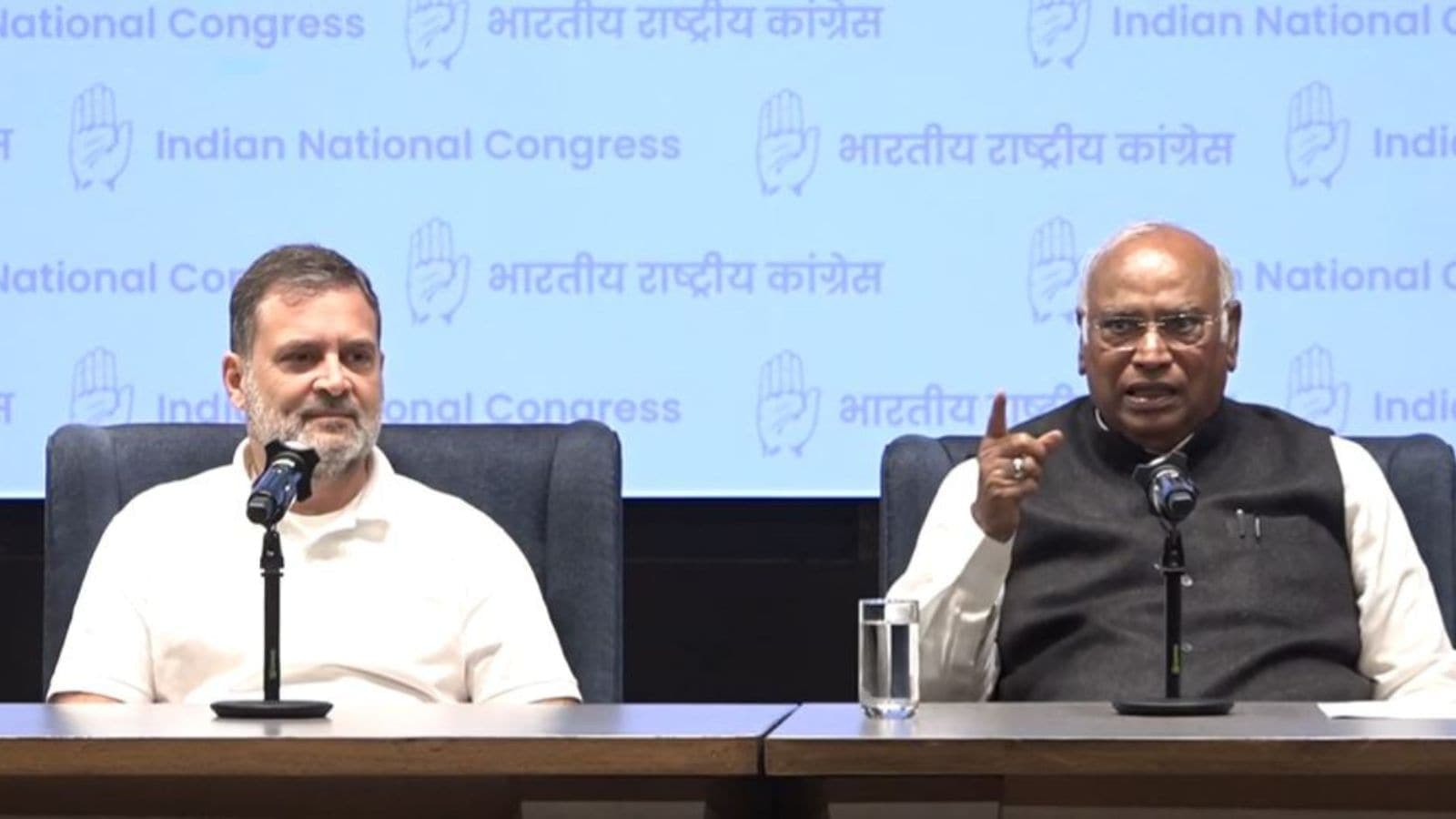
Congress to protest MGNREGA issues on Jan 5, demands repeal of 'VB-G RAM G Act': Kharge.
Summary
The Congress party, led by Kharge, is set to launch a 'MGNREGA Bachao' protest on January 5. This initiative aims to highlight alleged issues with the Mahatma Gandhi National Rural Employment Guarantee Act (MGNREGA) scheme. A key demand of the protest is the repeal of the 'VB-G RAM G Act', signifying political opposition to specific government policies or provisions affecting the crucial rural employment program, making it relevant for understanding social welfare schemes and political dynamics.
Key Points
- 1The Congress party plans to launch a 'MGNREGA Bachao' (Save MGNREGA) protest.
- 2The protest is scheduled to be initiated on January 5.
- 3The initiative is being led by Congress President Kharge.
- 4A primary demand of the protest is the repeal of the 'VB-G RAM G Act'.
- 5The protest focuses on concerns related to the Mahatma Gandhi National Rural Employment Guarantee Act (MGNREGA) scheme.
In-Depth Analysis
The Congress party's announcement of a 'MGNREGA Bachao' (Save MGNREGA) protest, led by its president Mallikarjun Kharge, on January 5, underscores the persistent political and social significance of the Mahatma Gandhi National Rural Employment Guarantee Act. This protest highlights alleged issues with the scheme's implementation and demands the repeal of what the party refers to as the 'VB-G RAM G Act' – likely a reference to specific government policies or changes that the Congress perceives as detrimental to the core spirit and functioning of MGNREGA.
**Background Context: The Genesis and Vision of MGNREGA**
MGNREGA, enacted on August 25, 2005, is a landmark social security measure that guarantees the 'right to work' by providing at least 100 days of wage employment in a financial year to every rural household whose adult members volunteer to do unskilled manual work. Launched initially in 200 districts, it was expanded nationwide by April 1, 2008. The scheme's core objectives include reducing rural poverty, creating durable assets (like roads, ponds, wells), empowering women and marginalized communities, and checking distress migration. It is a demand-driven scheme, and its legal backing makes it unique, distinguishing it from previous employment generation programs. It aims to inject purchasing power into the rural economy, thereby stimulating local markets and contributing to overall economic growth.
**What Happened: The Protest and its Demands**
The Congress's 'MGNREGA Bachao' protest on January 5 is a direct political challenge to the incumbent government regarding its handling of this crucial welfare scheme. While the specific 'VB-G RAM G Act' is not a widely recognized central legislation, the Congress's demand for its repeal likely refers to a set of recent policy changes, administrative directives, or budgetary allocations that the opposition claims are undermining MGNREGA. Common grievances often include delays in wage payments, insufficient budget allocation leading to job rationing, the mandatory use of Aadhaar-Based Payment System (ABPS) for wage disbursements (which has faced criticism for excluding genuine beneficiaries), and reduced scope of work. The protest aims to draw public attention to these issues and pressure the government to address them, especially in the context of upcoming elections.
**Key Stakeholders and Their Roles**
1. **Congress Party (Opposition):** As the party that introduced MGNREGA, Congress views itself as its custodian. The protest serves to highlight perceived governmental failures, rally political support, and position itself as a champion of rural welfare.
2. **Central Government (Ruling Party):** Responsible for policy formulation, budget allocation, and overall implementation of MGNREGA. It faces scrutiny over scheme performance, fund releases, and the efficacy of its administrative reforms.
3. **Rural Labourers/Beneficiaries:** The primary stakeholders whose livelihoods and right to work are directly impacted by the scheme's effectiveness. Issues like delayed wages or denial of work directly affect their economic security.
4. **State Governments:** Responsible for implementing the scheme on the ground, including identifying beneficiaries, creating work, and disbursing wages. They often face challenges related to administrative capacity, timely fund transfers from the Centre, and local political pressures.
5. **Civil Society Organizations and Activists:** Play a crucial role in monitoring MGNREGA's implementation, conducting social audits, advocating for workers' rights, and bringing transparency issues to light.
**Significance for India: Economic, Social, and Political Impact**
MGNREGA holds immense significance for India. Economically, it acts as a safety net during periods of agricultural distress, provides a crucial source of income for millions of rural households, and helps create vital rural infrastructure. Socially, it has been instrumental in empowering women (who constitute over 50% of the workforce), Scheduled Castes, and Scheduled Tribes, by providing them with independent income and decision-making power. It has also reduced distress migration by offering local employment. Politically, MGNREGA is a powerful electoral tool and a symbol of welfare state commitment. Any perceived weakening or mismanagement of the scheme can have significant political ramifications, especially in rural constituencies.
**Historical Context and Constitutional Linkages**
MGNREGA built upon earlier employment generation schemes like the National Rural Employment Programme (NREP) and Jawahar Rozgar Yojana (JRY), but crucially added a legal guarantee. It embodies the spirit of the Directive Principles of State Policy (DPSP) enshrined in Part IV of the Indian Constitution. Specifically, **Article 41** directs the State to make effective provision for securing the right to work, to education, and to public assistance in cases of unemployment, old age, sickness, and disablement. **Article 43** aims to secure a living wage and conditions of work ensuring a decent standard of life. MGNREGA is a legislative fulfillment of these constitutional aspirations, transforming a moral obligation into a legal right. The **MGNREGA Act, 2005**, is the foundational legislation for the scheme.
**Future Implications**
The protest signifies ongoing political contention over welfare spending and the design of social security programs. Future implications could include increased parliamentary debate on MGNREGA, potential adjustments in budgetary allocations, or a re-evaluation of administrative reforms like the ABPS. The scheme's effectiveness will continue to be a key indicator of rural economic health and a barometer of political accountability. The balance between fiscal prudence and providing a robust social safety net will remain a critical challenge for any government. The debate around MGNREGA also touches upon broader themes of federalism, as states often seek more autonomy and funds for implementation, and the role of technology in welfare delivery, which brings both efficiency gains and exclusion risks.
The 'MGNREGA Bachao' protest, therefore, is not merely a political event but a reflection of deeper concerns regarding rural livelihoods, social justice, and the future trajectory of India's welfare state, making it a critical topic for competitive exam aspirants to understand comprehensively.
Exam Tips
This topic falls under GS-II (Government Policies and Interventions for Development in various sectors, Welfare Schemes for Vulnerable Sections) and GS-III (Indian Economy and issues relating to Planning, Mobilization of Resources, Growth, Development and Employment) of the UPSC Civil Services Syllabus. For SSC/Banking/Railway/State PSC exams, focus on its objectives, features, launch date, and impact.
Study MGNREGA's core features (100 days guarantee, demand-driven, legal right, 1/3rd women reservation), its evolution since 2005, and its impact on poverty alleviation, women empowerment, and rural infrastructure. Pay attention to common challenges like wage delays, budget shortfalls, and implementation issues.
Common question patterns include direct questions on the objectives and features of MGNREGA, critical analysis of its success and failures, its role in rural development, comparison with other welfare schemes, and the constitutional articles (DPSP, Article 41, 43) it aligns with. Be prepared for questions on recent policy changes or controversies surrounding the scheme (e.g., Aadhaar linkage, budget cuts).