


Relevant for Exams
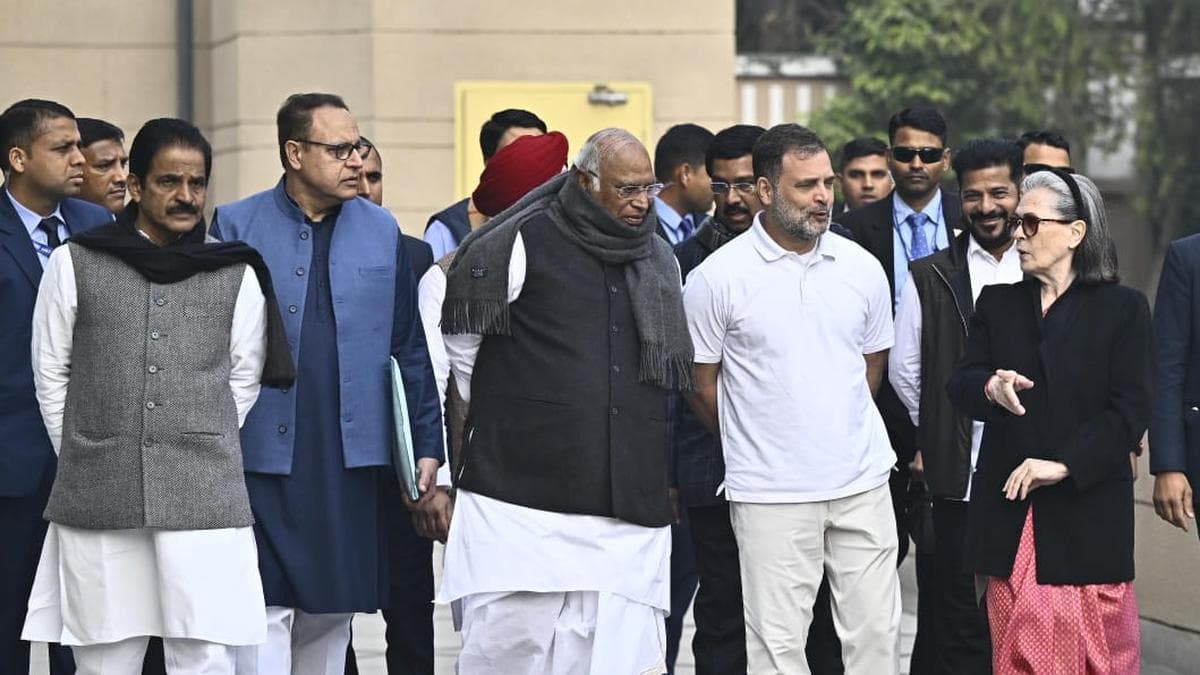
Congress CWC meets to strategize for upcoming Assembly polls in Assam, Kerala, West Bengal, Tamil Nadu, Puducherry.
Summary
The Congress Working Committee (CWC) convened a meeting attended by top party leaders to discuss strategy. The primary focus was on deliberating the party's approach for the upcoming Assembly polls in five states/UTs: Assam, Kerala, West Bengal, Tamil Nadu, and Puducherry. This internal strategic discussion is significant for understanding the Congress party's electoral preparedness and political roadmap in key regions, making it relevant for current affairs and political science sections in competitive exams.
Key Points
- 1The meeting convened was of the Congress Working Committee (CWC).
- 2Top Congress leaders attended the CWC meet to discuss party strategy.
- 3A primary agenda point was deliberating the party's strategy for upcoming elections.
- 4The meeting was held ahead of next year's Assembly polls.
- 5The five states/UT facing elections are Assam, Kerala, West Bengal, Tamil Nadu, and Puducherry.
In-Depth Analysis
The Congress Working Committee (CWC) meeting, as highlighted, represents a critical strategic deliberation for India's oldest political party. To truly understand its significance, one must delve into the background, the current political landscape, and the constitutional framework governing elections.
**Background Context and What Happened:**
The Congress Working Committee (CWC) is the highest decision-making body of the Indian National Congress party. Its meetings are crucial for setting the party's agenda, strategizing for elections, and making major policy pronouncements. The recent meeting, attended by top Congress leaders, was specifically convened to strategize for the upcoming Assembly polls in five significant regions: Assam, Kerala, West Bengal, Tamil Nadu, and Puducherry. These elections, typically held in the early part of the year, are often seen as a barometer of public sentiment and can significantly influence the national political narrative. The mention of 'VB-G RAM G law' in the title appears to be a misinterpretation or an internal party reference not fully elaborated in the provided context; the core focus, as per the quick summary and key points, was unequivocally on electoral strategy and action against specific political challenges or laws impacting their electoral prospects.
**Key Stakeholders Involved:**
The primary stakeholder is, of course, the **Indian National Congress party** itself, particularly its top leadership who constitute the CWC. Their decisions will shape the party's campaign, alliances, and messaging. Other crucial stakeholders include the **electorate** in the five states/UTs, whose votes will determine the outcome. **Rival political parties**—such as the Bharatiya Janata Party (BJP), regional powerhouses like the Trinamool Congress (TMC) in West Bengal, the DMK and AIADMK in Tamil Nadu, the Left Democratic Front (LDF) and United Democratic Front (UDF) in Kerala, and the All India N.R. Congress (AINRC) in Puducherry, along with the Asom Gana Parishad (AGP) and AIUDF in Assam—are also key stakeholders. Their strategies and performance directly impact the Congress's prospects. Finally, the **Election Commission of India (ECI)** is a vital constitutional body, responsible for conducting free and fair elections in these states, ensuring adherence to the Model Code of Conduct.
**Why This Matters for India and Historical Context:**
These state elections are not merely local contests; they have profound implications for India's federal structure and multi-party democracy. For the Congress, which has seen a significant decline in its electoral fortunes nationally since 2014, these polls are crucial for its revival and continued relevance. Historically, the Congress dominated Indian politics for decades post-independence, playing a pivotal role in nation-building and shaping the country's political discourse. However, the rise of regional parties and the BJP's ascendancy have challenged its position. Strong performances in state elections can provide the party with much-needed momentum, resources, and a platform to challenge the ruling dispensation at the national level. Conversely, poor results could further weaken its organizational structure and impact its ability to form effective alliances.
**Constitutional Provisions and Broader Themes:**
The entire election process is anchored in the Indian Constitution. **Article 324** empowers the Election Commission of India to superintend, direct, and control the preparation of electoral rolls and the conduct of all elections to Parliament and the Legislature of every State and to the offices of President and Vice-President. The conduct of Assembly elections falls squarely under the ECI's purview. The **Representation of the People Act, 1951**, further details the conduct of elections, qualifications/disqualifications of members, and electoral offences. These elections underscore the principle of **federalism**, where states have distinct legislative powers and political identities. The outcomes will influence state-level governance, policies related to welfare, development, and economic growth, reflecting the diverse needs and aspirations of India's population. The Congress's strategy, therefore, must align with these regional specificities while projecting a coherent national vision.
**Future Implications:**
The results of these Assembly polls will have significant future implications. For the Congress, success could mean greater bargaining power in potential future national alliances, a boost to party morale, and renewed vigor to challenge the BJP. Failure, however, might lead to further introspection, leadership questions, and a diminishing footprint, potentially cementing the dominance of regional parties in their respective states. These elections will also test the efficacy of different political strategies – alliances versus going it alone, focusing on local issues versus national narratives. The political landscape post-elections could see shifts in state governments, changes in policy priorities, and a recalibration of political equations ahead of the next general elections. The performance of national parties like Congress and BJP, and the strength of regional parties, will continue to shape India's dynamic democratic fabric.
Exam Tips
This topic falls under the 'Indian Polity and Governance' section of the UPSC Civil Services Exam (Prelims & Mains GS-II), State PSCs, and SSC CGL/CHSL exams. Focus on the structure and functioning of political parties, the election process, and federalism.
Study the role and powers of the Election Commission of India (Article 324), the Representation of the People Act, 1951, and the concept of Model Code of Conduct. Also, understand the constitutional provisions related to State Legislatures (Articles 168-212).
Common question patterns include: direct questions on the CWC's role, the process of state assembly elections, constitutional articles related to elections, and the significance of regional parties in India's federal structure. Be prepared for current affairs questions linking specific election outcomes to national political trends.
Related Topics to Study
Full Article
Speaking at the Congress Working Committee meeting in New Delhi, Mr. Kharge also said that the Special Intensive Revision of electoral rolls was a “well-planned conspiracy” to limit democratic rights