
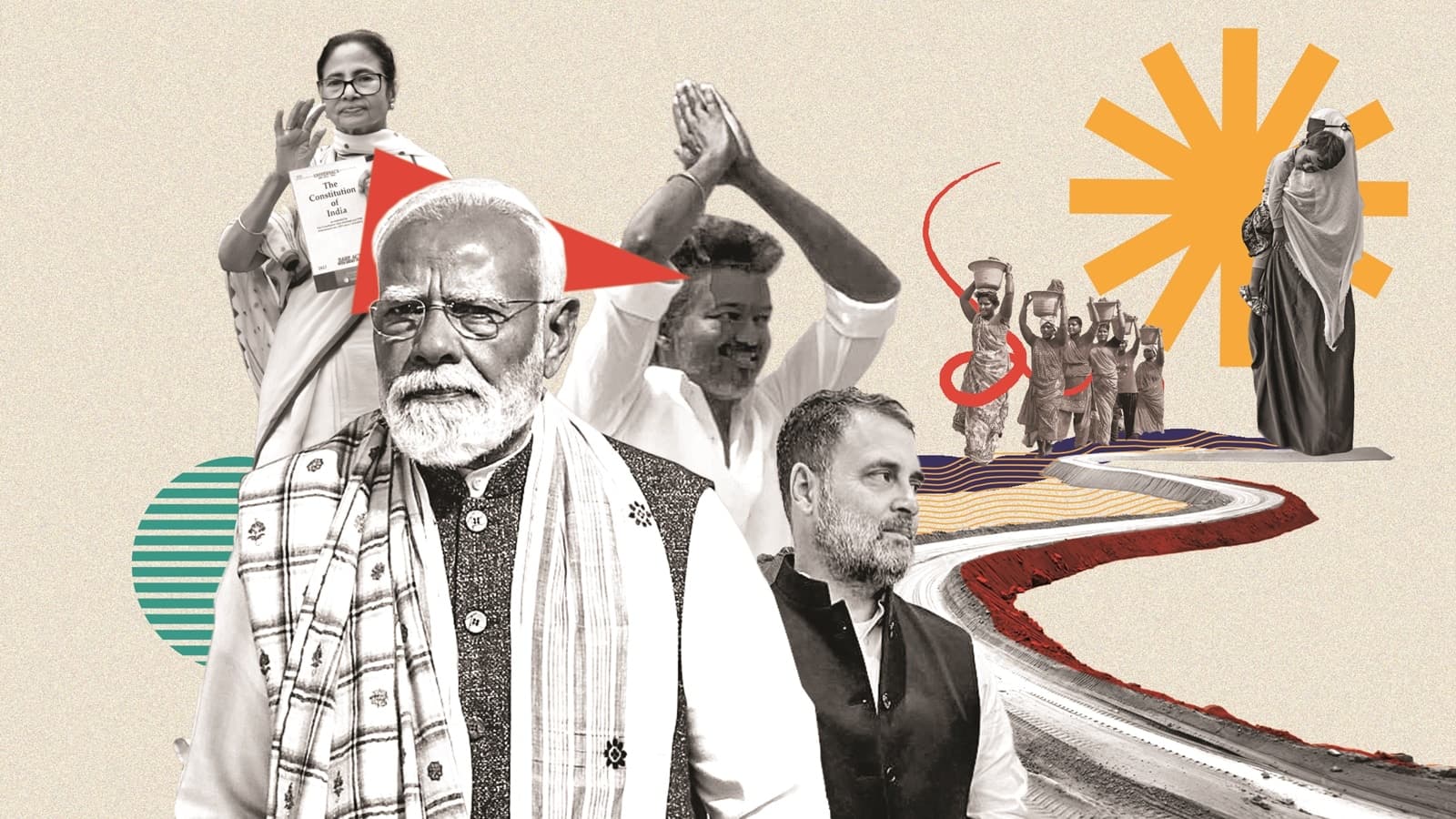


Indian politics 2025: No content provided for analysis of deepening divides.
Summary
No article content was provided for analysis, hence no specific events, policies, or political developments can be summarized. The title suggests a yearender review of Indian politics in 2025, focusing on deepening political divides and setting the stage for future events. However, without the actual content, its significance for competitive exam preparation cannot be determined, as no factual details are available for extraction.
Key Points
- 1Specific political events or policy decisions for 2025 are not detailed in the absence of content.
- 2Key political figures, parties, or constitutional provisions related to 'deepening divides' are not identified.
- 3No quantitative data, specific dates, or locations regarding political developments are available for extraction.
- 4The article's actual content, crucial for competitive exam preparation, is explicitly stated as missing.
- 5Without content, no factual basis exists to formulate MCQs on Indian politics for the year 2025.
In-Depth Analysis
The title "Yearender 2025 | Indian politics: A year of deepening political divides sets the stage for another", while lacking specific content, offers a potent lens through which to examine a persistent and evolving challenge in Indian democracy: political polarization. For competitive exam aspirants, understanding the dynamics of political divides goes beyond mere facts; it requires grasping their historical roots, constitutional implications, and socio-economic consequences. This analysis will delve into these broader themes, assuming the premise of deepening divides in 2025.
**Background Context and Historical Evolution:**
Indian politics has always been marked by competition, but the nature and intensity of divides have transformed significantly. Post-independence, the initial decades were characterized by the dominance of the Congress party, where internal factions often served as the primary source of political contestation. The Emergency (1975-77) marked a watershed moment, leading to a more defined opposition and ideological cleavages. The late 1980s and early 1990s witnessed the rise of identity politics, fueled by the Mandal Commission recommendations on reservations and the Ram Janmabhoomi movement. This period saw the emergence of strong regional parties and the weakening of national parties, leading to an era of coalition governments. While coalitions necessitated compromise, they also often amplified regional and identity-based differences. In recent times, India has witnessed a shift towards a more bipolar political landscape, with the Bharatiya Janata Party (BJP) often leading the ruling dispensation and a fragmented opposition attempting to coalesce. This has, at times, intensified ideological battles and personal attacks, contributing to what the title describes as "deepening political divides."
**What Constitutes 'Deepening Divides'?**
Conceptually, deepening political divides can manifest in several ways. Firstly, it involves increasing ideological polarization, where political discourse moves away from policy nuances towards stark binaries (e.g., nationalist vs. anti-national, secular vs. communal). Secondly, it often entails the weaponization of identity – caste, religion, language, and region – to mobilize voters, sometimes at the cost of national unity and social harmony. Thirdly, it can lead to a breakdown of parliamentary decorum and consensus-building, with frequent disruptions, walkouts, and reduced legislative scrutiny. Lastly, it can strain Centre-State relations, particularly when different political parties govern at the national and state levels, leading to disputes over resource allocation, policy implementation, and federal powers.
**Key Stakeholders Involved:**
Several stakeholders contribute to and are impacted by these divides. The **ruling party/coalition** often sets the national agenda and narrative, and its policies and rhetoric can either bridge or widen existing gaps. The **opposition parties** play a crucial role in holding the government accountable, but their effectiveness can be hampered by internal divisions or a failure to present a united front. **Voters and citizens** are the ultimate arbiters, with their choices reflecting and reinforcing these divides. The **media**, both traditional and social, plays a critical, albeit often polarizing, role in shaping public opinion. **Civil society organizations** and **judicial institutions** also act as checks and balances, often intervening in debates concerning fundamental rights and constitutional principles.
**Significance for India:**
Deepening political divides have profound implications for India. **Democratically**, they can undermine the spirit of deliberative democracy, make consensus-building difficult, and reduce the effectiveness of parliamentary institutions. **Socially**, they risk fragmenting society along identity lines, potentially leading to increased social tensions, communal disharmony, and a breakdown of trust. **Economically**, political instability and policy uncertainty, often exacerbated by deep divides, can deter investment, hinder long-term planning, and impede crucial reforms. Furthermore, a highly polarized environment can divert attention from critical developmental issues, impacting governance and public welfare.
**Related Constitutional Articles, Acts, and Policies:**
Several constitutional provisions are central to understanding political divides. **Article 19(1)(a)**, guaranteeing freedom of speech and expression, is often invoked in debates over political rhetoric, hate speech, and dissent. The principles of **Secularism** (enshrined in the Preamble and reinforced by Articles 25-28 on freedom of religion) are frequently at the heart of identity politics and communal polarization. **Federalism (Part XI of the Constitution, particularly Articles 245-263)** governs Centre-State relations, and disputes arising from political differences often manifest as federal tensions. The **Tenth Schedule (Anti-defection Law)**, while aimed at curbing political opportunism, sometimes becomes a tool in political maneuvering, contributing to instability. The **Election Commission of India (Article 324)** plays a vital role in ensuring fair electoral practices amidst divisive campaigns. Debates around **Articles 14, 15, and 16** (equality, non-discrimination, equal opportunity) are fundamental to discussions on reservations and social justice, which are often sources of political contention.
**Future Implications:**
The trend of deepening political divides, if unchecked, could pose significant challenges to India's democratic fabric. It could lead to further erosion of institutional trust, increased social fragmentation, and potentially impact India's global standing as a stable democracy. The role of technology, particularly social media, in amplifying echo chambers and spreading misinformation, will continue to be a critical factor. The long-term health of Indian democracy hinges on the ability of political stakeholders to engage in constructive dialogue, uphold constitutional values, and prioritize national interest over partisan gains. The upcoming elections beyond 2025 will be crucial in determining whether these divides consolidate further or whether new political dynamics emerge to foster greater unity and consensus.
Exam Tips
**GS Paper II - Polity & Governance:** This topic falls squarely under Indian Polity. Focus on the structural aspects of democratic functioning, federalism, role of political parties, electoral reforms, and the working of Parliament. Understand how political divides impact these institutions.
**Related Topics for Interdisciplinary Study:** Connect this topic with GS Paper I (Indian Society, Post-Independence History - evolution of political parties, identity movements like Mandal-Mandir), GS Paper III (Economy - impact of political stability on reforms, investment), and GS Paper IV (Ethics - political ethics, integrity in public life, polarization vs. national interest).
**Common Question Patterns:** Expect analytical questions on the causes and consequences of political polarization in India, challenges to federalism due to political differences, the role of opposition, impact on parliamentary functioning, and constitutional safeguards against divisive politics. Be prepared to offer solutions or reforms.