


Relevant for Exams
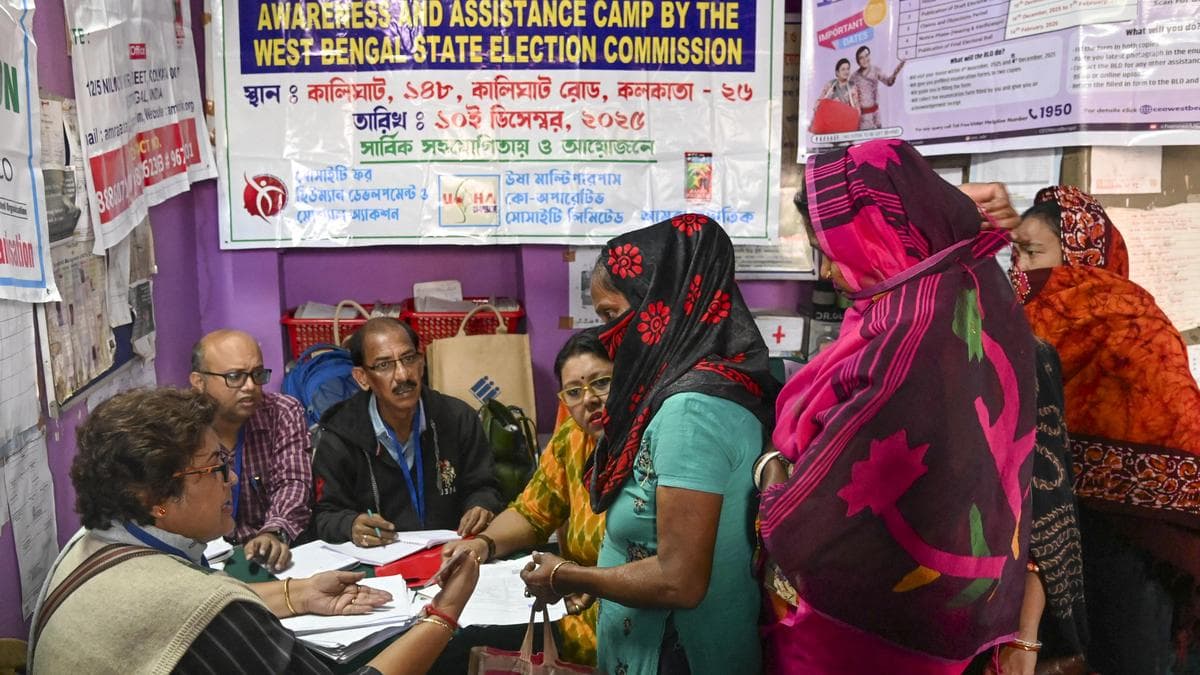
West Bengal begins hearings for 32 lakh 'unmapped' voters on Dec 27; CAA certificates valid for applications.
Summary
West Bengal will commence hearings for 32 lakh 'unmapped' electors on December 27, across 3,234 desks, as part of the Special Summary Revision of electoral rolls. This process is significant as the Chief Electoral Officer has clarified that citizenship certificates obtained under the CAA can be used for new voter applications, highlighting the intersection of electoral law and recent citizenship legislation for competitive exams.
Key Points
- 1West Bengal to initiate hearings for 32 lakh 'unmapped' electors starting December 27.
- 2The hearings are part of the Special Summary Revision (SSR) of electoral rolls.
- 33,234 desks will be set up across the state to conduct these hearings.
- 4Citizenship certificates obtained under the Citizenship Amendment Act (CAA) can be submitted for new voter applications.
- 5This clarification was provided by the Chief Electoral Officer (CEO) of West Bengal.
In-Depth Analysis
The news regarding West Bengal's Special Summary Revision (SSR) for 32 lakh 'unmapped' electors, particularly the Chief Electoral Officer's (CEO) clarification on using Citizenship Amendment Act (CAA) certificates for voter applications, is a crucial development with significant implications for India's democratic process and citizenship landscape. This event intertwines electoral law, constitutional provisions, and recent political legislation, making it highly relevant for competitive exam aspirants.
**Background Context and What Happened:**
Electoral roll revision is a fundamental exercise undertaken by the Election Commission of India (ECI) to ensure the accuracy and currency of voter lists. This process typically involves adding new eligible voters, deleting deceased or shifted voters, and correcting errors. The term 'unmapped' electors generally refers to individuals whose names exist on the electoral rolls but whose geographical location or polling station mapping might be unclear or incorrect, making it difficult for them to cast their vote efficiently. The Special Summary Revision (SSR) is an intensive, time-bound exercise to update these rolls. West Bengal's announcement to commence hearings for 32 lakh such electors from December 27, across 3,234 dedicated desks, signals a large-scale effort to rectify these discrepancies before upcoming elections. The pivotal aspect, however, is the CEO's explicit statement that citizenship certificates obtained under the Citizenship Amendment Act (CAA) can be submitted for new voter applications. This directly links the electoral process to the controversial CAA, 2019, which seeks to grant Indian citizenship to persecuted religious minorities (Hindus, Sikhs, Buddhists, Jains, Parsis, and Christians) who migrated to India from Bangladesh, Pakistan, and Afghanistan before December 31, 2014.
**Key Stakeholders Involved:**
Several key players are central to this development. The **Election Commission of India (ECI)**, through the **Chief Electoral Officer (CEO) of West Bengal**, is the primary constitutional body responsible for the superintendence, direction, and control of the preparation of electoral rolls and the conduct of elections (Article 324). Their role is to ensure a free, fair, and accurate electoral process. **Political parties** in West Bengal, especially the ruling Trinamool Congress and the opposition BJP, are significant stakeholders, as the accuracy and composition of electoral rolls directly impact their electoral prospects. The inclusion or exclusion of a large number of voters based on CAA could potentially alter the political landscape. The **citizens/electors** themselves, particularly the 32 lakh 'unmapped' individuals and those seeking citizenship under CAA, are directly affected, as their right to vote and their citizenship status are at stake. Finally, the **Union Government** and the **State Government** play roles in policy formulation (like CAA) and administrative support, respectively.
**Significance for India and Historical Context:**
This development holds profound significance for India. Firstly, it underscores the **integrity of the democratic process**. Accurate electoral rolls are the bedrock of fair elections and universal adult franchise (Article 326). Rectifying 'unmapped' electors ensures that every eligible citizen can exercise their right to vote. Secondly, it marks a practical implementation phase of the **Citizenship Amendment Act (CAA)**, a law that has been a subject of intense national debate since its enactment in December 2019. The ECI's clarification provides a clear pathway for new citizens under CAA to register as voters, integrating them into the electoral system. This is particularly relevant in West Bengal, a state bordering Bangladesh, which has historically witnessed significant migration and has been a hotbed for discussions around citizenship, the National Register of Citizens (NRC), and the CAA. The historical context includes India's long-standing challenges with undocumented migration, especially from Bangladesh, and the political sensitivity surrounding these issues, which peaked with the NRC exercise in Assam and the nationwide protests against CAA.
**Future Implications and Constitutional/Policy References:**
The immediate future implications include the successful completion of the SSR, potentially leading to a more accurate and updated electoral roll in West Bengal for upcoming elections, including the 2024 Lok Sabha elections. The inclusion of new voters through CAA certificates could have a tangible impact on the demographic composition of voters in certain constituencies, which will be closely watched by political parties. This could also set a precedent for other states where CAA implementation is underway. However, the process might also face legal challenges or political controversies, especially from groups opposing the CAA, who might question the validity or fairness of such inclusions. This situation highlights the importance of several constitutional articles and acts:
* **Article 324 of the Constitution**: Grants the Election Commission of India the power to superintend, direct, and control the preparation of electoral rolls and the conduct of all elections to Parliament and state legislatures.
* **Article 326 of the Constitution**: Establishes universal adult franchise, stating that elections to the House of the People and to the Legislative Assembly of every State shall be on the basis of adult suffrage.
* **Representation of the People Act, 1950**: Deals with the preparation and revision of electoral rolls, qualifications of voters, and delimitation of constituencies.
* **Representation of the People Act, 1951**: Governs the actual conduct of elections, administrative machinery for elections, and election disputes.
* **Citizenship Act, 1955**: The principal legislation governing Indian citizenship, which has been amended multiple times, most recently by the **Citizenship (Amendment) Act, 2019 (CAA)**. The CAA provides a specific pathway to citizenship for certain communities and its operationalization directly impacts voter eligibility.
This event connects to broader themes of governance, federalism (ECI's role independent of state government), and the ongoing evolution of India's citizenship policy. It underscores the dynamic interplay between law, policy, and democratic practice, making it a critical topic for in-depth understanding for any competitive exam aspirant.
Exam Tips
This topic primarily falls under 'Indian Polity and Governance' (UPSC GS-II, State PSCs) and 'General Awareness' (SSC, Banking, Railways). Focus on the functions and powers of the Election Commission of India (Article 324) and the provisions related to citizenship.
Study the Citizenship Act, 1955, and specifically the Citizenship (Amendment) Act, 2019 (CAA) in detail. Understand its provisions, the rationale behind it, and the criticisms it has faced. Also, review the Representation of the People Act, 1950 and 1951, focusing on electoral roll preparation.
Common question patterns include factual questions on constitutional articles (e.g., Article 324, 326), dates of acts (e.g., CAA 2019), and the composition/powers of the ECI. Analytical questions may ask about the impact of the CAA on electoral rolls, the challenges in maintaining accurate voter lists, or the significance of universal adult franchise.
Related Topics to Study
Full Article
Hearings to start across 3,234 desks across the State; citizenship certificates obtained under CAA can be submitted for new voter applications, CEO says