
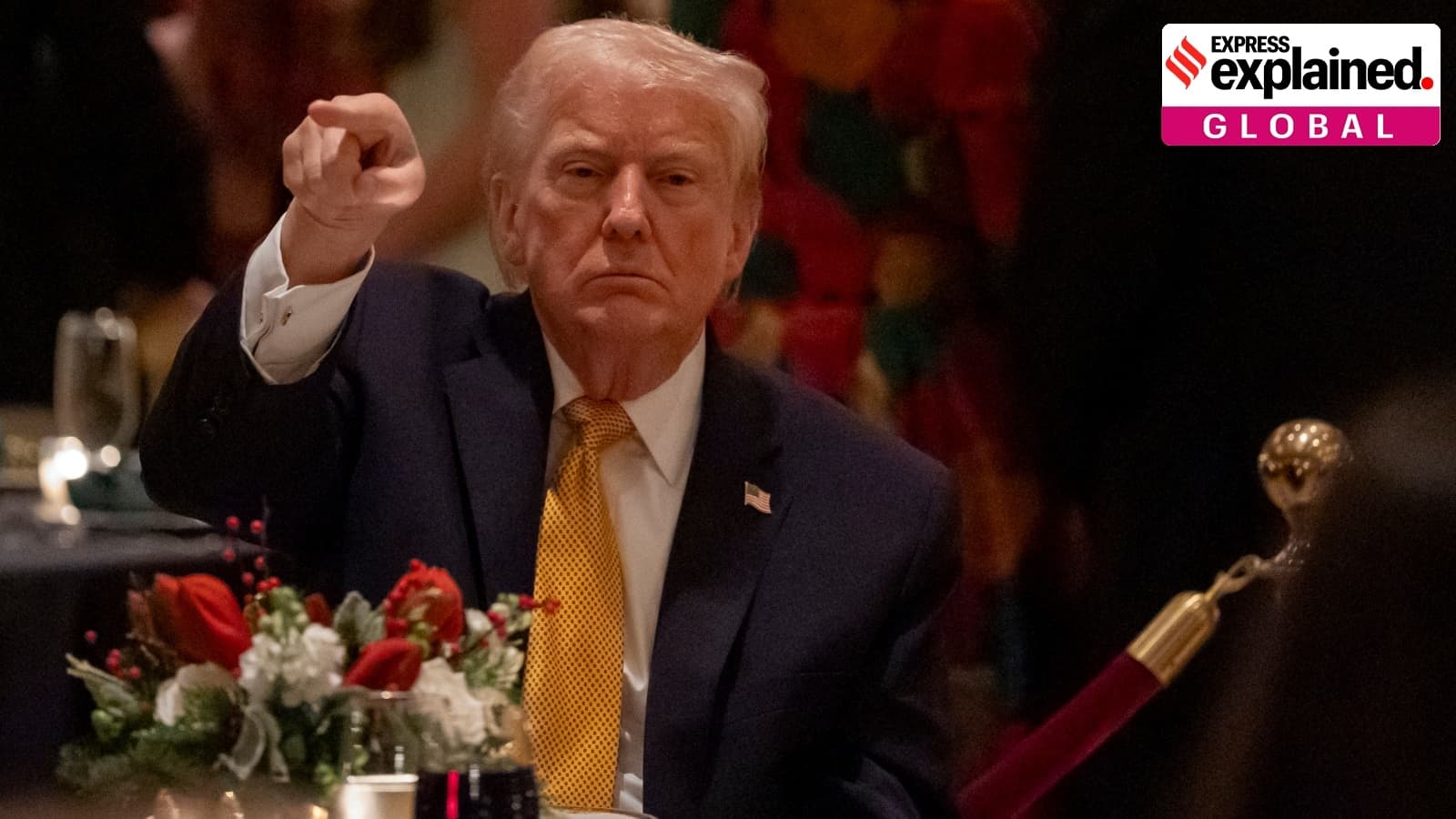

Content unavailable for 'Trump orders strikes on Nigeria' article, preventing analysis.
Summary
No content was provided for the article titled 'Trump orders strikes on Nigeria: Is the African country witnessing the persecution of Christians?'. Consequently, a detailed analysis, identification of key events, their significance, or specific facts for competitive exam preparation is not possible due to the absence of text.
Key Points
- 1The provided article explicitly states 'No content available'.
- 2Specific facts, dates, names, numbers, or percentages cannot be extracted.
- 3Analysis of the 'Trump orders strikes on Nigeria' topic is impossible without content.
- 4No exam-relevant information can be identified or summarized from the given input.
- 5The request cannot be fully processed due to the absence of article text.
In-Depth Analysis
The article title, "Trump orders strikes on Nigeria: Is the African country witnessing the persecution of Christians?", presents a complex scenario, even without specific content to elaborate on the alleged 'strikes'. This title immediately brings to the forefront critical themes in international relations: state sovereignty, counter-terrorism, humanitarian intervention, religious freedom, and the geopolitical interests of major global powers. For competitive exam aspirants, understanding the implications of such a headline requires a deep dive into the background of Nigeria's internal conflicts, US foreign policy objectives, and the broader context of religious persecution.
Nigeria, Africa's most populous nation and largest economy, has been grappling with severe internal security challenges for decades. The most prominent among these is the Islamist extremist group Boko Haram, which emerged in the early 2000s and escalated its insurgency in 2009, aiming to establish an Islamic state. Boko Haram, and its splinter faction, the Islamic State West Africa Province (ISWAP), have been responsible for widespread violence, abductions (most notably the Chibok girls in 2014), and displacement, primarily targeting government institutions, civilians, and often, Christian communities and moderate Muslims. Beyond these groups, Nigeria also faces significant ethno-religious conflicts, particularly between predominantly Christian farmers and largely Muslim Fulani herders, especially in the country's Middle Belt region. These clashes, often over land and resources, frequently take on a religious dimension, contributing to a narrative of Christian persecution.
The implied 'Trump orders strikes on Nigeria' suggests a potential unilateral military action by the United States. Under President Trump, US foreign policy often emphasized counter-terrorism, protecting religious minorities, and a more assertive stance against perceived threats. Such strikes, if they had occurred, would likely have been justified by the US as targeting terrorist groups like Boko Haram or ISWAP, or potentially as a humanitarian intervention to protect persecuted populations. Key stakeholders in such a scenario would include the Nigerian Federal Government and its military, the US administration (President, State Department, Pentagon), the affected Christian and Muslim communities in Nigeria, international human rights organizations, and regional bodies like the African Union and ECOWAS. The legality and legitimacy of unilateral strikes without the explicit consent of the host nation or a UN Security Council resolution would invariably spark international debate, touching upon principles of national sovereignty and international law.
For India, this topic holds significant relevance. Firstly, India maintains robust economic and strategic ties with Nigeria, a major oil supplier and a significant trading partner. Any instability in Nigeria, exacerbated by foreign intervention or escalating internal conflict, could impact India's energy security and economic interests. Secondly, India has a substantial diaspora in Nigeria, whose safety and well-being would be a primary concern. Thirdly, India's foreign policy is rooted in multilateralism, non-intervention, and respect for national sovereignty. While India is a strong proponent of counter-terrorism cooperation, it generally advocates for actions that respect international law and the sovereignty of nations. The narrative of religious persecution also resonates in India, a secular nation with constitutional provisions guaranteeing religious freedom (Articles 25-28). India often highlights its commitment to protecting minorities and promoting communal harmony, and would likely view with concern any situation involving widespread persecution of any religious group, while also being cautious about foreign interventions based on such pretexts.
Historically, US involvement in counter-terrorism in Africa has ranged from intelligence sharing and training to drone strikes, often in cooperation with local governments. However, direct 'strikes' as implied in the title would represent a significant escalation. The future implications of such actions could be profound: they could either destabilize Nigeria further by fueling anti-Western sentiment and potentially empowering extremist narratives, or, if carefully executed and coordinated, could theoretically degrade terrorist capabilities. However, military solutions rarely address the root causes of conflict, which often include poverty, governance failures, and historical grievances. The debate over sovereignty versus the responsibility to protect (R2P) would also be reignited. For India, continued engagement with Nigeria and African nations, advocating for peaceful resolution, capacity building, and supporting regional stability through forums like the African Union and the UN, would remain critical. India's own constitutional framework, particularly Article 51, which promotes international peace and security and respect for international law, guides its diplomatic approach to such complex global challenges.
In essence, while the specific 'strikes' remain unconfirmed by the article content, the headline provides a potent lens through which to examine the intricate web of global security, human rights, and geopolitical power dynamics, all crucial for an aspirant's understanding of contemporary international relations.
Exam Tips
This topic falls under GS Paper 2 (International Relations and Polity) and GS Paper 3 (Internal Security, Economy). Focus on US-Africa relations, India-Africa ties, challenges to internal security in Nigeria, and the concept of religious freedom.
Study related topics like the origin and evolution of Boko Haram/ISWAP, the geopolitics of the Sahel region, the concept of humanitarian intervention vs. sovereignty, and the role of the UN in conflict resolution. Understand India's 'Look Africa' policy.
Expect questions on the impact of terrorism on regional stability, the role of external powers in internal conflicts, the challenges of religious extremism, and India's stance on non-intervention and multilateralism. MCQs might focus on specific groups, countries, or constitutional articles (e.g., Articles 25-28, Article 51).
Analyze the ethical dilemmas involved in foreign military interventions, especially when framed around protecting religious minorities. Understand the potential for such interventions to be perceived as neo-colonialism or to exacerbate existing conflicts.