


Relevant for Exams
Hyderabad's rainwater harvesting efforts face apathy and upkeep issues despite HMWSSB's push for aquifer recharge.
Summary
Hyderabad Metropolitan Water Supply & Sewerage Board (HMWSSB) is implementing citywide rainwater harvesting to replenish aquifers and reduce reliance on water tankers. This initiative is crucial for urban water security and sustainable resource management in Hyderabad. However, the efforts face significant challenges from cultural apathy, poor upkeep, and fragmented community participation, highlighting hurdles in achieving a water-secure future.
Key Points
- 1The Hyderabad Metropolitan Water Supply & Sewerage Board (HMWSSB) is rolling out citywide rainwater harvesting.
- 2The primary goal of the rainwater harvesting initiative is to refill aquifers in Hyderabad.
- 3Another key objective is to curb the city's dependence on water tankers.
- 4Challenges threatening the efforts include cultural apathy, poor upkeep, and fragmented community action.
- 5The initiative addresses urban water security in Hyderabad through sustainable water management practices.
In-Depth Analysis
Hyderabad, a burgeoning metropolis and a major IT hub, finds itself at a critical juncture in its quest for water security. The article highlights a significant initiative by the Hyderabad Metropolitan Water Supply & Sewerage Board (HMWSSB) to implement citywide rainwater harvesting (RWH). This move is not merely a technical fix but a strategic shift towards sustainable urban water management, necessitated by decades of unsustainable practices and rapid demographic expansion.
**Background Context and Historical Perspective:**
India, historically, has a rich tradition of water conservation, with diverse indigenous RWH structures like 'baolis' and 'talaabs'. However, the post-independence era, marked by rapid industrialization and urbanization, saw a shift towards large-scale, centralised water supply systems, often neglecting traditional methods and local water bodies. Hyderabad, like many Indian cities, has experienced exponential growth. Its population surged from around 4 million in 2001 to over 10 million today. This demographic explosion, coupled with the city's transformation into a global IT and pharmaceutical hub, has placed immense strain on its natural resources, particularly water. The city historically relied on its numerous lakes, but many have been encroached upon or polluted. This led to increasing dependence on distant river sources like the Krishna and Godavari, through massive and expensive projects, making the water supply vulnerable to inter-state disputes and climate variability. Groundwater, once a reliable source, has been severely over-exploited, leading to drastic declines in water tables and increased reliance on private water tankers, creating an unregulated and often exploitative market.
**The Initiative and Key Objectives:**
The HMWSSB's citywide RWH initiative is a direct response to this looming water crisis. The primary goals are two-fold: first, to replenish the city's depleted aquifers, thereby improving groundwater levels; and second, to significantly reduce the city's heavy dependence on water tankers, which are costly, inefficient, and contribute to carbon emissions. By promoting RWH at individual household, community, and institutional levels, HMWSSB aims to create a decentralised, resilient water supply system. However, the article correctly identifies critical challenges: 'cultural apathy', 'poor upkeep', and 'fragmented community action'. These are not mere operational hurdles but deep-seated societal issues that often plague public utility projects in India. A lack of ownership, inadequate maintenance culture, and difficulties in mobilising collective action can undermine even the best-intentioned policies.
**Key Stakeholders Involved:**
Several key stakeholders are central to the success of this initiative. The **Hyderabad Metropolitan Water Supply & Sewerage Board (HMWSSB)** is the primary implementing agency, responsible for policy formulation, technical guidance, and potentially financial incentives. **Citizens and communities** are perhaps the most crucial stakeholders; their active participation in constructing, maintaining, and utilising RWH structures is paramount. Their 'cultural apathy' and 'fragmented action' represent significant barriers. **Local municipal bodies** play a role in integrating RWH into urban planning and building codes. **Private water tanker operators** represent an interesting stakeholder group; while their services are currently essential, a successful RWH program would inevitably reduce their business, potentially leading to resistance. **Environmental NGOs and research institutions** can also play a vital role in advocacy, awareness generation, and providing technical expertise.
**Significance for India:**
Hyderabad's journey towards a water-secure future holds immense significance for India. It serves as a microcosm of the broader urban water crisis facing numerous Indian cities. A successful RWH model in Hyderabad could provide a blueprint for other urban centres struggling with similar challenges of rapid urbanization, groundwater depletion, and climate change impacts. This initiative aligns directly with **Sustainable Development Goal (SDG) 6: Clean Water and Sanitation**, which calls for ensuring availability and sustainable management of water and sanitation for all. Furthermore, it represents a crucial climate change adaptation strategy, enhancing urban resilience against erratic rainfall patterns and prolonged dry spells. The emphasis on decentralised, community-led water management is a vital shift from the traditional top-down approach, promoting local ownership and resource efficiency, which is essential for India's diverse geography and socio-economic landscape.
**Constitutional and Policy Framework:**
Water management in India operates within a robust, albeit complex, constitutional and policy framework. Under the **Seventh Schedule of the Indian Constitution**, 'Water' (Entry 17) is primarily a **State Subject** (List II), meaning state governments have the primary responsibility for water supply, irrigation, canals, drainage, and embankments. However, the Union government can regulate inter-state rivers and river valleys (Entry 56, List I). The **right to clean water** has been interpreted by the Supreme Court as an integral part of the **right to life under Article 21**. Policy-wise, the **National Water Policy (2012)** explicitly advocates for rainwater harvesting and artificial recharge of groundwater. More recently, the Union government launched the **Jal Shakti Abhiyan: Catch the Rain campaign** in 2021, specifically urging states and stakeholders to create and maintain RWH structures. The **Model Building Bye-Laws, 2016**, issued by the Ministry of Housing and Urban Affairs, also mandate RWH systems in new constructions for various categories of buildings, providing a legal impetus at the local level. The **Atal Bhujal Yojana (ABHY)**, launched in 2019, focuses on community-led sustainable groundwater management, further underscoring the shift towards participatory approaches.
**Future Implications:**
The success of Hyderabad's RWH initiative will hinge on its ability to overcome the identified challenges. If successful, it could catalyse a paradigm shift in urban water governance across India, demonstrating the efficacy of decentralised, nature-based solutions. This would lead to enhanced urban resilience, reduced expenditure on distant water projects, and improved environmental sustainability. Failure, however, would underscore the difficulties in behavioural change and community mobilisation, potentially reinforcing reliance on unsustainable practices. Future efforts will need sustained public awareness campaigns, robust enforcement of RWH mandates, innovative financial incentives, and effective mechanisms for monitoring and maintenance to ensure long-term viability. Integrating RWH with smart water management technologies could also play a crucial role, providing real-time data on groundwater levels and RWH system performance. The long road to a water-secure future for Hyderabad, and indeed for India, requires not just infrastructure, but a profound shift in mindset and collective responsibility.
Exam Tips
This topic falls under GS-I (Geography - Water Resources), GS-II (Governance, Policies & Interventions), and GS-III (Environment & Sustainable Development) for UPSC. For SSC/State PSCs, it's relevant for General Awareness sections on Indian Geography, Environment, and Government Schemes.
When studying, connect this to broader themes like urbanization challenges, climate change adaptation, sustainable development goals (SDG 6), and the concept of 'water as a state subject' under the Indian Constitution. Understand the evolution of India's water policies.
Common question patterns include: direct questions on government schemes (e.g., Jal Shakti Abhiyan, Atal Bhujal Yojana), analytical questions on urban water crisis and solutions, essay topics on sustainable water management, and case studies on community participation in resource management. Be prepared to discuss both the benefits and challenges of RWH.
Focus on specific constitutional articles (Article 21, Seventh Schedule - State List Entry 17), national policies (National Water Policy 2012), and key initiatives (Jal Jeevan Mission, Jal Shakti Abhiyan, Atal Bhujal Yojana) related to water management and conservation.
Related Topics to Study
Full Article
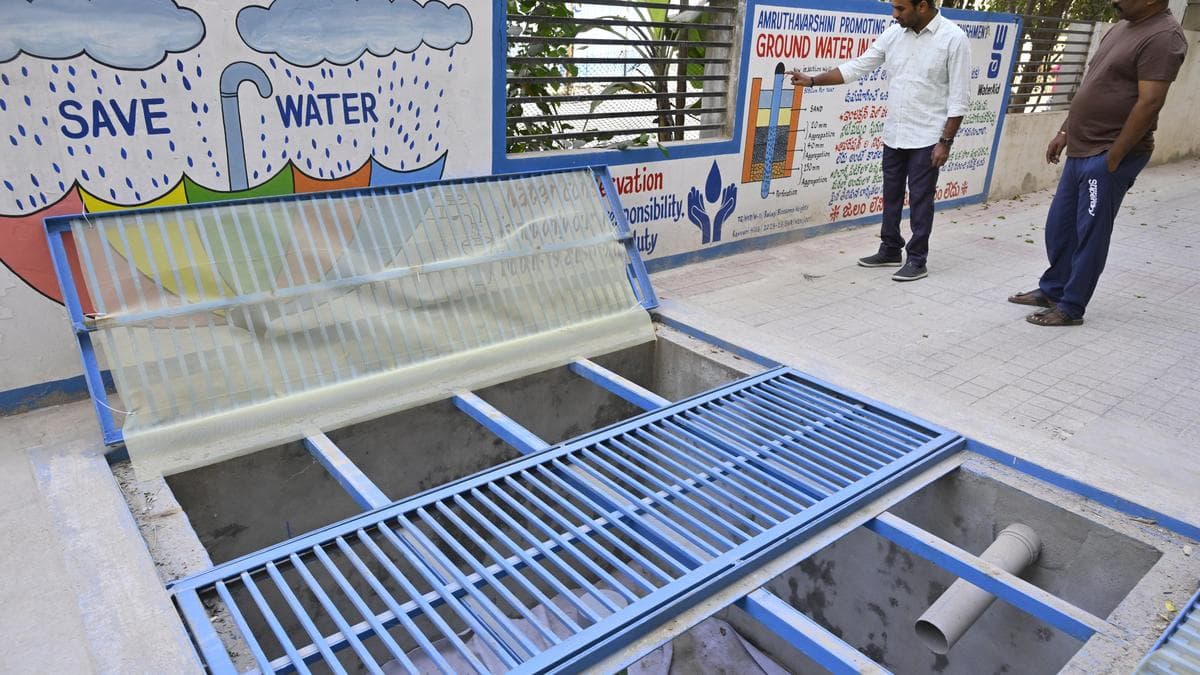
Hyderabad is chasing rain, literally. With the Hyderabad Metropolitan Water Supply & Sewerage Board rolling out citywide rainwater harvesting, the goal is to refill aquifers and curb dependence on tankers. But cultural apathy, poor upkeep and fragmented community action threaten to drain these efforts dry, finds B. Pradeep