


Relevant for Exams
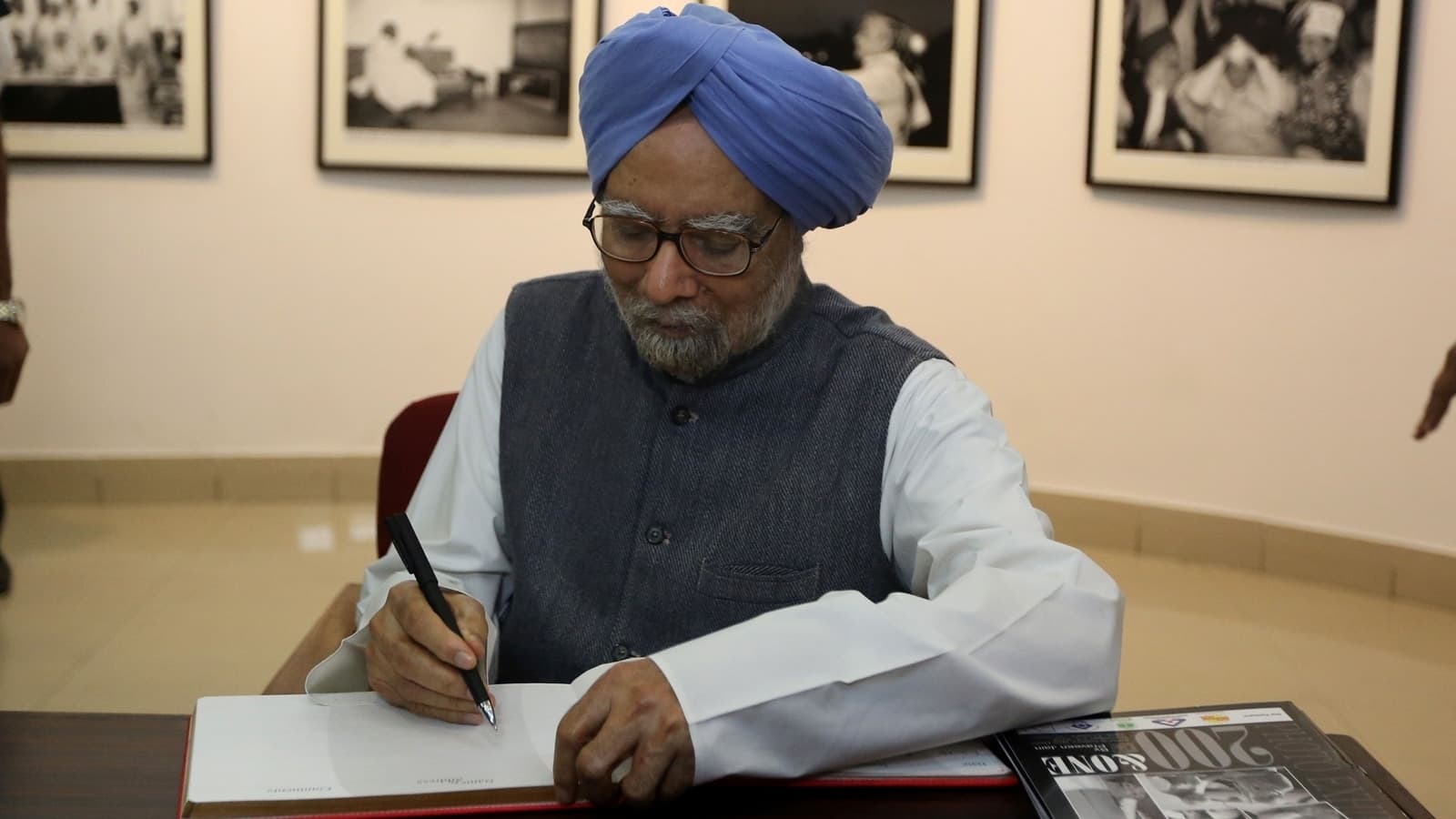
Leaders pay tribute on former PM Manmohan Singh's first death anniversary.
Summary
The news highlights the first death anniversary of former Prime Minister Manmohan Singh, with leaders from various political parties paying tributes. This event underscores his significant contributions to India's economic reforms and political landscape. For competitive exams, it's crucial to recall his tenure, key policies, and constitutional roles as a prominent national figure.
Key Points
- 1Manmohan Singh served as India's 13th Prime Minister for two consecutive terms from 2004 to 2014.
- 2He is widely recognized as the architect of India's 1991 economic reforms, serving as Finance Minister under P.V. Narasimha Rao.
- 3He held the position of Finance Minister from 1991 to 1996, initiating significant liberalization policies.
- 4He was a long-serving member of the Rajya Sabha, representing Assam for five terms from 1991 to 2019.
- 5Manmohan Singh was awarded the Padma Vibhushan, India's second-highest civilian honour, in 1999.
In-Depth Analysis
The first death anniversary of former Prime Minister Manmohan Singh serves as a poignant reminder of a pivotal figure in modern Indian history whose contributions profoundly reshaped the nation's economic and political landscape. His legacy is inextricably linked to India's transformation from a relatively closed, socialist-leaning economy to a global economic powerhouse. Understanding his tenure and policies is crucial for any competitive exam aspirant.
**Background to a Paradigm Shift: The 1991 Economic Crisis**
India in the late 1980s and early 1990s faced an unprecedented economic crisis. Decades of a 'License Raj' regime, characterized by extensive state control, protectionist policies, and inward-looking development strategies, had led to inefficiencies, slow growth, and limited foreign investment. The situation reached a critical point in 1991 with a severe balance of payments crisis. Foreign exchange reserves plummeted to a level barely sufficient for three weeks of imports, inflation was rampant, and the fiscal deficit was unsustainably high. India was on the brink of defaulting on its international obligations, prompting the government to pledge its gold reserves to secure emergency loans from the International Monetary Fund (IMF) and the World Bank. This dire situation necessitated a radical departure from past economic policies.
**The Architect of Reforms: Finance Minister (1991-1996)**
It was against this backdrop that P.V. Narasimha Rao, as Prime Minister, made a historic decision to appoint Manmohan Singh, a technocrat and economist with a distinguished career in the Reserve Bank of India and various government ministries, as his Finance Minister. Singh, along with Rao, spearheaded the landmark 1991 economic reforms. These reforms included significant industrial deregulation, dismantling the 'License Raj,' opening the economy to foreign investment, trade liberalization through tariff reductions, and financial sector reforms. His famous budget speech in 1991, stating "No power on earth can stop an idea whose time has come," signaled a new era. These policies, often referred to as the Liberalization, Privatization, and Globalization (LPG) reforms, fundamentally altered India's economic trajectory, paving the way for sustained high growth rates and integrating India into the global economy.
**Leadership as Prime Minister (2004-2014)**
Manmohan Singh's role continued to evolve when he became India's 13th Prime Minister in 2004, serving two consecutive terms until 2014. His premiership was characterized by efforts to sustain economic growth while focusing on inclusive development. Key policy initiatives during his tenure included the Mahatma Gandhi National Rural Employment Guarantee Act (MGNREGA, 2005), which provided a legal guarantee for 100 days of wage employment in rural areas; the Right to Information Act (RTI, 2005), enhancing transparency and accountability; and the National Food Security Act (NFSA, 2013), aiming to provide subsidized food grains to a large portion of the population. On the foreign policy front, a significant achievement was the India-US Civil Nuclear Agreement (2008), which ended India's nuclear isolation and opened avenues for civil nuclear cooperation. Despite facing global economic challenges like the 2008 financial crisis and domestic issues such as inflation and allegations of policy paralysis towards the end of his second term, his government oversaw substantial economic expansion and implemented critical social welfare legislation.
**Key Stakeholders and Significance for India**
Beyond Manmohan Singh himself, key stakeholders included Prime Minister P.V. Narasimha Rao, who provided the political will; the Indian National Congress party, which formed the government; the bureaucracy and the Reserve Bank of India, responsible for implementation; and international bodies like the IMF, which played a catalytic role. The significance of his contributions for India is immense. Economically, he laid the foundation for India's rapid growth, reduced poverty, and transformed India into a significant player in the global economy. Politically, his quiet demeanor often masked a strong resolve, and he navigated complex coalition politics. Socially, his focus on inclusive growth through flagship programs aimed to bridge disparities, though challenges persist.
**Constitutional and Policy References**
Manmohan Singh's career touched upon several constitutional and policy aspects. As Finance Minister, he was responsible for presenting the Union Budget (Annual Financial Statement as per **Article 112** of the Constitution) to Parliament. His role as Prime Minister and Finance Minister falls under the executive powers defined in **Articles 74 and 75** concerning the Council of Ministers. His long tenure as a member of the Rajya Sabha (representing Assam for five terms) highlights the importance of the upper house in India's parliamentary democracy. The 1991 economic liberalization policies, while not a single constitutional amendment, represented a monumental shift in state policy. Furthermore, landmark acts like MGNREGA, RTI, and NFSA are crucial legislative achievements under his premiership, demonstrating the state's role in social welfare and governance.
**Future Implications**
Manmohan Singh's legacy continues to influence India's policy discourse. The debate over the balance between economic liberalization and state intervention, the pursuit of inclusive growth, and India's role in global affairs are ongoing themes. His reforms set a precedent for future governments to continue structural adjustments while striving for social equity. India's aspirations to become a 5 trillion-dollar economy and a leading global power are direct continuations of the path he helped forge, emphasizing the need for continued reforms, investment in human capital, and robust governance frameworks.
Exam Tips
**Syllabus Section & Focus**: This topic primarily falls under 'Indian Economy' (for 1991 reforms, economic policies, fiscal/monetary policy) and 'Indian Polity & Governance' (for PM's role, constitutional articles, major acts like RTI, MGNREGA). Be prepared for questions on both aspects.
**Related Topics to Study Together**: Link Manmohan Singh's tenure to the 'Balance of Payments Crisis of 1991', the 'LPG Reforms (Liberalization, Privatization, Globalization)', the evolution of 'Planning Commission to NITI Aayog', and major 'Social Sector Schemes' (MGNREGA, NFSA). Also, study the 'Role of the Prime Minister and Council of Ministers' in detail.
**Common Question Patterns**: Expect MCQs on specific dates (e.g., year of 1991 reforms, year of MGNREGA), key policies, constitutional articles related to the executive or finance, and awards (Padma Vibhushan). For descriptive exams, questions might focus on the 'impact of 1991 reforms on India's economy' or 'Manmohan Singh's contribution to inclusive growth' or 'challenges faced during his premiership'.