


Relevant for Exams
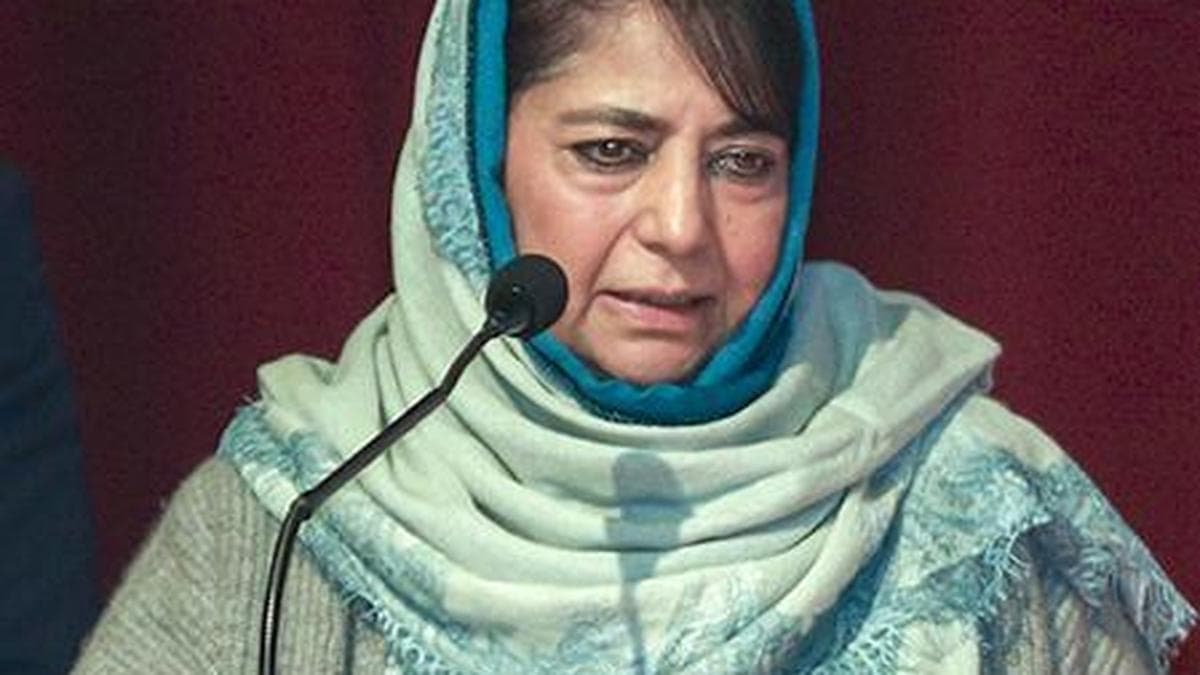
Mehbooba criticizes J&K HC order on undertrials' repatriation, calls court 'last resort'.
Summary
Mehbooba Mufti expressed surprise and disappointment regarding a Jammu & Kashmir High Court order related to a Public Interest Litigation (PIL) concerning undertrials. She emphasized that the court was her last resort to ensure that undertrials, particularly those without serious charges, are brought back to Kashmir. This highlights ongoing issues of judicial oversight, human rights for detainees, and the political situation in J&K, relevant for governance and polity sections in competitive exams.
Key Points
- 1The statement was made by Mehbooba Mufti, former Chief Minister of Jammu and Kashmir.
- 2The criticism is directed at an order issued by the Jammu and Kashmir High Court.
- 3The court order pertains to a Public Interest Litigation (PIL).
- 4The PIL specifically concerns the repatriation of undertrials, particularly those without serious charges, back to Kashmir.
- 5Mufti highlighted the court's role as the "last resort" for ensuring justice for these undertrials.
In-Depth Analysis
The statement by Mehbooba Mufti, former Chief Minister of Jammu and Kashmir, expressing surprise and disappointment over a J&K High Court order related to a Public Interest Litigation (PIL) concerning undertrials, particularly those without serious charges, highlights critical issues at the intersection of human rights, judicial oversight, and the complex political landscape of the region. Her emphasis on the court being the "last resort" underscores a perceived failure in upholding justice for detainees.
**Background Context: The Post-370 Scenario and Detentions in J&K**
Jammu and Kashmir has a long history of political instability, insurgency, and the use of stringent security measures. The situation escalated significantly after August 5, 2019, when the Government of India abrogated Article 370, which granted special status to J&K, and reorganized the state into two Union Territories: Jammu and Kashmir, and Ladakh. This constitutional change was accompanied by an unprecedented security lockdown, communication blackouts, and mass arrests of political leaders, activists, and ordinary citizens. Many individuals were detained under the Public Safety Act (PSA), 1978, a preventive detention law that allows for detention without trial for up to two years. A significant number of these detainees, including many undertrials, were subsequently shifted to prisons outside J&K, citing security concerns or lack of adequate facilities within the Union Territory. This mass transfer of prisoners raised concerns about their access to legal aid, family visits, and fair trial proceedings, as their cases would often be heard in J&K courts while they were incarcerated thousands of kilometers away.
**The Specific Incident: A PIL and Judicial Scrutiny**
The news article refers to Mehbooba Mufti's reaction to a specific J&K High Court order concerning a PIL. While the exact details of the PIL and the court's order are not provided in the summary, Mufti's statement clearly indicates that the order was not favorable to the plea for repatriating undertrials back to Kashmir. PILs are a crucial mechanism for the judiciary to address public grievances and protect fundamental rights, especially for marginalized or vulnerable groups. In this instance, the PIL likely sought judicial intervention to ensure that undertrials, particularly those facing minor charges or prolonged detention without conviction, are brought back to their home region, facilitating their legal representation and family contact.
**Key Stakeholders and Their Roles**
1. **Mehbooba Mufti**: As a prominent political leader and former Chief Minister, she represents a significant voice advocating for the rights of Kashmiris. Her statement reflects the concerns of civil society and families of detainees regarding the judicial process and human rights in J&K. Her reference to the court as a "last resort" highlights a perceived lack of alternative avenues for redressal.
2. **Jammu & Kashmir High Court**: The judiciary is a critical pillar of democracy, responsible for upholding the rule of law and safeguarding fundamental rights. Its decisions, especially on PILs, have far-reaching implications. In J&K, the High Court plays an especially sensitive role in balancing national security imperatives with individual liberties.
3. **Undertrials**: These are individuals awaiting trial or whose trials are ongoing. They are presumed innocent until proven guilty and possess fundamental rights, including the right to a speedy trial, legal representation, and humane treatment. Their plight is central to the issue.
4. **J&K Administration/Union Government**: Responsible for maintaining law and order, administering prisons, and ensuring justice. Their policies regarding detentions, transfers, and legal processes directly impact the rights of undertrials.
**Why This Matters for India's Democratic Fabric**
This incident is significant for several reasons. Firstly, it touches upon the **Rule of Law** and **Access to Justice**. The ability of citizens, particularly those detained, to access legal recourse and have their cases heard fairly and promptly is a cornerstone of any democratic society. The transfer of undertrials to distant jails can severely impede this access. Secondly, it raises questions about **Human Rights and Fundamental Rights**. Article 21 of the Indian Constitution guarantees the Protection of Life and Personal Liberty, which includes the right to a fair and speedy trial, and humane treatment in custody. Article 22 provides safeguards against arbitrary arrest and detention. The prolonged detention of undertrials, especially those without serious charges, and their incarceration away from home, can be seen as violations of these rights. Thirdly, it underscores the importance of **Judicial Independence and Oversight**. The judiciary's role as a check on executive power is vital, particularly in regions under heightened security measures. A perceived setback in judicial relief can erode public trust in institutions. Lastly, it impacts **Political Stability and Public Trust** in J&K, where addressing grievances related to human rights and justice is crucial for long-term peace and integration.
**Constitutional and Legal Framework**
Several constitutional articles and legal provisions are relevant here:
* **Article 21 (Protection of Life and Personal Liberty)**: Encompasses the right to a fair trial, speedy trial, and humane treatment for prisoners.
* **Article 22 (Protection against arrest and detention in certain cases)**: Mandates that an arrested person be informed of the grounds of arrest, allowed to consult a legal practitioner, and produced before a magistrate within 24 hours.
* **Article 32 and Article 226**: Empower the Supreme Court and High Courts, respectively, to issue writs like *Habeas Corpus* to challenge unlawful detention.
* **Public Safety Act (PSA), 1978 (J&K)**: A controversial preventive detention law that allows detention without charge or trial for extended periods. Its application and constitutionality have been frequently challenged.
* **Criminal Procedure Code (CrPC)**: Governs the procedures for arrest, investigation, bail, and trial. Sections related to production before a magistrate and bail are crucial for undertrials.
* **Prisoners Act, 1900**: Contains provisions for the transfer of prisoners, but such transfers must not infringe upon fundamental rights.
**Broader Implications and the Road Ahead**
This incident connects to broader themes of governance, human rights, and centre-state relations. It highlights the delicate balance between national security and individual liberties, a recurring challenge in regions like J&K. The future implications include continued scrutiny of judicial decisions in J&K, sustained advocacy by political leaders and human rights groups, and potential for further legal challenges regarding the rights of detainees. The handling of undertrials and prisoners' rights will remain a crucial aspect of gauging the human rights situation and the effectiveness of the justice delivery system in the Union Territory. For India, ensuring fair treatment and due process for all citizens, irrespective of their location or political background, is paramount for upholding its democratic values and strengthening its constitutional edifice.
Exam Tips
This topic falls under GS Paper II (Polity & Governance) - particularly 'Indian Constitution - fundamental rights', 'Judiciary', 'Centre-State Relations', and 'Governance issues in Union Territories'. It also touches upon GS Paper III (Internal Security) regarding issues in J&K.
Study related topics like Fundamental Rights (Articles 19, 20, 21, 22), Judicial Review, Public Interest Litigation (PIL), Preventive Detention laws (e.g., PSA, UAPA), Prison Reforms, and the historical and current political status of Jammu & Kashmir after the abrogation of Article 370.
Common question patterns include analytical questions on the balance between national security and individual liberties, the role of the judiciary in protecting fundamental rights in sensitive regions, constitutional provisions related to personal liberty and detention, and the implications of the J&K reorganization for governance and human rights. Be prepared to discuss the merits and demerits of preventive detention laws.
Related Topics to Study
Full Article
She said the court was the last resort for her “to ensure that undertrials who have no serious charges” are brought back to Kashmir