


Relevant for Exams
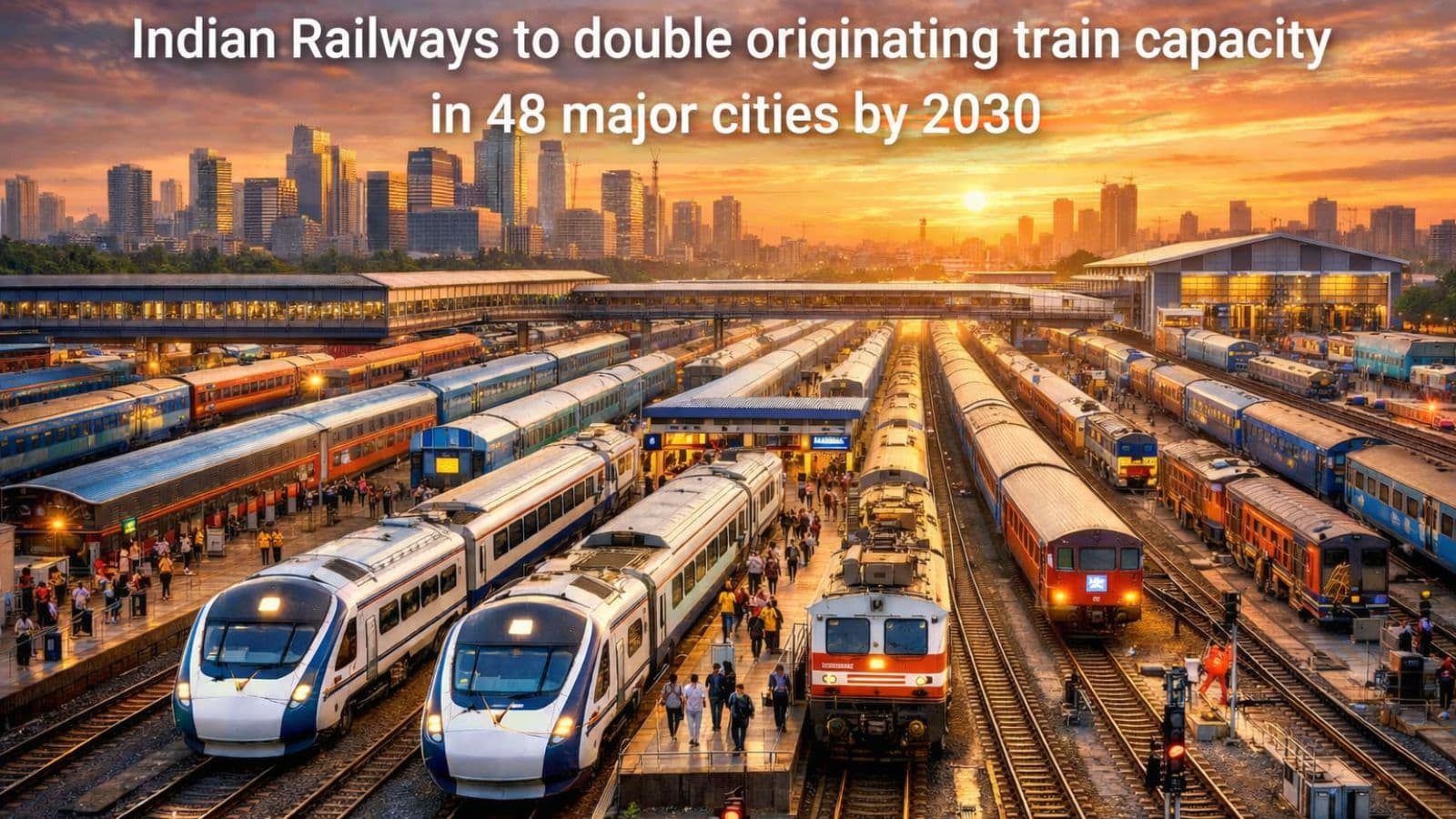
Indian Railways Vision 2030 targets doubling originating train capacity in 48 major cities.
Summary
Indian Railways has unveiled its Vision 2030 plan, aiming to significantly enhance its infrastructure and services. A key objective is to double the originating train capacity across 48 major cities by the year 2030. This initiative is crucial for meeting growing passenger demand, improving operational efficiency, and is highly relevant for competitive exams focusing on government policies and infrastructure development.
Key Points
- 1Indian Railways has launched its strategic long-term plan known as Vision 2030.
- 2A primary goal of Vision 2030 is to double the originating train capacity.
- 3This capacity expansion program specifically targets implementation across 48 major cities.
- 4The ambitious target for achieving this doubling of capacity is set for the year 2030.
- 5The initiative is part of Indian Railways' broader efforts towards infrastructure modernization and service improvement.
In-Depth Analysis
Indian Railways, often referred to as the lifeline of the nation, is one of the world's largest railway networks, playing an indispensable role in India's economic and social fabric. Faced with the twin challenges of burgeoning passenger demand and the need for modern, efficient infrastructure, Indian Railways has unveiled its ambitious 'Vision 2030' plan. A pivotal component of this vision is the commitment to double the originating train capacity in 48 major cities by the year 2030. This initiative is not merely about adding more trains; it signifies a comprehensive upgrade aimed at transforming urban mobility and national connectivity.
The genesis of Vision 2030 lies in the pressing need to address the severe congestion, aging infrastructure, and increasing demand for rail transport across India. With a rapidly urbanizing population, major cities are experiencing unprecedented pressure on their existing transport networks. Indian Railways, despite its vast reach, has struggled to keep pace with the exponential growth in passenger and freight traffic. Issues such as inadequate line capacity, outdated signaling systems, and insufficient terminal infrastructure have led to delays, reduced operational efficiency, and a suboptimal passenger experience. The COVID-19 pandemic further highlighted the need for robust and resilient infrastructure capable of handling emergencies and future growth. Historically, while the Indian Railways network expanded significantly since its inception in 1853, modernization efforts often lagged behind, leading to bottlenecks that Vision 2030 aims to systematically dismantle.
The core objective of doubling originating train capacity in 48 major cities means enhancing the ability of these critical hubs to initiate a greater number of train services. This involves a multi-pronged approach: constructing additional platforms, expanding yard capacities, upgrading signaling and telecommunication systems to allow for closer train spacing, laying new lines, and potentially developing satellite terminals to decongest primary stations. The focus on 'originating' capacity is crucial as these major cities serve as key nodes for regional and long-distance travel, and their ability to dispatch more trains directly impacts the overall network throughput and connectivity.
Key stakeholders in this monumental undertaking include, first and foremost, the **Ministry of Railways** and the **Indian Railways Board**, which are responsible for policy formulation, strategic planning, and execution. **State Governments** and **Urban Local Bodies** are critical partners, especially for land acquisition, last-mile connectivity, and integrating railway development with urban planning. The **passengers and commuters** are the ultimate beneficiaries, experiencing improved service frequency, reduced travel times, and enhanced comfort. **Freight customers**, though not directly targeted by this specific capacity expansion, will indirectly benefit from a more efficient network as passenger and freight operations often share tracks. The **private sector** is also a significant stakeholder, with potential for Public-Private Partnerships (PPPs) in station redevelopment, rolling stock manufacturing, and infrastructure projects, thereby contributing expertise and capital.
This initiative holds profound significance for India. Economically, enhanced rail capacity will bolster logistics and supply chains, supporting the 'Make in India' initiative by facilitating faster movement of goods and raw materials. It will create numerous direct and indirect employment opportunities in construction, manufacturing, and services. Socially, improved connectivity will enhance access to education, healthcare, and job markets, particularly for populations in tier-2 and tier-3 cities connected to these major hubs. Environmentally, a shift from road to rail for long-distance passenger and freight movement will significantly reduce carbon emissions and alleviate road congestion. Politically, efficient infrastructure is a cornerstone of good governance and national integration, connecting diverse regions and fostering a sense of unity.
The constitutional framework for railways in India places it under the **Union List** (Entry 22) of the Seventh Schedule, granting the central government exclusive legislative and executive powers over this sector. This centralized control facilitates large-scale, coordinated projects like Vision 2030. Furthermore, this vision aligns seamlessly with broader government policies such as the **National Rail Plan (NRP) 2030**, which aims to create a 'future-ready' railway system, and the **PM Gati Shakti National Master Plan**, an integrated approach to infrastructure development designed to break departmental silos and accelerate project implementation. The **Railways Act, 1989**, provides the legislative framework for the functioning and operation of Indian Railways.
The future implications of Vision 2030 are transformative. It is expected to fundamentally reshape urban landscapes by making rail transport a more viable and attractive option for daily commutes and inter-city travel. This could lead to a decentralization of urban growth, reducing pressure on mega-cities and fostering development in satellite towns. The increased capacity will pave the way for faster, more reliable services, potentially including semi-high-speed corridors. However, challenges such as securing adequate funding, timely land acquisition, navigating complex urban environments, and ensuring seamless coordination across multiple agencies will be crucial for the successful realization of this ambitious vision. Ultimately, Vision 2030 is a testament to India's commitment to building a modern, sustainable, and inclusive transport network for its growing aspirations.
Exam Tips
This topic falls under GS Paper 3 (Indian Economy: Infrastructure – Railways, Government Policies & Interventions) and GS Paper 1 (Geography: Transport Systems) for UPSC. For SSC/Banking/Railway exams, it's crucial for General Awareness/Current Affairs, often appearing as factual questions.
When studying, focus on the 'why' behind Vision 2030 (challenges faced by Indian Railways), the specific targets (doubling capacity, 48 cities, 2030 deadline), and the broader implications (economic, social, environmental). Link it to other national infrastructure projects.
Common question patterns include: (Prelims) 'What is the target year for Indian Railways Vision 2030?', 'Which constitutional list does Railways fall under?', 'Which cities are targeted for capacity doubling? (though specific list might be too detailed, general understanding is key)'. (Mains) 'Critically analyze the significance of Indian Railways Vision 2030 for India's economic development and urban mobility.', 'Discuss the challenges and opportunities in modernizing Indian Railways infrastructure.'