


Relevant for Exams
SC prods government on Aravalli definition; new norm protects only 100m+ hills from mining, sparks outrage.
Summary
The government's prolonged failure to define the Aravalli mountain range, despite over a year's effort, prompted a Supreme Court threat of contempt proceedings. The subsequent definition, which only protects hills above 100m from mining activities, has ignited significant public outrage. This issue is crucial for competitive exams as it highlights environmental governance, the judiciary's role in conservation, and policy formulation challenges related to critical ecological zones.
Key Points
- 1The Supreme Court threatened contempt proceedings against committee members for failing to define the Aravallis.
- 2The submitted definition protects Aravalli hills only if they are above 100 meters in height.
- 3The protection provided by the definition is specifically against mining activities.
- 4The government's effort to formulate a definition for the Aravallis spanned over a year.
- 5The controversy revolves around the definition and protection of the Aravalli mountain range.
In-Depth Analysis
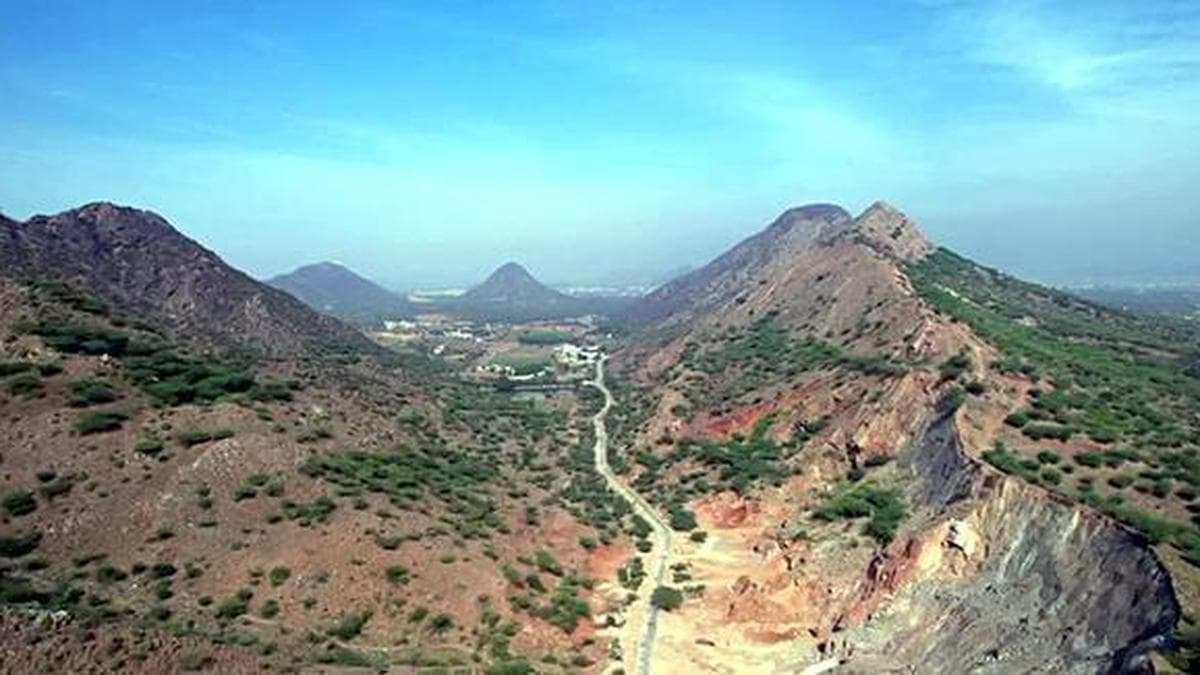
The prolonged failure of the Indian government to definitively delineate the Aravalli mountain range, culminating in a controversial definition, has brought to the forefront critical issues concerning environmental governance, judicial oversight, and sustainable development. The Aravallis, one of the world's oldest fold mountain ranges, stretch approximately 692 km across Gujarat, Rajasthan, Haryana, and Delhi. They are not merely geological formations but vital ecological assets, acting as a natural green barrier against the Thar Desert's expansion, a crucial groundwater recharge zone for the National Capital Region (NCR), and a biodiversity hotspot.
**Background Context and What Happened:**
For decades, the Aravallis have faced relentless degradation due to illegal mining, deforestation, and unchecked urbanization. This has led to significant ecological damage, including loss of forest cover, depletion of water tables, and increased air pollution, particularly in the NCR. Recognizing the severe environmental threat, the Supreme Court of India has, on several occasions, intervened to protect the Aravallis. The Court's activism stems from the executive's perceived inaction in enforcing environmental laws. The most recent controversy arose when the government failed for over a year to submit a clear, comprehensive definition of the Aravalli range, despite explicit directives from the Supreme Court. This delay prompted the Court to threaten contempt proceedings against the committee members responsible, underscoring the judiciary's increasing frustration with executive inertia on environmental matters. Under this judicial pressure, a definition was finally submitted, but it proved highly contentious: it proposed protecting Aravalli hills only if they are above 100 meters in height, and specifically from mining activities. This narrow and arbitrary definition immediately sparked widespread public outrage and condemnation from environmentalists, who argue that it opens up vast tracts of the ecologically fragile Aravallis to further exploitation.
**Key Stakeholders Involved:**
Several key stakeholders are deeply invested in this issue. The **Supreme Court of India** stands as a primary guardian, exercising its powers under Article 32 and Article 142 to ensure environmental protection, often stepping in when the executive fails. The **Central and State Governments** (specifically the Ministry of Environment, Forest and Climate Change, and state departments in Haryana, Rajasthan, and Gujarat) are responsible for formulating and implementing environmental policies, balancing development needs with conservation. Their challenge lies in reconciling economic interests, such as revenue from mining, with ecological preservation. **Environmental Activists and Non-Governmental Organizations (NGOs)** like the Aravalli Bachao Andolan have been instrumental in raising awareness, conducting studies, and approaching the courts to advocate for stronger protection. The **Mining Lobby** represents significant economic interests, often pushing for more permissive regulations. Finally, **Local Communities** living in and around the Aravallis are directly impacted by both mining activities (displacement, pollution) and the ecological services provided by the range (water, livelihood).
**Why This Matters for India:**
This issue holds profound significance for India. Ecologically, the Aravallis are critical for the environmental health of North India, particularly for the water security and air quality of the NCR. Their degradation exacerbates climate change impacts and biodiversity loss, directly impinging on India's commitments to Sustainable Development Goals (SDG 15: Life on Land, SDG 6: Clean Water and Sanitation). From a governance perspective, it highlights the challenges of policy formulation in critical ecological zones, the executive's accountability to judicial directives, and the persistent tension between development and conservation. The Supreme Court's threat of contempt proceedings underscores the vital role of judicial activism in filling governance gaps and ensuring the enforcement of environmental laws, especially when the executive machinery is perceived as slow or reluctant.
**Historical Context and Future Implications:**
The history of the Aravallis is intertwined with a long struggle against unsustainable exploitation. Despite various laws like the Environment (Protection) Act, 1986, and the Forest (Conservation) Act, 1980, illegal mining has persisted, often aided by weak enforcement. The current definition, if upheld, could set a dangerous precedent, potentially allowing for the destruction of significant portions of the Aravalli ecosystem based on an arbitrary height criterion. This could lead to further irreversible environmental damage, impacting groundwater levels, biodiversity, and air quality across the region. It is highly probable that this controversial definition will face further legal challenges from environmental groups, potentially leading to more judicial interventions. The issue also calls for a more robust, science-based approach to defining and protecting ecologically sensitive areas, potentially necessitating amendments to existing policies or the formulation of new, comprehensive regulations.
**Related Constitutional Articles, Acts, or Policies:**
This issue is deeply rooted in India's constitutional framework and environmental legislation. **Article 21 (Right to Life and Personal Liberty)** has been expansively interpreted by the Supreme Court to include the right to a clean and healthy environment. **Article 48A (Directive Principles of State Policy)** mandates the State to endeavour to protect and improve the environment and to safeguard the forests and wildlife of the country. **Article 51A(g) (Fundamental Duties)** imposes a duty on every citizen to protect and improve the natural environment. Key legislative instruments include the **Environment (Protection) Act, 1986**, which grants the central government wide powers to take measures to protect and improve the environment; the **Forest (Conservation) Act, 1980**, regulating the diversion of forest land for non-forest purposes; and the **Mines and Minerals (Development and Regulation) Act, 1957**, which governs mining activities. The role of the **National Green Tribunal Act, 2010**, in providing for effective and expeditious disposal of cases relating to environmental protection is also crucial in such matters. The concept of **Ecologically Sensitive Zones (ESZs)**, often declared around Protected Areas, is also relevant, as a comprehensive definition of the Aravallis could potentially lead to its declaration as an ESZ, affording it greater protection.
Exam Tips
This topic falls under GS Paper III (Environment & Ecology, Conservation, Environmental Impact Assessment, Disaster Management) and GS Paper II (Indian Polity - Judiciary, Governance, Executive-Judiciary relations) for UPSC. Focus on the interplay between environmental protection and developmental needs.
Study related topics such as Judicial Activism and Environmental Jurisprudence in India, the concept of Ecologically Sensitive Zones (ESZs) with examples (e.g., Western Ghats), the various environmental protection laws (EPA 1986, FCA 1980, WPA 1972), and the role of the National Green Tribunal (NGT).
Common question patterns include analytical questions on balancing development and environment, the role of the judiciary in environmental protection, the constitutional provisions related to environmental conservation (Articles 21, 48A, 51A(g)), and case studies of environmental degradation and conservation efforts in India. Be prepared to discuss the implications of such policy decisions.
Memorize specific facts about the Aravallis (e.g., oldest fold mountains, states covered, ecological significance) and relevant constitutional articles and acts. Understand the concept of 'contempt of court' in the context of judicial directives on environmental matters.
Practice essay writing on topics like 'Environmental protection vs. economic development: A perpetual dilemma for India' or 'The role of the judiciary in safeguarding India's ecological heritage', using the Aravalli case as a prime example.
Related Topics to Study
Full Article
The Supreme Court’s threat of contempt proceedings against committee members prodded them into submitting a definition that only protects hills above 100m from mining activities, sparking public outrage