


Relevant for Exams
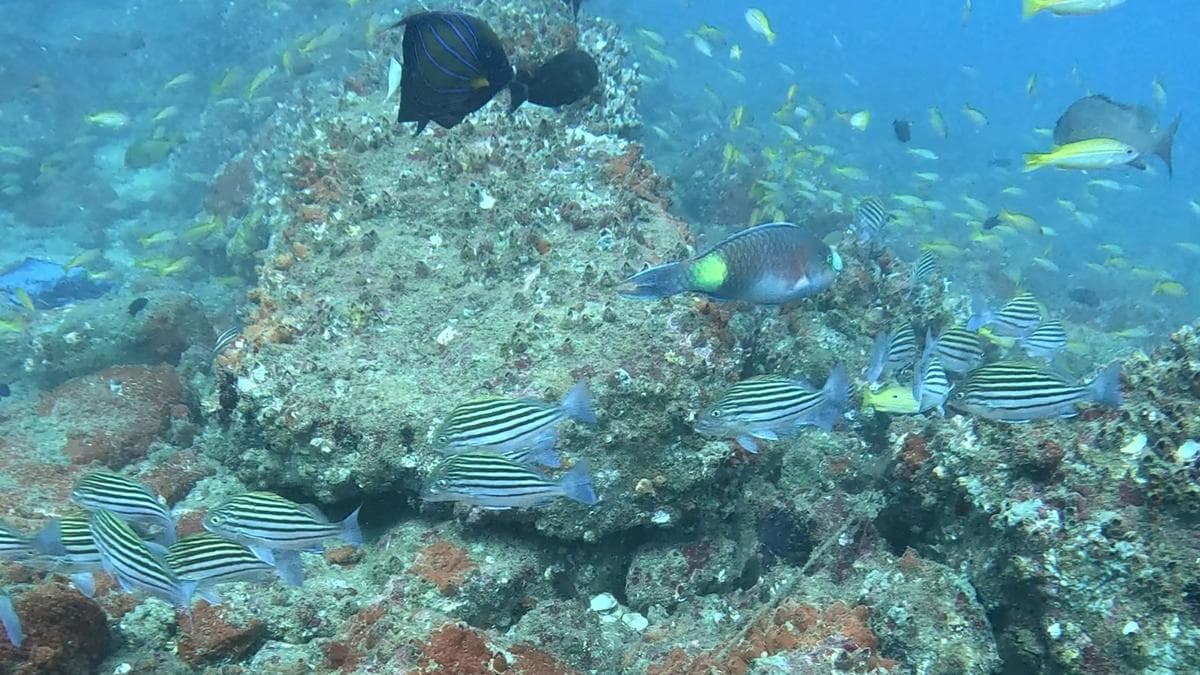
Biodiversity-rich 'Panthakallu' underwater rocky habitat documented off Thiruvananthapuram coast.
Summary
Researchers have documented a biodiversity-rich underwater rocky habitat, locally known as 'Panthakallu', off the Thiruvananthapuram coast in Kerala, specifically between Adimalathura and Poovar. This discovery highlights the importance of protecting unique marine ecosystems and their fish wealth, which is crucial for local livelihoods and marine biodiversity. For competitive exams, this is relevant for environment, geography, and general awareness sections, emphasizing local ecosystems and conservation.
Key Points
- 1Researchers documented a biodiversity-rich underwater rocky habitat off the Thiruvananthapuram coast.
- 2The specific location of the documented habitat is between Adimalathura and Poovar in Kerala.
- 3Local fishers refer to this underwater ecosystem, rich in fish wealth, as 'Panthakallu'.
- 4The habitat is characterized by its rocky structure, supporting diverse marine life.
- 5The documentation emphasizes the need to protect such unique and ecologically significant underwater ecosystems.
In-Depth Analysis
The recent documentation of a biodiversity-rich underwater rocky habitat, locally known as 'Panthakallu', off the Thiruvananthapuram coast in Kerala, specifically between Adimalathura and Poovar, represents a significant development for India's marine conservation efforts. This discovery, rich in fish wealth, underscores the critical importance of identifying and protecting unique marine ecosystems, which are vital not just for ecological balance but also for the livelihoods of coastal communities.
**Background Context and What Happened:**
India boasts a coastline stretching over 7,500 km and an Exclusive Economic Zone (EEZ) of approximately 2.02 million sq km, making it home to a vast array of marine ecosystems including coral reefs, mangroves, seagrass beds, and diverse deep-sea habitats. Despite this immense wealth, our understanding of many underwater ecosystems remains incomplete. What led to this specific documentation was likely a combination of scientific curiosity and, crucially, the invaluable traditional ecological knowledge passed down through generations of local fishers. These fishing communities have long known about 'Panthakallu' – literally 'rocky shelf' or 'rocky base' – recognizing it as a productive fishing ground. Researchers, likely from institutions such as the Central Marine Fisheries Research Institute (CMFRI) or local universities, embarked on a scientific expedition to document and study this area, confirming its ecological significance and diverse marine life. This documentation involves mapping the habitat, identifying species present, and assessing its health and potential threats.
**Key Stakeholders Involved:**
Several stakeholders play crucial roles in this discovery and its future management. Firstly, **Researchers and Scientists** are at the forefront, conducting the surveys, identifying species, and providing scientific evidence for the habitat's importance. Their work forms the basis for conservation strategies. Secondly, **Local Fishing Communities** are indispensable; their traditional knowledge of 'Panthakallu' was instrumental in guiding researchers to the site. They are also the primary beneficiaries and, potentially, guardians of this ecosystem, as their livelihoods are directly tied to its health. Thirdly, **Government Bodies** such as the Ministry of Environment, Forests and Climate Change (MoEFCC) at the national level, and the Kerala State Fisheries Department and Environment Department at the state level, are critical for policy formulation, funding conservation initiatives, and potentially declaring the area as a protected zone. Lastly, **Non-Governmental Organizations (NGOs)** and conservation groups often act as advocates, facilitate community engagement, and can provide additional resources and expertise for conservation efforts.
**Why This Matters for India:**
This discovery holds immense significance for India on multiple fronts. Ecologically, it adds to our national inventory of biodiversity, potentially revealing new species and further highlighting the unique marine biodiversity of the Western Ghats region extending into the Arabian Sea. For the **Blue Economy**, a concept promoted by India for sustainable use of ocean resources, this habitat represents a natural capital that must be conserved to ensure long-term economic benefits from fisheries, potential ecotourism, and biotechnological research. Economically, the 'fish wealth' of Panthakallu directly supports the livelihoods of local fishers, making its protection essential for their socio-economic stability. From a climate change perspective, healthy marine ecosystems are more resilient to environmental shifts and can play a role in carbon sequestration. Furthermore, it validates the importance of **Traditional Ecological Knowledge (TEK)**, urging a more integrated approach where scientific research complements and builds upon local wisdom, a practice crucial for sustainable development.
**Historical Context and Constitutional Provisions:**
India's journey towards environmental protection gained momentum post the Stockholm Conference of 1972, leading to significant legislative actions. The protection of such ecosystems is enshrined in the Indian Constitution. **Article 48A** of the Directive Principles of State Policy (DPSP) mandates that "The State shall endeavour to protect and improve the environment and to safeguard the forests and wild life of the country." Furthermore, **Article 51A(g)**, a Fundamental Duty, states that "It shall be the duty of every citizen of India to protect and improve the natural environment including forests, lakes, rivers and wild life, and to have compassion for living creatures." Specific legislative frameworks include the **Environment (Protection) Act, 1986**, which provides an umbrella for environmental legislation, and the **Wildlife (Protection) Act, 1972**, which, while primarily focused on terrestrial and freshwater ecosystems, can be extended to marine species and habitats through declarations of Marine Protected Areas (MPAs). The **Coastal Regulation Zone (CRZ) Notifications**, periodically updated (e.g., CRZ Notification 2018), regulate developmental activities along the coast to protect marine and coastal ecosystems. The **National Policy on Marine Fisheries, 2017**, also emphasizes sustainable fisheries and marine ecosystem conservation.
**Future Implications:**
The documentation of 'Panthakallu' could lead to several important future implications. Firstly, there is a strong case for its designation as a **Marine Protected Area (MPA)** or a 'No-Take Zone' to ensure its long-term preservation, following a similar model to other MPAs like the Gulf of Mannar or the Andaman and Nicobar Islands. This would involve specific regulations on fishing and other activities. Secondly, it calls for the implementation of **sustainable fisheries management practices** in the surrounding areas, including restrictions on destructive fishing gear, seasonal bans, and catch limits, to prevent overexploitation of the rich fish wealth. Thirdly, it could foster **community-based conservation initiatives**, empowering local fishers to become active participants in monitoring and protecting the habitat. Finally, it emphasizes the need for continuous research and monitoring to understand the full extent of this ecosystem, its connectivity with other marine areas, and its resilience to threats like climate change and pollution. Integrating such discoveries into marine spatial planning and coastal zone management will be crucial for India to achieve its conservation goals and foster a truly sustainable blue economy.
Exam Tips
This topic falls under 'Environment & Ecology' (UPSC GS-III), 'Indian Geography' (UPSC GS-I), and 'General Awareness' (SSC, State PSC). Focus on the location (Kerala, Thiruvananthapuram coast, Adimalathura-Poovar), the local name ('Panthakallu'), and its significance (biodiversity, livelihoods).
Study related topics such as Marine Protected Areas (MPAs) in India, the Coastal Regulation Zone (CRZ) Notifications, the concept of 'Blue Economy', and Sustainable Development Goal 14 (Life Below Water). Understand how these policies and concepts are interconnected.
Common question patterns include direct factual questions (e.g., 'Panthakallu' is located off the coast of which state?), policy-based questions (e.g., 'Which constitutional articles are relevant to marine conservation?'), and analytical questions on the significance of such discoveries for India's biodiversity or economy. Be prepared to link local discoveries to broader national policies and international commitments.
Related Topics to Study
Full Article
Researchers document underwater rocky habitat, between Adimalathura and Poovar, which is rich in fish wealth known to local fishers as ‘Panthakallu’