


Relevant for Exams
Bangladesh turmoil and Jamaat-e-Islami's shadow: India's strategic concerns.
Summary
The article title highlights political instability in Bangladesh, specifically the growing influence of Jamaat-e-Islami, and its strategic implications for India. This subject is highly relevant for understanding India's 'Neighbourhood First' policy, regional security dynamics, and historical context of India-Bangladesh relations, making it crucial for UPSC and State PSC examinations.
Key Points
- 1Bangladesh's internal stability is crucial for India's 'Neighbourhood First' policy and border security, impacting states like West Bengal and Tripura.
- 2Jamaat-e-Islami, a prominent Islamist political party in Bangladesh, has historical ties to the 1971 Liberation War, which remains a sensitive issue.
- 3India-Bangladesh bilateral relations are vital for regional connectivity, trade, and counter-terrorism efforts under various agreements.
- 4Political unrest in Bangladesh poses risks of refugee influx and cross-border security challenges, directly affecting India's internal security.
- 5India's foreign policy navigates complex geopolitical dynamics in Bangladesh, balancing democratic values with strategic interests in the Bay of Bengal region.
In-Depth Analysis
Bangladesh, a nation strategically vital to India, frequently experiences political flux, the latest iteration of which is highlighted by the lengthening shadow of Jamaat-e-Islami (JeI). Understanding this dynamic is crucial for competitive exam aspirants, as it encapsulates India's 'Neighbourhood First' policy, regional security, and historical ties. India shares a 4,096 km long border with Bangladesh, making its internal stability a direct determinant of India's own security and economic interests, particularly for its northeastern states.
The background to Bangladesh's political turmoil is rooted in its very genesis. Born out of the 1971 Liberation War, which saw India's crucial support, Bangladesh was founded on principles of secularism, nationalism, democracy, and socialism. However, the assassination of its founding father, Sheikh Mujibur Rahman, in 1975, ushered in a period of military rule and a gradual Islamisation of politics. This created fertile ground for Islamist parties like Jamaat-e-Islami, which had opposed Bangladesh's independence and collaborated with the Pakistani army during the 1971 genocide. JeI's ideology is rooted in political Islam, advocating for an Islamic state based on Sharia law, a stark contrast to the nation's secular founding principles.
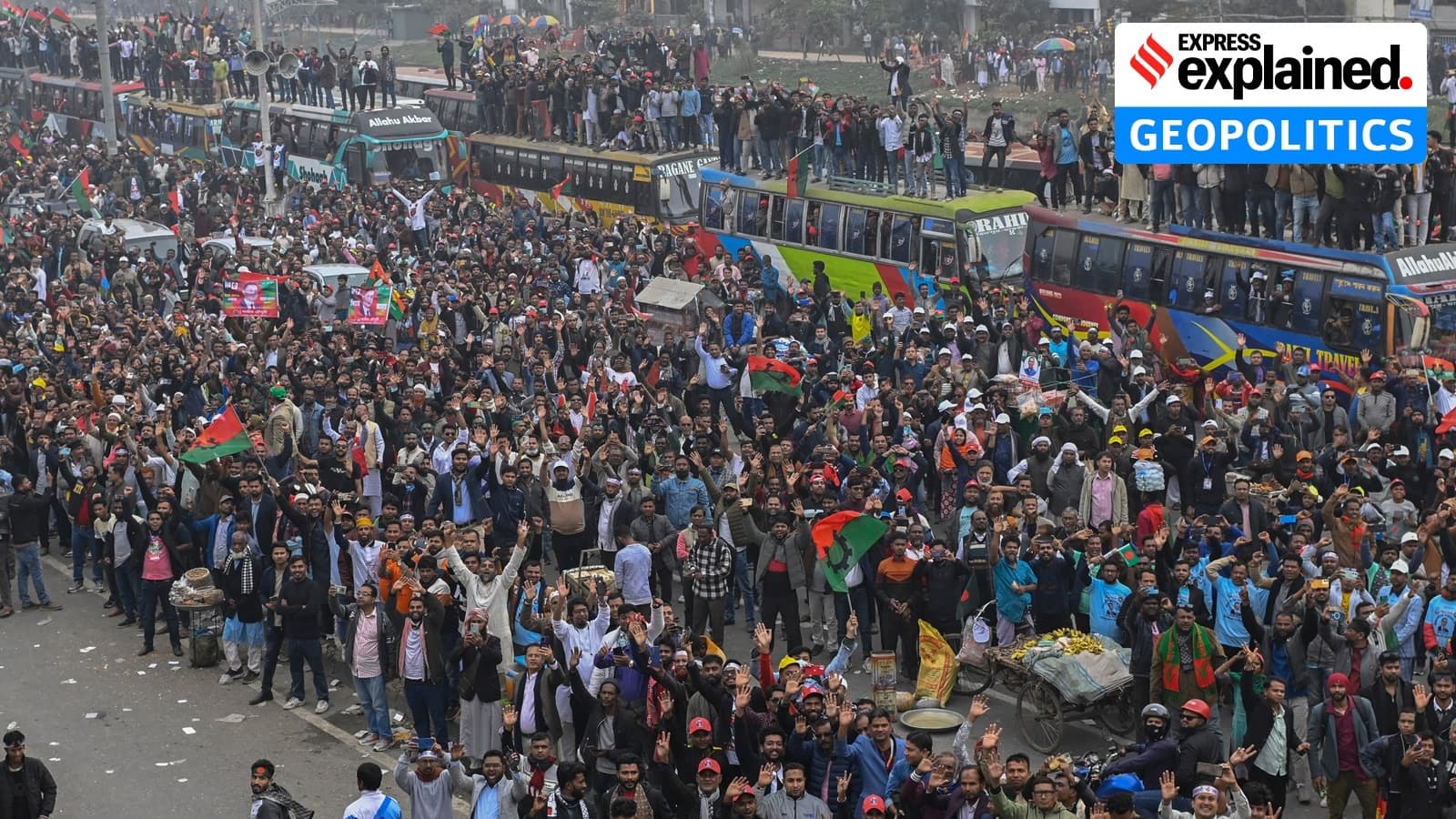
What is happening now is a continuation of the struggle between secular and Islamist forces, often manifesting as intense political rivalry between the ruling Awami League (AL) and the opposition Bangladesh Nationalist Party (BNP), frequently allied with JeI. The recent political unrest often revolves around general elections, with opposition parties alleging rigging and demanding caretaker governments. JeI, despite being de-registered as a political party by the Bangladesh Election Commission in 2013 due to its unconstitutional charter (violating the secular principles), continues to operate through various fronts and participate in protests, leveraging its grassroots support. The trials and executions of several JeI leaders for war crimes committed during the 1971 Liberation War under the International Crimes Tribunal (ICT) further intensified the political polarization, with JeI viewing these as politically motivated.
Key stakeholders in this scenario include the **Awami League government**, led by Prime Minister Sheikh Hasina, which espouses a secular agenda, seeks closer ties with India, and has taken a firm stance against Islamist radicalism. The **Bangladesh Nationalist Party (BNP)**, the main opposition, often aligns with JeI, and its political narrative frequently includes anti-India sentiments. **Jamaat-e-Islami (JeI)**, though officially banned from electoral politics, remains a significant religious-political force, mobilizing support through its affiliated organizations and posing a challenge to Bangladesh's secular fabric. **India** is a crucial external stakeholder, carefully navigating its relationship with the current government while monitoring the rise of Islamist forces. Other international players like **China** and the **United States** also have growing strategic and economic interests in Bangladesh, adding layers of geopolitical complexity.
This situation matters immensely for India. From a **security perspective**, political instability in Bangladesh could lead to an influx of refugees into India's bordering states, straining resources and potentially altering demographics. It also raises concerns about cross-border infiltration by radical elements and the potential for increased fundamentalist activities, directly impacting India's internal security and the stability of its sensitive northeastern region. India and Bangladesh have robust cooperation mechanisms under bilateral agreements for border management and counter-terrorism, but these can be undermined by internal turmoil. From an **economic standpoint**, Bangladesh is India's largest trade partner in South Asia. Instability can disrupt trade, connectivity projects (like the BBIN Initiative – Bangladesh, Bhutan, India, Nepal), and India's 'Act East Policy', which relies heavily on Bangladesh as a bridge to Southeast Asia. India's investment in Bangladesh and joint projects in energy and infrastructure would also suffer. Geopolitically, a stable, secular, and friendly Bangladesh is vital for India's regional influence, especially in the Bay of Bengal, where India seeks to counter the growing presence of other powers.
Historically, India's support for Bangladesh's independence in 1971 laid the foundation for a strong relationship. However, the post-1975 political shifts and the resurgence of Islamist narratives have tested this bond. The current government's efforts to uphold the secular spirit of the 1971 Liberation War and prosecute war criminals align with India's interests in regional stability and counter-radicalization. India's foreign policy, guided by its 'Neighbourhood First' principle, aims to foster cooperation, enhance connectivity, and ensure mutual security, but it must constantly balance these objectives with the evolving political landscape within Bangladesh.
Looking ahead, the future implications suggest continued vigilance for India. A prolonged period of political instability or a significant shift towards Islamist governance in Bangladesh could pose substantial challenges. India will need to continue its multi-pronged engagement: strengthening security cooperation, promoting economic partnership, and engaging in diplomatic efforts to support democratic processes and secular values. This involves careful diplomacy, avoiding interference while ensuring India's strategic interests are protected. India's own constitutional framework, particularly **Article 51** (promotion of international peace and security) and the principles enshrined in its **Preamble** (secularism, democracy), guide its approach to regional stability and relations with neighbours. India's various bilateral agreements with Bangladesh, covering trade, transit, border management, and counter-terrorism, are crucial policy instruments in managing these complex dynamics.
In essence, the political trajectory of Bangladesh, especially the influence of groups like Jamaat-e-Islami, is not merely an internal matter for Dhaka; it is a critical component of India's foreign policy, national security, and regional strategic calculations. Aspirants must grasp these intricate linkages to understand India's role in its neighbourhood and the broader geopolitical landscape.
Exam Tips
This topic primarily falls under GS Paper-II (International Relations - India and its Neighbourhood) and GS Paper-III (Internal Security - Border Management, Linkages between development and spread of extremism).
Study the historical context of India-Bangladesh relations, focusing on the 1971 Liberation War, key agreements (like the Land Boundary Agreement), and ongoing connectivity projects (e.g., BBIN Initiative).
Be prepared for analytical questions on the impact of political instability in neighbouring countries on India's internal security, foreign policy challenges, and the effectiveness of India's 'Neighbourhood First' policy. Factual questions on dates, agreements, and key personalities are also common.
Understand the constitutional provisions in India (e.g., Article 51, Preamble's secular ideals) and Bangladesh that are relevant to bilateral relations and internal political dynamics.
Connect this topic with broader themes like refugee crises, cross-border terrorism, regional economic integration, and India's 'Act East Policy' to provide a comprehensive answer.