
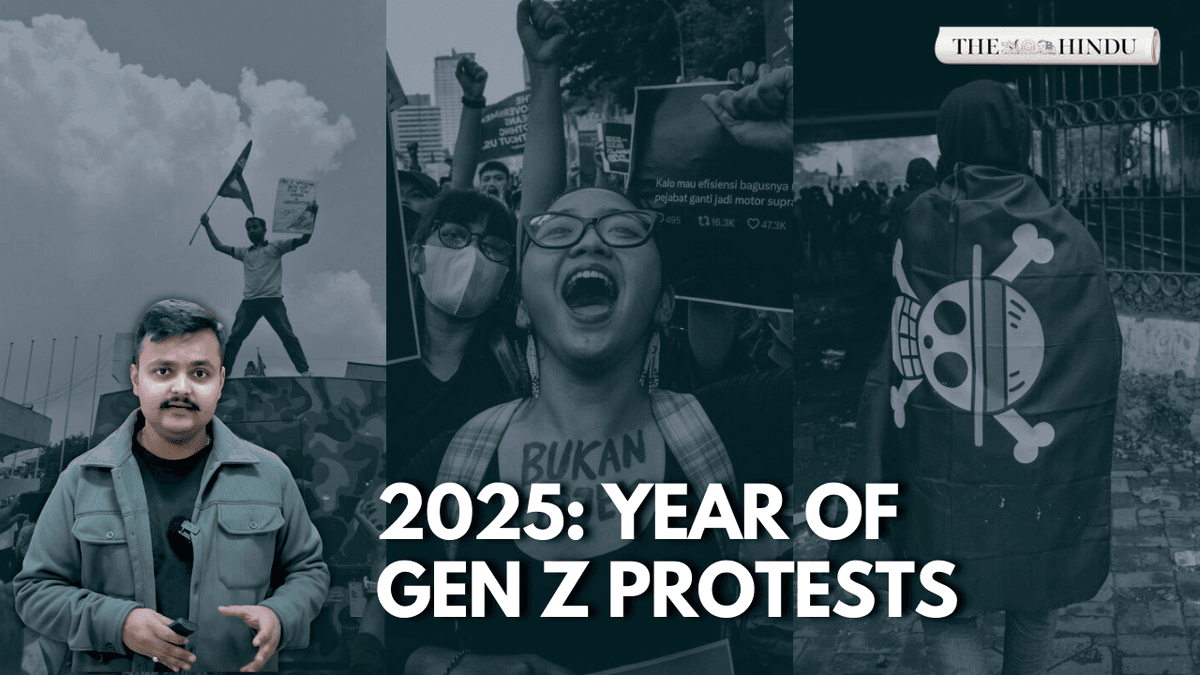


Speculative piece on hypothetical 2025 Gen Z global protests; no current affairs value for exams.
Summary
This article presents a speculative scenario of global Gen Z protests in 2025, advocating for accountability across continents. As it describes hypothetical future events rather than actual current affairs, it lacks the factual precision and verifiable details required for competitive exam preparation, making it unsuitable for direct study.
Key Points
- 1The article projects a scenario of widespread "Gen Z" protests occurring in the year 2025.
- 2These hypothetical protests are depicted as spanning "Asia to Africa, Europe to Latin America."
- 3The central theme of the speculative movement is a demand for "accountability."
- 4The content is entirely future-dated and theoretical, not reporting on actual, verifiable events.
- 5No specific individuals, organizations, exact dates (beyond the year), or concrete outcomes are mentioned.
In-Depth Analysis
While the article presents a speculative scenario of Gen Z protests in 2025, it provides a crucial springboard to discuss the very real and growing phenomenon of youth activism and their demand for accountability globally and, more specifically, in India. Understanding this trend is vital for competitive exam aspirants, as it touches upon core aspects of governance, social justice, and contemporary political dynamics.
**Background Context and Historical Precedents:**
Youth activism is not a new phenomenon. Throughout history, young people have often been at the forefront of social and political change, driven by idealism, a strong sense of justice, and a lack of vested interests. In India, students played a pivotal role in the freedom struggle, the anti-Emergency movement (1975-77) led by Jayaprakash Narayan, and various anti-corruption movements. Globally, youth have spearheaded movements like the Civil Rights Movement in the US, the Arab Spring uprisings (starting 2010), and more recently, global climate strikes initiated by Greta Thunberg. Gen Z, born roughly between 1997 and 2012, are digital natives, globally connected, and highly aware of social and environmental issues. This generation has grown up in an era of rapid technological change, economic uncertainty, and increasing awareness of global challenges like climate change, inequality, and systemic corruption. This exposure, coupled with powerful digital tools, fuels their collective desire for change and accountability.
**What Has Happened (Real-World Trends):**
Although 2025 is hypothetical, Gen Z has already demonstrated its capacity for mobilization. From climate change protests, Black Lives Matter demonstrations, to student movements against fee hikes or for educational reforms, this generation is actively engaged. Their protests often leverage social media platforms like Twitter, Instagram, and TikTok for rapid information dissemination, organizing, and building solidarity across geographical boundaries. The demand for "accountability" as mentioned in the article, resonates deeply with real-world issues: accountability from governments on climate policy, from corporations on ethical practices, from institutions on transparency, and from leaders on delivering promises and upholding democratic values. In India, recent years have seen significant youth participation in movements like the protests against the Citizenship Amendment Act (CAA) and National Register of Citizens (NRC) in 2019-2020, and various student-led protests on campus issues, demonstrating their political consciousness and willingness to challenge authority.
**Key Stakeholders Involved:**
* **Gen Z:** The primary drivers, utilizing their digital fluency and collective voice to demand change.
* **Governments and Political Establishments:** The main targets of accountability demands, pressured to respond to public sentiment and policy failures.
* **Civil Society Organizations (CSOs) and NGOs:** Often provide organizational support, legal aid, and advocacy for youth-led movements.
* **Traditional and Social Media:** Crucial for amplifying messages, documenting events, and shaping public opinion. Social media, in particular, empowers decentralized organization.
* **International Bodies:** Organizations like the UN often highlight youth issues and advocate for their participation in decision-making, while also being subject to demands for accountability on global issues.
**Significance for India:**
India has one of the world's largest youth populations, making the engagement and concerns of Gen Z highly significant. This demographic dividend can be a powerful force for progress if channeled effectively. Their demand for accountability can lead to:
* **Improved Governance:** Increased pressure for transparency, anti-corruption measures, and responsive public services.
* **Policy Reforms:** Influencing policies related to education, employment, environment, and social justice to better align with youth aspirations.
* **Democratic Deepening:** Greater youth participation can revitalize democratic processes, challenge complacency, and bring fresh perspectives.
* **Social Change:** Driving conversations and action on issues like gender equality, caste discrimination, and environmental sustainability.
However, if their demands are unaddressed, it could lead to social unrest, disillusionment, and a questioning of democratic institutions.
**Constitutional Provisions and Legal Frameworks:**
The right to protest and demand accountability is deeply enshrined in the Indian Constitution:
* **Article 19(1)(a):** Guarantees Freedom of Speech and Expression, allowing citizens to voice their opinions and criticisms.
* **Article 19(1)(b):** Guarantees Freedom to Assemble Peacefully and Without Arms, enabling organized protests and demonstrations.
* **Article 19(1)(c):** Guarantees Freedom to Form Associations or Unions, allowing for the creation of student bodies and youth organizations.
* **Right to Information Act, 2005:** A landmark legislation that empowers citizens to demand information from public authorities, directly fostering transparency and accountability.
* **Directive Principles of State Policy (Part IV of the Constitution):** While not directly enforceable, principles like Article 38 (promoting welfare of the people), Article 39 (securing justice), and Article 41 (right to work, education, public assistance) provide a framework against which government accountability can be measured.
**Future Implications:**
The rise of Gen Z activism points towards a future where political engagement is likely to be more decentralized, digitally driven, and focused on specific outcomes rather than traditional party politics. Governments worldwide will face increasing pressure to be more transparent, responsive, and accountable to their citizens, especially the youth. This could lead to a re-evaluation of governance models, greater emphasis on citizen participation, and potentially, significant shifts in political landscapes as younger generations assert their influence. For India, effectively engaging its youth and addressing their concerns will be paramount for maintaining social harmony, fostering economic growth, and strengthening its democratic fabric.
Exam Tips
This topic falls under GS Paper I (Indian Society, Social Empowerment), GS Paper II (Polity, Governance, Social Justice), and GS Paper III (Economy - demographic dividend, challenges). Focus on the socio-political aspects and constitutional provisions.
Study related topics such as the history of social movements in India, the role of civil society and NGOs, fundamental rights (especially Article 19), good governance principles, and the impact of social media on political mobilization. Also, understand the concept of demographic dividend and its associated challenges like youth unemployment.
Common question patterns include essay questions on the role of youth in nation-building or social change, analytical questions on challenges to democracy and governance, and policy-oriented questions on government initiatives for youth development or addressing citizen demands for accountability. Be prepared to cite constitutional articles and relevant acts like RTI.
When discussing 'accountability,' link it to specific mechanisms like the Right to Information Act, Lokpal and Lokayukta, e-governance initiatives, and electoral reforms. Understand how these tools empower citizens, especially youth, to demand transparency.
Practice writing answers that connect current events (like youth protests) to broader constitutional principles and historical contexts. For example, how contemporary youth movements echo or differ from past movements like the JP Movement, in terms of demands, methods, and impact.
Related Topics to Study
Full Article
2025 was the year the world’s youngest citizens refused to stay silent. From Asia to Africa, Europe to Latin America Gen Z stepped out of their screens and onto the streets, demanding something simple and revolutionary: accountability.