


Relevant for Exams
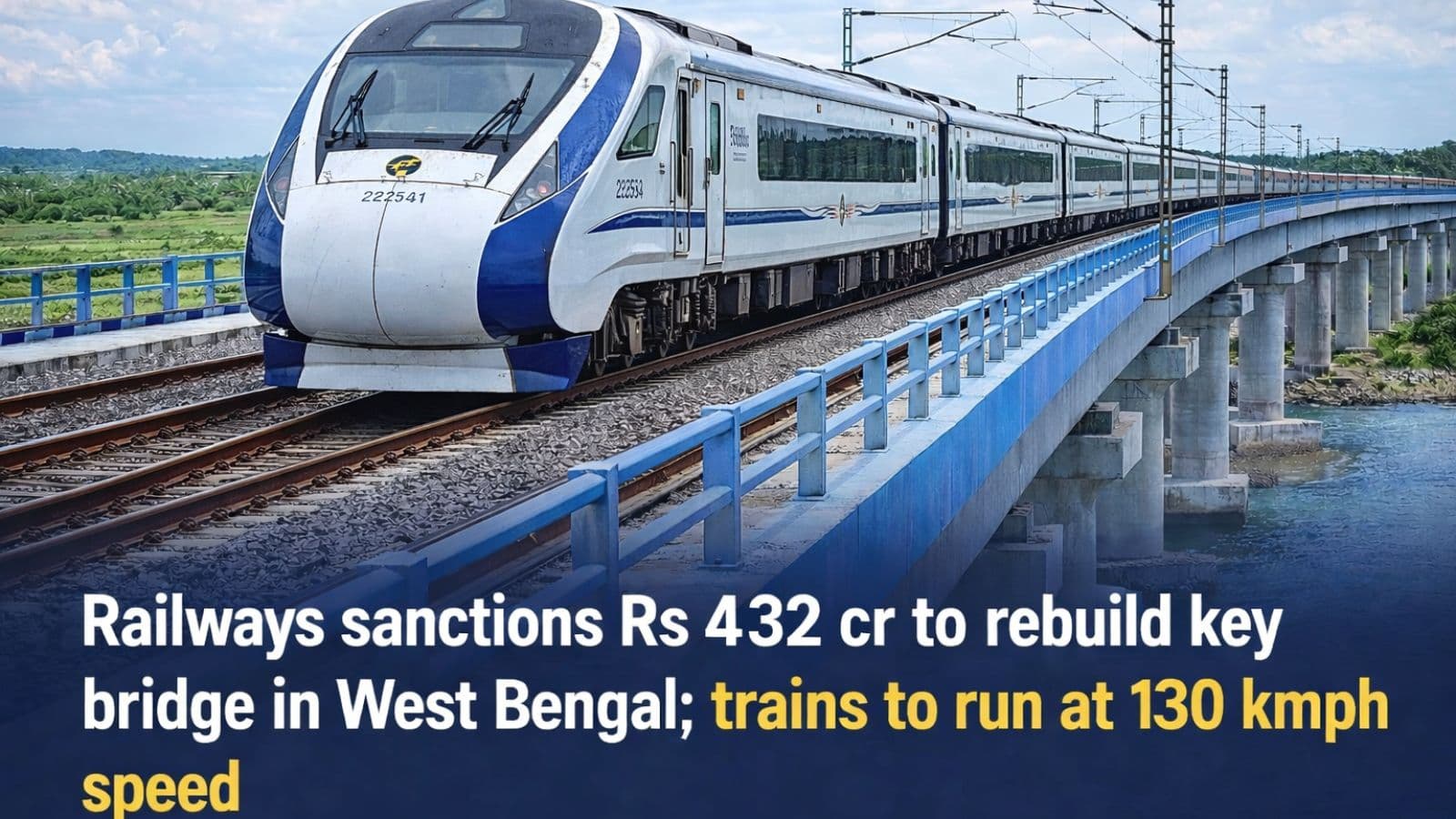
Railways sanctions Rs 432 cr for West Bengal bridge rebuild, enabling 130 kmph train speed.
Summary
Indian Railways has sanctioned Rs 432 crore for the crucial project of rebuilding a key bridge in West Bengal. This significant infrastructure upgrade aims to enhance railway connectivity and efficiency, enabling trains to achieve speeds of up to 130 kmph. For competitive exams, this highlights government investment in railway infrastructure, regional development, and specific project details like funding and operational improvements.
Key Points
- 1Indian Railways sanctioned Rs 432 crore for the reconstruction of a key bridge.
- 2The bridge rebuilding project is specifically located in West Bengal.
- 3The upgraded bridge will allow trains to operate at a maximum speed of 130 kmph.
- 4The allocated amount of Rs 432 crore signifies a substantial investment in railway infrastructure.
- 5This initiative aims to improve railway connectivity and operational efficiency in the region.
In-Depth Analysis
The Indian Railways' sanction of Rs 432 crore for rebuilding a crucial bridge in West Bengal, enabling trains to run at 130 kmph, is more than just a local infrastructure project; it signifies a robust national commitment to modernizing India's railway network. This initiative is a microcosm of the larger vision outlined in the National Rail Plan (NRP) 2030 and the PM Gati Shakti National Master Plan, aiming to transform railway infrastructure for enhanced speed, safety, and efficiency.
**Background Context and What Happened:**
India boasts one of the world's largest railway networks, a legacy dating back to 1853. However, much of this infrastructure, including numerous bridges, tracks, and signaling systems, is old and requires significant upgrades to meet the demands of a rapidly growing economy and population. Many existing bridges were built decades ago, designed for lower speeds and lighter loads, making them bottlenecks for modern, faster trains. The specific project in West Bengal addresses one such critical bottleneck. The sanction of Rs 432 crore by Indian Railways is a direct allocation for the reconstruction of this key bridge, with the primary objective of enhancing its structural integrity and design to safely accommodate trains operating at speeds up to 130 kmph. This upgrade is crucial for improving connectivity and reducing travel times in the region.
**Key Stakeholders Involved:**
At the forefront is **Indian Railways**, operating under the **Ministry of Railways**, Government of India. As the implementing agency, it is responsible for planning, funding, executing, and maintaining railway infrastructure. The **Central Government** plays a vital role by allocating funds through the Union Budget and formulating overarching policies like the National Rail Plan. The **West Bengal State Government** is another significant stakeholder, as the project is located within its jurisdiction. While railways fall under the Union List, state governments often provide land acquisition support, local clearances, and ensure law and order during project execution. **Local communities** in West Bengal will be direct beneficiaries, experiencing improved connectivity and potential economic boosts. Finally, various **construction companies, engineering firms, and suppliers** will be involved in the actual rebuilding process, contributing to job creation and economic activity.
**Why This Matters for India:**
This project holds immense significance for India's economic and social fabric. Firstly, it directly contributes to **economic development** by enhancing logistics and transportation efficiency. Faster and more reliable rail connectivity can reduce transit times for both passengers and freight, boosting trade, commerce, and tourism. Secondly, it addresses **regional development**, particularly in West Bengal, by integrating it more effectively into the national network. Such improvements can attract investments and create employment opportunities. Thirdly, the focus on 130 kmph speed aligns with India's ambition to achieve **higher average speeds** across its network, moving towards semi-high-speed corridors and eventually high-speed rail. This also implicates **safety**, as modern infrastructure is designed with advanced safety features, reducing the risk of accidents. Furthermore, such investments align with the 'Make in India' initiative by stimulating domestic manufacturing of railway components and construction materials.
**Historical Context and Broader Themes:**
Indian Railways has a rich history, evolving from a colonial tool for resource extraction into the nation's lifeline post-independence. Jawaharlal Nehru famously called it 'the largest public undertaking in India'. Over decades, there has been a continuous effort to expand and modernize the network, with significant milestones like electrification, gauge conversion, and the introduction of faster trains like Rajdhani and Shatabdi Expresses. The current phase, however, marks an accelerated push for **capacity enhancement and speed upgrades**. This project is a testament to the broader theme of **infrastructure-led growth**, a key policy focus of the present government, as articulated in the PM Gati Shakti National Master Plan launched in October 2021. This plan aims for integrated infrastructure development across 16 ministries to reduce logistics costs and improve connectivity.
**Future Implications:**
The successful completion of this bridge project will pave the way for similar upgrades across the country, especially on high-density routes. It will contribute to achieving the targets set by the National Rail Plan 2030, which envisions a 'Future Ready' railway system capable of handling projected traffic demands up to 2050. This includes 100% electrification, upgrading speed to 160 kmph on major routes, and creating capacity ahead of demand. The move towards 130 kmph on conventional tracks is a stepping stone towards the broader goal of 160 kmph and even 200 kmph on dedicated corridors. This modernization will not only improve passenger experience but also significantly enhance freight movement, crucial for reducing logistics costs which are currently high in India. It also has environmental implications, as a more efficient rail system can reduce reliance on road transport, thereby lowering carbon emissions.
**Related Constitutional Articles, Acts, or Policies:**
* **Constitutional Provisions:** Railways falls under **Entry 22 of the Union List** (Seventh Schedule, Article 246) of the Constitution, granting the Parliament exclusive power to legislate on this subject. The allocation of funds, like the Rs 432 crore, is a financial decision routed through the **Consolidated Fund of India** (Article 266), sanctioned by Parliament through appropriation acts. **Article 282** allows the Union or a State to make grants for any public purpose, even if the purpose is not one with respect to which Parliament or the Legislature of the State, as the case may be, may make laws. This underpins the financial grants for such infrastructure projects.
* **Acts and Policies:** The **Indian Railways Act, 1989**, governs the management, operation, and safety of railways. More recently, policy frameworks like the **National Rail Plan (NRP) 2030** provide a long-term vision for railway infrastructure development, aiming to create a 'Future Ready' Railway system. The **PM Gati Shakti National Master Plan** integrates various infrastructure projects, including railways, for synergistic development and efficient project execution. This project aligns perfectly with the objectives of these national plans, emphasizing multi-modal connectivity and infrastructure modernization.
Exam Tips
**UPSC Civil Services Exam (GS-III - Economy & Infrastructure):** Focus on the broader implications of railway infrastructure projects. Questions can link this to economic growth, regional development, logistics, PM Gati Shakti, and the National Rail Plan 2030. Understand the role of public investment in infrastructure.
**SSC CGL/CHSL & Railway Exams (General Awareness & Current Affairs):** Expect factual questions like the sanctioned amount (Rs 432 crore), location (West Bengal), and the target speed (130 kmph). Also, be aware of major railway initiatives and policies like 'Mission Raftar' or dedicated freight corridors.
**State PSC Exams (General Knowledge & State-Specific):** Questions might focus on the specific project's impact on West Bengal, its connectivity benefits, and how it aligns with state development goals. Be ready to recall the amount, location, and speed.
**Banking Exams (General Awareness & Economic News):** Understand the economic rationale behind such investments – job creation, improved logistics, impact on GDP. Connect it to government spending, infrastructure development, and its role in economic recovery/growth.
**Common Question Patterns:** Factual recall (amount, location, speed), policy-based questions (linking to National Rail Plan, Gati Shakti), impact analysis (economic, social, regional), and comparison with other transport modes.