


Relevant for Exams
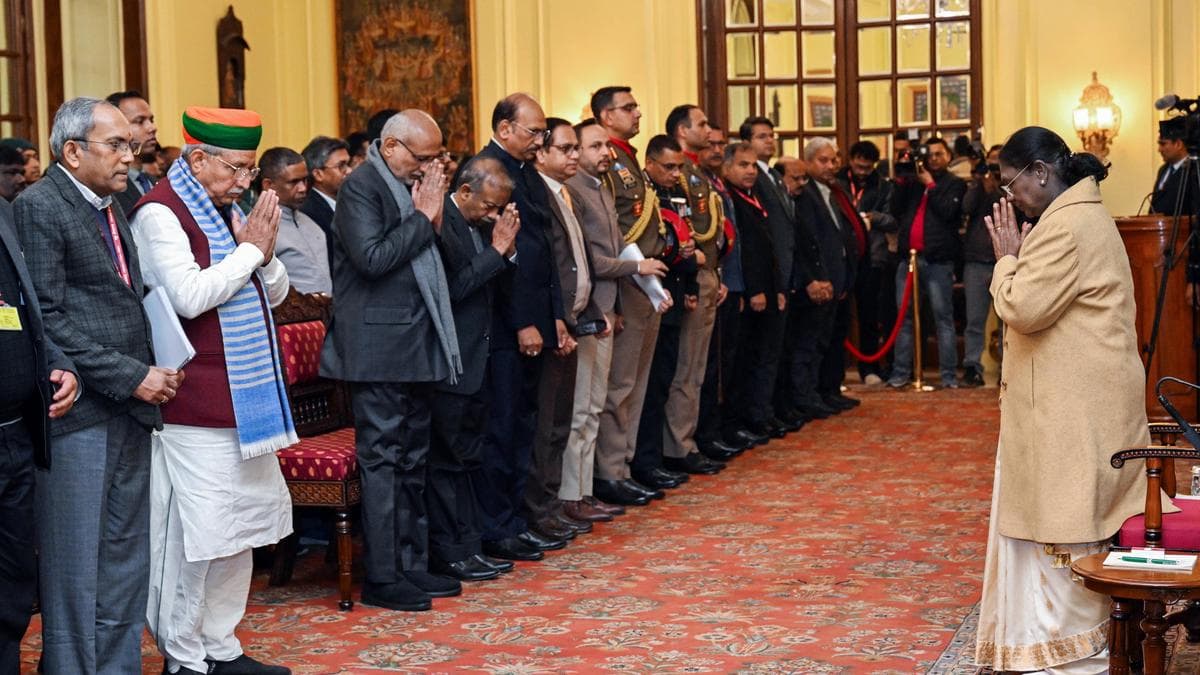
President Murmu releases Constitution of India in Santhali language, promoting linguistic inclusion.
Summary
President Droupadi Murmu released the first edition of the Constitution of India in the Santhali language. This landmark initiative aims to empower the Santhali people by enabling them to read and understand the Constitution in their native tongue. It underscores India's commitment to linguistic diversity and accessibility, particularly for tribal communities, making constitutional principles more inclusive and relevant for competitive exam preparation on constitutional provisions and tribal welfare.
Key Points
- 1President Droupadi Murmu released the first edition of the Constitution of India in the Santhali language.
- 2The Santhali language is one of the languages recognized under the Eighth Schedule of the Indian Constitution.
- 3The Constitution in Santhali is available in the Ol Chiki script, which is the official script for the Santhali language.
- 4This initiative aims to enable the Santhali people to read and understand the Constitution in their own language.
- 5The move promotes linguistic diversity and enhances the accessibility of constitutional principles for tribal communities.
In-Depth Analysis
President Droupadi Murmu's release of the first edition of the Constitution of India in the Santhali language marks a significant milestone in India's journey towards linguistic inclusion and tribal empowerment. This initiative is not merely a translation; it is a powerful statement about accessibility, identity, and the democratic principle of reaching every citizen in their own tongue. To truly grasp its importance, we must delve into the historical, constitutional, and social layers that underpin this event.
Historically, India has been a mosaic of languages, with over a thousand distinct tongues spoken across the subcontinent. While the Constitution recognized a select few as official languages, many indigenous and tribal languages, including Santhali, faced challenges in gaining mainstream recognition. The Santhali language, spoken by one of the largest Scheduled Tribe communities in India, primarily in Jharkhand, West Bengal, Odisha, Bihar, and Assam, along with Bangladesh and Nepal, has a rich oral tradition. Its journey towards constitutional recognition culminated in the 92nd Constitutional Amendment Act of 2003, which added Bodo, Dogri, Maithili, and Santhali to the Eighth Schedule of the Constitution. This was a hard-won battle, reflecting decades of advocacy by Santhali intellectuals and community leaders for their language's rightful place. The adoption of the Ol Chiki script, developed by Pandit Raghunath Murmu in 1925, as the official script for Santhali, further solidified its identity and paved the way for its use in education and administration.
The event itself saw President Droupadi Murmu, the first tribal President of India and a Santhali herself, release the translated Constitution. Her personal connection to the community amplifies the symbolic weight of this act. Key stakeholders in this initiative include the President's office, the Ministry of Law and Justice (responsible for legal translations and official publications), tribal cultural organizations, and language experts who meticulously worked on the translation. For the Santhali people, this translation is monumental. It empowers them to directly engage with the foundational legal document of their nation, fostering a deeper understanding of their rights, duties, and the framework of Indian governance without relying on translations or interpretations in other languages.
This development holds profound significance for India. Firstly, it strengthens India's commitment to linguistic diversity, a core tenet of its pluralistic democracy. By making the Constitution available in Santhali, the government reaffirms that all recognized languages are valuable and deserve equal respect. Secondly, it enhances constitutional literacy and access to justice for tribal communities. Many Santhali speakers, particularly in rural areas, may not be fluent in Hindi or English, the primary languages of legal discourse. Access to the Constitution in their native language can demystify legal processes, making them more aware of their fundamental rights (Articles 12-35), Directive Principles of State Policy (Articles 36-51), and the overall structure of governance. This can lead to greater participation in democratic processes and better protection against exploitation.
Constitutionally, this initiative aligns with several provisions. The Eighth Schedule (Article 344(1) and 351) lists the official languages recognized by the Constitution, a list Santhali joined in 2003. Article 29 protects the interests of minorities, including linguistic minorities, allowing them to conserve their distinct language, script, or culture. Furthermore, the spirit of Article 46, which mandates the State to promote the educational and economic interests of the Scheduled Castes and the Scheduled Tribes and to protect them from social injustice and all forms of exploitation, is deeply reflected in this move. Policies like the Panchayats (Extension to Scheduled Areas) Act, 1996 (PESA Act), and the Scheduled Tribes and Other Traditional Forest Dwellers (Recognition of Forest Rights) Act, 2006 (FRA), aim to empower tribal communities; providing the Constitution in their language complements these efforts by enhancing their understanding of their statutory rights and powers.
Looking ahead, this initiative sets a precedent for similar translations into other recognized tribal and regional languages listed in the Eighth Schedule. It could spur greater efforts in promoting education in mother tongues, especially in tribal areas, in line with the National Education Policy 2020 which emphasizes instruction in local languages. The long-term implications include improved governance through better public understanding of laws, stronger cultural preservation efforts for indigenous languages, and greater social cohesion as more communities feel truly represented and included in the national fabric. This move by President Murmu is a powerful step towards a more inclusive and equitable India, where the principles of justice, liberty, equality, and fraternity resonate in every language.
Exam Tips
This topic falls under 'Indian Polity and Governance' (UPSC Mains GS-II), 'Social Justice' (UPSC Mains GS-II), and 'Art & Culture' (UPSC Prelims/Mains GS-I). For State PSCs and other exams, it's relevant for General Awareness and Indian Constitution sections.
When studying, focus on the Eighth Schedule of the Constitution: know its purpose, the original number of languages, the amendments that added new languages (especially the 92nd Amendment for Santhali), and the total current number of languages. Understand the difference between official languages and recognized languages.
Related topics to study together include tribal welfare policies and acts (e.g., PESA Act, Forest Rights Act 2006), the role and powers of the President of India, and the constitutional provisions for linguistic minorities (Articles 29, 344, 351).
Common question patterns can include direct questions on the 92nd Amendment, the languages added, the significance of the Ol Chiki script, the role of the President in promoting linguistic diversity, or the broader implications of such initiatives for tribal empowerment and national integration. Expect objective questions on specific articles or amendments and subjective questions requiring analytical answers on the social and political impact.
Related Topics to Study
Full Article
The President said it is a matter of pride and joy for all the Santhali people, and it will enable them to read and understand the Constitution in their own language