


Relevant for Exams
PM inaugurates Rashtra Prerna Sthal in Lucknow on Vajpayee's 101st anniversary, references Article 370.
Summary
Prime Minister Narendra Modi inaugurated the Rashtra Prerna Sthal in Lucknow, Uttar Pradesh. The inauguration coincided with the 101st birth anniversary of former Prime Minister Atal Bihari Vajpayee. During the event, PM Modi underscored the BJP government's pride in having abrogated Article 370, highlighting its political significance. This news is crucial for exams, covering national memorials, prominent personalities, and a major constitutional provision.
Key Points
- 1The Rashtra Prerna Sthal was inaugurated in Lucknow.
- 2The inauguration took place on the 101st birth anniversary of former Prime Minister Atal Bihari Vajpayee.
- 3Prime Minister Narendra Modi performed the inauguration of the Rashtra Prerna Sthal.
- 4PM Modi stated the BJP government was proud to have had the opportunity to 'tear down the wall of Article 370'.
- 5The event links a national memorial with a significant constitutional amendment (Article 370) and a former PM's legacy.
In-Depth Analysis
The inauguration of the Rashtra Prerna Sthal in Lucknow by Prime Minister Narendra Modi, coinciding with the 101st birth anniversary of former Prime Minister Atal Bihari Vajpayee, is a multifaceted event with significant political, historical, and constitutional implications for India. This event not only commemorates a towering figure in Indian politics but also serves as a platform to reiterate the government's stance on a landmark constitutional amendment.
The **background context** for this event intertwines two distinct but strategically linked narratives. Firstly, the Rashtra Prerna Sthal, meaning 'National Inspiration Site', is a memorial dedicated to inspiring future generations. Its establishment in Lucknow, a constituency Vajpayee represented in the Lok Sabha for five terms, underscores his deep connection to the city and his lasting legacy. Vajpayee, a statesman, poet, and orator, was a founding member of the Bharatiya Jana Sangh and later the BJP, serving as Prime Minister from 1996 and then from 1998 to 2004. His birth anniversary on December 25th is also observed as 'Good Governance Day' in India, emphasizing his commitment to transparency and accountability in public life.
Secondly, the Prime Minister's explicit mention of the abrogation of Article 370 during the inauguration brings a crucial **constitutional and political dimension**. Article 370 of the Indian Constitution, which granted special status to Jammu and Kashmir (J&K), was a temporary provision since its inception in 1949. It allowed J&K to have its own constitution, flag, and autonomy over all matters except defence, foreign affairs, and communications. This special status was further reinforced by Article 35A, introduced via a Presidential Order in 1954, which defined 'permanent residents' of J&K and conferred special rights and privileges upon them, particularly concerning land ownership and state government jobs. The abrogation of Article 370 and 35A had been a long-standing ideological plank of the BJP, viewing it as a barrier to national integration and development in the region.
**What happened** on this occasion was the formal unveiling of a national memorial, followed by a powerful political statement. PM Modi's assertion that the BJP government was proud to have had the opportunity to 'tear down the wall of Article 370' directly refers to the momentous decision taken on August 5, 2019. On this date, the President of India issued a Constitutional Order (C.O. 272) superseding the 1954 order, effectively rendering Article 370 inoperative. Simultaneously, the Parliament passed the Jammu and Kashmir Reorganisation Act, 2019, bifurcating the state into two Union Territories: Jammu and Kashmir (with a legislature) and Ladakh (without a legislature). This move was seen by the government as a definitive step towards fully integrating J&K with the rest of India.
**Key stakeholders involved** include the Government of India, particularly the ruling BJP, which views the abrogation of Article 370 as a historic achievement aligning with its core ideology of 'One Nation, One Constitution'. Former Prime Minister Atal Bihari Vajpayee, through his memorial, remains a central figure, representing a legacy of statesmanship and nationalist ideals that the current government often invokes. The people of Uttar Pradesh and Lucknow are stakeholders in the development of the memorial, which aims to be a site of cultural and historical significance. Most importantly, the people of Jammu and Kashmir are direct stakeholders in the aftermath of Article 370's abrogation, experiencing its social, economic, and political consequences.
**Why this matters for India** is profound. Politically, it signifies the fulfilment of a key electoral promise by the BJP, reinforcing its nationalist narrative and commitment to a uniform legal framework across the country. Constitutionally, the method of abrogation, involving Presidential Orders and parliamentary approval, sparked extensive debates on federalism, the powers of the President, and the interpretation of 'temporary provisions'. The Supreme Court, in its December 2023 verdict, largely upheld the government's decision, affirming the President's power to abrogate Article 370 and validating the reorganisation of J&K into Union Territories, while also directing the Election Commission to take steps to hold elections in J&K by September 2024. Socially and economically, the government argues that the abrogation will pave the way for greater investment, development, and the extension of central laws and welfare schemes to J&K, fostering inclusive growth and empowering marginalized sections previously excluded by Article 35A.
**Future implications** are critical. The government's continued emphasis on Article 370's abrogation indicates its ongoing political salience, especially with upcoming elections. The focus will now shift to ensuring peace, security, and economic prosperity in J&K, alongside the restoration of its statehood as promised by the Home Minister in Parliament. The success of these initiatives will be crucial in validating the government's narrative. Furthermore, this event reinforces a broader theme of national integration and governance, highlighting the government's commitment to a strong, unified India where all regions are subject to the same constitutional provisions, fostering a sense of shared national identity and development.
This event, thus, serves as a powerful reminder of India's evolving constitutional landscape, the enduring legacy of its leaders, and the dynamic interplay between historical memory, political ideology, and national aspirations.
Exam Tips
This topic falls under Indian Polity (Indian Constitution – Federalism, Special Provisions, Amendments, Centre-State Relations) and Current Affairs (National Events, Government Policies) for UPSC, SSC, and State PSC exams. Focus on the constitutional provisions and the timeline of events.
Study related topics such as the Instrument of Accession, the role of Article 35A, the Jammu and Kashmir Reorganisation Act, 2019, and the recent Supreme Court judgment on Article 370. Understand the arguments for and against its abrogation.
Common question patterns include factual questions (date of abrogation, who inaugurated, location of memorial), conceptual questions (nature of Article 370, federalism implications), and analytical questions (impact on J&K, constitutional validity, future of statehood).
Related Topics to Study
Full Article
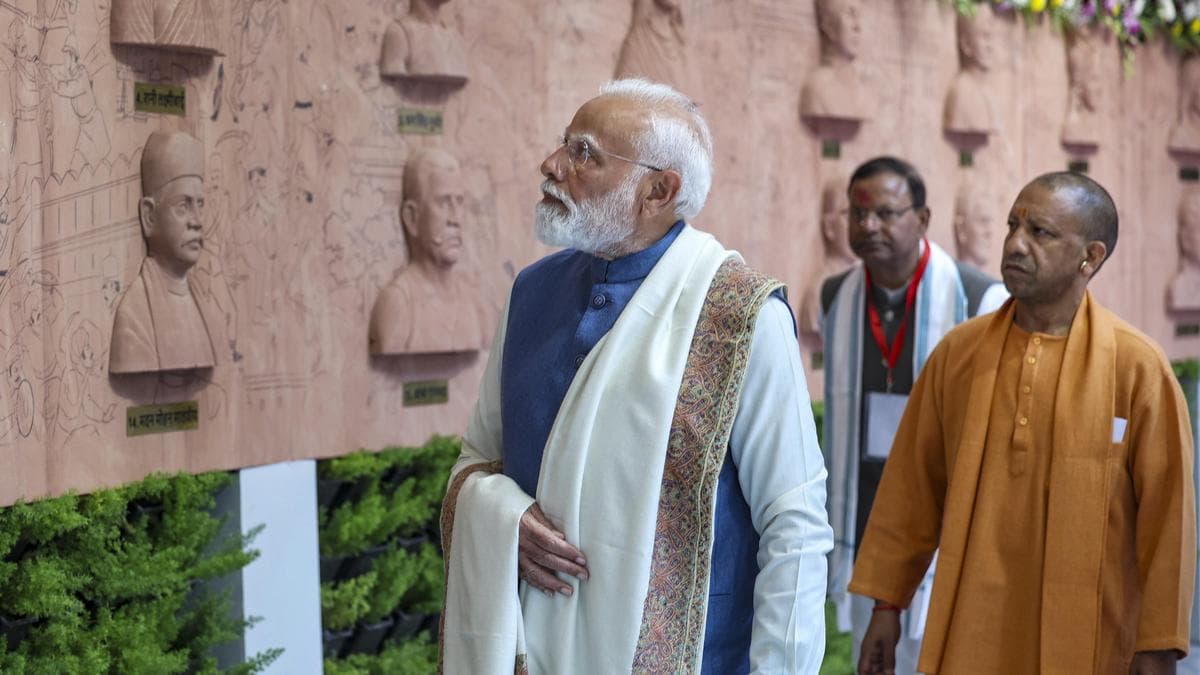
The Rashtra Prerna Sthal in Lucknow was inaugurated on the 101st birth anniversary of former prime minister Atal Bihari Vajpayee