


Relevant for Exams
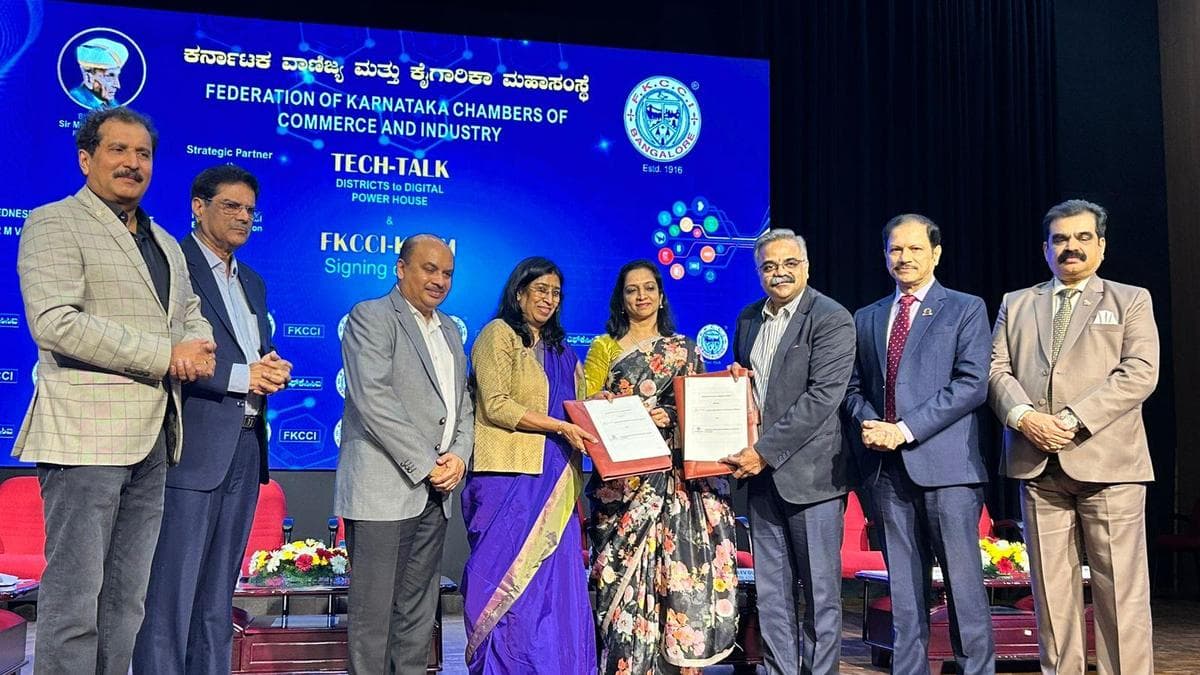
KDEM-FKCCI partner for cluster-based development and MSME growth in Karnataka's non-metro districts.
Summary
The Karnataka Digital Economy Mission (KDEM) has partnered with the Federation of Karnataka Chambers of Commerce and Industry (FKCCI) to foster cluster-based development. This collaboration aims to boost MSME digitisation, startup growth, investment readiness, and entrepreneurship in Karnataka's non-metro districts, moving economic development beyond Bengaluru. It is significant for competitive exams as it highlights state-level economic policies and regional development initiatives.
Key Points
- 1The collaboration is between the Karnataka Digital Economy Mission (KDEM) and the Federation of Karnataka Chambers of Commerce and Industry (FKCCI).
- 2The initiative focuses on driving cluster-based development in non-metro districts of Karnataka, extending beyond Bengaluru.
- 3Key objectives include promoting MSME digitisation, startup growth, investment readiness, and entrepreneurship.
- 4The partnership will leverage FKCCI’s extensive network of over 30 district chambers.
- 5KDEM's role involves implementing its cluster-led ecosystem initiatives to achieve these development goals.
In-Depth Analysis
The recent collaboration between the Karnataka Digital Economy Mission (KDEM) and the Federation of Karnataka Chambers of Commerce and Industry (FKCCI) to drive cluster-based development beyond Bengaluru marks a pivotal step in addressing regional economic disparities and fostering inclusive growth within Karnataka. This initiative, focusing on MSME digitisation, startup growth, investment readiness, and entrepreneurship in non-metro districts, is a practical manifestation of India's broader development goals.
**Background Context: The Bengaluru Phenomenon and Regional Imbalance**
Karnataka, particularly its capital Bengaluru, has long been hailed as India's 'Silicon Valley,' a global hub for Information Technology (IT) and innovation. This rapid growth, while contributing significantly to the state and national GDP, has inadvertently led to a highly centralised economic model. Bengaluru attracts immense investment, talent, and infrastructure, often at the expense of other districts. Non-metro regions grapple with issues such as inadequate infrastructure, limited access to capital, lack of skilled workforce, and a less vibrant entrepreneurial ecosystem. This imbalance results in internal migration, pressure on urban amenities in Bengaluru, and underutilised potential in other parts of the state. Recognizing this, the Karnataka government, through initiatives like KDEM, has been striving to decentralize economic growth and extend the benefits of the digital economy to tier-2 and tier-3 cities.
**What Happened: A Strategic Partnership for Decentralized Growth**
The KDEM-FKCCI partnership is designed to tackle this challenge head-on. KDEM, established under the Department of Electronics, IT, Bt, and S&T, Government of Karnataka, aims to expand the state's digital economy footprint beyond Bengaluru. FKCCI, a century-old apex chamber of commerce and industry in Karnataka, brings to the table an extensive network of over 30 district chambers and deep roots within the local business community, especially among Micro, Small, and Medium Enterprises (MSMEs). The collaboration will leverage FKCCI’s grassroots presence and KDEM’s cluster-led ecosystem initiatives to implement programs focused on four key pillars: enhancing MSME digitisation, nurturing startup growth, improving investment readiness for local businesses, and promoting entrepreneurship across Karnataka's non-metro districts.
**Key Stakeholders and Their Roles**
1. **Karnataka Digital Economy Mission (KDEM):** As a state government initiative, KDEM is the primary driver of digital economy expansion. Its role involves formulating strategies, identifying growth clusters, providing policy support, and facilitating access to technology and expertise. KDEM's cluster-led approach means focusing on specific industries or sectors in different regions to build specialized ecosystems.
2. **Federation of Karnataka Chambers of Commerce and Industry (FKCCI):** Representing the voice of trade and industry, FKCCI acts as the crucial bridge between government initiatives and the local business community. Its network of district chambers will be instrumental in identifying local needs, disseminating information, mobilising MSMEs, and providing on-ground support for implementation.
3. **MSMEs (Micro, Small, and Medium Enterprises):** These are the primary beneficiaries and also the engines of this initiative. By focusing on their digitisation, the partnership aims to enhance their efficiency, market reach, and competitiveness. MSMEs form the backbone of local economies, providing employment and fostering innovation.
4. **Startups and Entrepreneurs:** The initiative seeks to create a conducive environment for new ventures and foster an entrepreneurial spirit outside Bengaluru, diversifying the state's innovation landscape.
5. **State Government:** Provides the overarching policy framework, funding, and regulatory support to ensure the success and sustainability of these development programs.
**Significance for India: A Model for Balanced Regional Development**
This initiative holds immense significance for India's broader development trajectory. Firstly, it directly addresses the critical issue of **regional economic disparities**, a persistent challenge since independence. By decentralizing growth, it can alleviate pressure on mega-cities and create more equitable opportunities. Secondly, the focus on **MSME digitisation** is vital. MSMEs contribute significantly to India's GDP (around 30%) and employment (over 11 crore people). Enabling them to adopt digital tools aligns with the national 'Digital India' mission and enhances their global competitiveness, contributing to 'Atmanirbhar Bharat' (self-reliant India). Thirdly, fostering **startup ecosystems** in non-metro areas will tap into untapped talent pools, reduce brain drain from smaller towns, and promote innovation across diverse sectors. Finally, it aligns with the **federal structure** of India, where states play a crucial role in economic development, often pioneering models that can be emulated nationwide.
**Historical Context and Constitutional Underpinnings**
The idea of balanced regional development has been a cornerstone of India's planning since the First Five-Year Plan (1951-56). Post-independence, various policies aimed at industrial dispersal, such as establishing Public Sector Undertakings (PSUs) in backward regions and offering incentives for private industries to set up units away from metropolitan centers, were pursued. Karnataka's journey saw it emerge as an IT powerhouse in the 1990s, but the benefits remained concentrated. This current initiative is a modern iteration of those historical efforts, adapted for the digital age.
Constitutionally, the Directive Principles of State Policy (DPSP) provide the philosophical bedrock for such initiatives. **Article 38** mandates the state to secure a social order for the promotion of welfare of the people, striving to minimize inequalities in income, status, facilities, and opportunities. **Article 39(b) and (c)** direct the state to ensure that the ownership and control of the material resources of the community are so distributed as best to subserve the common good, and that the operation of the economic system does not result in the concentration of wealth and means of production to the common detriment. These articles underscore the state's responsibility to promote equitable growth and prevent economic concentration, which the KDEM-FKCCI collaboration directly addresses. Furthermore, the **MSME Development Act, 2006**, provides the legal framework for the promotion and development of MSMEs, while central government policies like 'Startup India' and 'Digital India' provide a national impetus to these efforts.
**Future Implications**
The success of this collaboration could transform the economic landscape of Karnataka. It could lead to the emergence of new growth hubs, attract investments, create diverse employment opportunities, and improve the overall quality of life in non-metro districts. It could also serve as a blueprint for other Indian states grappling with similar regional imbalances. Challenges, however, remain, including ensuring adequate infrastructure, sustained funding, skill development, and overcoming bureaucratic hurdles. If successful, this model promises a more inclusive, resilient, and decentralized economic future for Karnataka and potentially for India.
Exam Tips
This topic falls under the 'Indian Economy' section (GS-III for UPSC Civil Services Exam, and relevant sections for State PSCs, SSC, and Banking exams). Focus on understanding government initiatives for regional development and MSME promotion.
Study related topics like the 'MSME Sector in India: Challenges and Opportunities,' 'Regional Disparities in India,' 'Digital India Mission,' 'Startup India Initiative,' and the 'Directive Principles of State Policy (DPSP).' Questions often link these concepts.
Expect questions on policy analysis (e.g., objectives, implementation strategy, potential impact), roles of various stakeholders (government bodies, industry associations), and the significance of such initiatives for inclusive growth and job creation. Be prepared for both factual and analytical questions.
Related Topics to Study
Full Article
The collaboration will leverage FKCCI’s network of over 30 district chambers, alongside KDEM’s cluster-led ecosystem initiatives, to drive MSME digitisation, startup growth, investment readiness, and entrepreneurship across non-metro districts in Karnataka