


Relevant for Exams
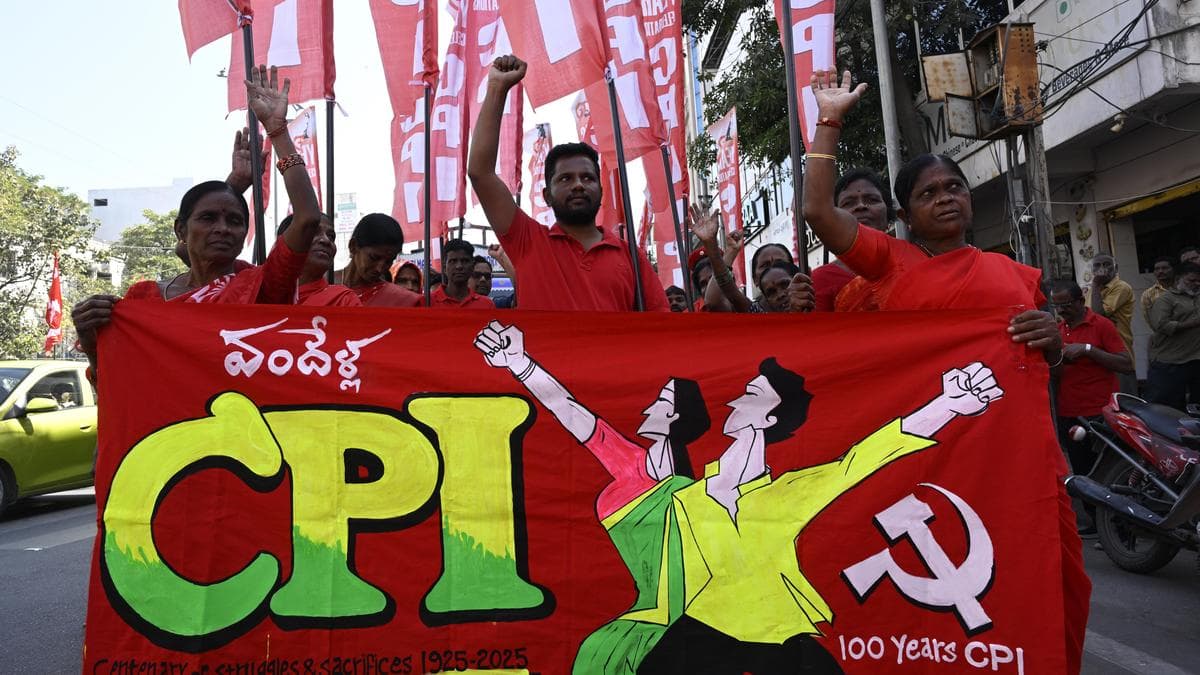
Communist Party of India marks a century of political engagement, reflecting on legacy and core ideals.
Summary
The Communist Party of India (CPI) recently marked a century of its political engagement in India, prompting reflection on its historical legacy. This milestone underscores the party's enduring commitment to rebuilding India on the foundational principles of equality, secularism, and justice. For competitive exams, understanding the CPI's origins, its ideological stance, and its role in India's political history is crucial for General Studies papers.
Key Points
- 1The Communist Party of India (CPI) recently completed a century of its political engagement in India.
- 2The CPI was officially founded on December 26, 1925, in Kanpur, Uttar Pradesh.
- 3The party's core ideological principles, as highlighted, are equality, secularism, and justice.
- 4It stands as one of India's oldest political parties, having played a significant role in the nation's political landscape for 100 years.
- 5The centenary marks an occasion to reflect on the party's historical contributions and its vision for India's future.
In-Depth Analysis
The completion of a century of political engagement by the Communist Party of India (CPI) is a momentous occasion, inviting a deep reflection on its indelible mark on India's political, social, and economic landscape. This milestone is not merely a celebration of longevity but an opportunity to understand the evolution of political ideologies in India and their impact on the nation's foundational principles of equality, secularism, and justice.
**Background Context and Formation:**
The genesis of communism in India is deeply intertwined with global events and India's own struggle for independence. The October Revolution of 1917 in Russia, which brought the Bolsheviks to power, inspired revolutionaries worldwide, including many Indian nationalists. Figures like M.N. Roy, one of the pioneers of Indian communism, were instrumental in spreading Marxist ideas. While an Indian Communist Party was formed in Tashkent in 1920 by émigré Indians, the Communist Party of India (CPI) was officially founded on **December 26, 1925**, in Kanpur, Uttar Pradesh. Its early leaders included S.A. Dange, Muzaffar Ahmed, and Shaukat Usmani. The party emerged from the confluence of anti-colonial sentiment, a growing awareness of class exploitation, and the international communist movement, aiming to organize workers and peasants against both British imperialism and indigenous exploitation.
**What Happened and Key Stakeholders:**
The CPI's century of engagement signifies its enduring presence and influence, despite fluctuating electoral fortunes. The primary stakeholders are the party's cadre and leadership, who have consistently articulated a vision for a socialist India. Beyond the party itself, the working class, peasants, and marginalized communities have historically been its core constituency and beneficiaries of its advocacy. Other key stakeholders include rival political parties, particularly the Indian National Congress (with whom it had a complex relationship, sometimes cooperative, sometimes confrontational) and later, other left parties like the Communist Party of India (Marxist) (CPI(M)), formed after a major split in 1964. The Indian state and various social movements have also been significant actors, interacting with the CPI's demands and policies.
**Significance for India:**
The CPI's legacy is multifaceted. **Politically**, it introduced and popularized socialist and communist ideologies within the mainstream Indian discourse, influencing the direction of post-independence India. It played a crucial role in shaping parliamentary democracy, often serving as a strong opposition voice and participating in coalition governments, notably the first democratically elected communist government in the world in Kerala in 1957. **Socially**, the CPI was instrumental in organizing powerful trade unions and peasant movements, advocating for land reforms, minimum wages, and social justice. Its commitment to secularism has been unwavering, standing against communal forces throughout its history. **Economically**, the party consistently pushed for state-led development, nationalization of industries, and equitable distribution of wealth, influencing policies that aimed to reduce economic disparities. While its direct electoral power has diminished in recent decades, its ideological contributions to India's public policy debates remain significant.
**Historical Context and Constitutional Relevance:**
The CPI's journey reflects India's own evolution. In the pre-independence era, it participated in the freedom struggle, albeit with ideological differences from the mainstream Congress. Post-independence, it initially pursued a path of radical opposition, leading to periods of suppression. The split in 1964, largely due to ideological differences stemming from the Sino-Soviet split and differing views on the Indian government, significantly altered the left landscape. Despite the schism, both CPI and CPI(M) continued to advocate for the principles enshrined in the **Preamble of the Indian Constitution**, particularly the ideals of a "SOVEREIGN SOCIALIST SECULAR DEMOCRATIC REPUBLIC." The inclusion of 'Socialist' and 'Secular' through the **42nd Amendment in 1976** can be seen, in part, as a reflection of the national consensus around these values, which the Left parties strongly championed. Furthermore, the CPI's advocacy aligns with the **Directive Principles of State Policy (DPSP)**, particularly Articles 38, 39, and 43, which call for securing a social order for the promotion of welfare of the people, minimizing inequalities, and ensuring a living wage for workers. The party's existence and activities are safeguarded by **Article 19(1)(c)**, which guarantees the fundamental right to form associations or unions.
**Future Implications:**
As the CPI enters its next century, it faces significant challenges. The global decline of traditional communist movements, economic liberalization in India, and the rise of identity politics have eroded its traditional support base. The party's electoral relevance has dwindled, with its strongholds largely confined to Kerala and Tripura (historically, also West Bengal). However, its commitment to issues like social justice, environmental protection, anti-imperialism, and democratic rights ensures its continued, albeit reduced, presence in the political discourse. For the CPI to regain prominence, it would need to adapt its strategies, forge broader alliances, and articulate its ideology in a manner resonant with contemporary Indian realities, addressing new forms of exploitation and inequality in the age of globalization and digitalization. Its legacy serves as a reminder of the enduring struggle for an equitable and just society, a task that continues to be relevant for India's future.
Exam Tips
This topic falls under 'Indian Polity' and 'Modern Indian History' sections for UPSC, State PSC, and SSC exams. Focus on the timeline of the party's formation, key leaders, and significant events like the 1964 split.
When studying, connect CPI's ideology with the Preamble (Socialist, Secular) and Directive Principles of State Policy (DPSP) like Articles 38, 39, 43. Understand how their demands influenced constitutional amendments and policy-making.
Common question patterns include: factual questions on founding date/place/leaders; analytical questions on the party's impact on Indian politics, land reforms, or labor movements; and comparative questions distinguishing CPI from CPI(M) or other political parties.
Pay attention to the role of communist parties in coalition politics and specific state governments (e.g., Kerala, West Bengal). Questions often test knowledge of 'firsts' like the first democratically elected communist government.
Relate the CPI's journey to broader themes like the evolution of Indian nationalism, the socialist movement in India, and the challenges to secularism and social justice.
Related Topics to Study
Full Article
As the Communist Party of India marks a century of political engagement, its legacy invites reflection on the task to rebuild India on the foundations of equality, secularism, and justice