


Relevant for Exams
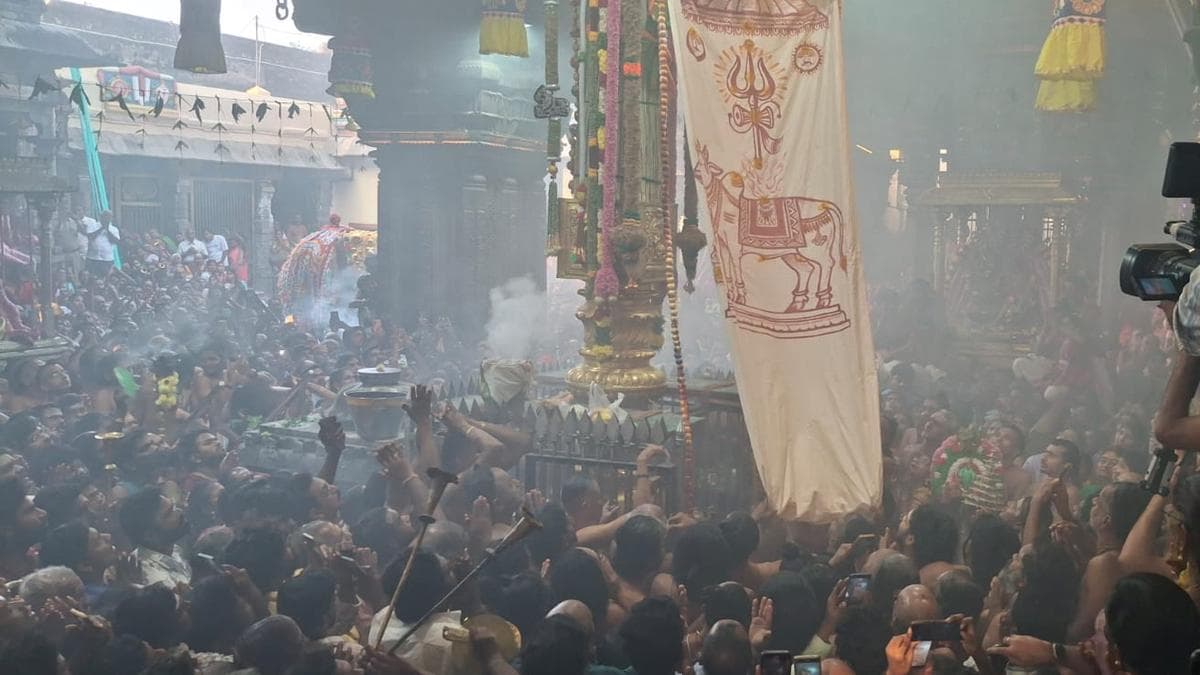
Arudra Darshan festival begins at Chidambaram Natarajar temple with flag hoisting; car procession on Jan 2, 2026.
Summary
The annual Arudra Darshan festival has commenced at the historic Chidambaram Natarajar temple in Tamil Nadu, marked by a flag hoisting ceremony. This significant Shaivite festival, celebrating Lord Shiva as Nataraja, is a key event in India's cultural and religious calendar. For competitive exams, understanding major temple festivals, their locations, and associated dates is crucial for General Knowledge and Culture sections, especially for State Public Service Commissions.
Key Points
- 1The Arudra Darshan festival began at the Chidambaram Natarajar temple.
- 2The festival commenced with a traditional flag hoisting ceremony.
- 3The main car procession is scheduled to take place on January 2, 2026.
- 4The core Arudra Darshan festivities are slated for January 3, 2026.
- 5The Chidambaram Natarajar temple is a renowned Shiva temple located in Chidambaram, Tamil Nadu.
In-Depth Analysis
The Arudra Darshan festival at the Chidambaram Natarajar temple is not just a local event; it's a profound cultural and religious spectacle deeply embedded in India's spiritual fabric, offering a window into its rich heritage and complex legal landscape surrounding religious institutions. The recent flag hoisting ceremony, marking the commencement of the festival with the main car procession on January 2, 2026, and the core Arudra Darshan festivities on January 3, 2026, highlights the enduring vibrancy of such traditions.
**Background Context and Historical Significance:**
The Chidambaram Natarajar Temple, located in Chidambaram, Tamil Nadu, is one of the most ancient and revered Shiva temples in India. It is unique among Shiva temples as Lord Shiva is worshipped here in his cosmic dancer form, Nataraja, depicting the 'Ananda Tandava' (dance of bliss). This temple is also one of the Pancha Bhoota Sthalams, representing Akasha (ether), one of the five primordial elements. Its architecture, predominantly of the Dravidian style, showcases exquisite craftsmanship and has seen patronage from various dynasties, including the Cholas, Pallavas, Pandyas, and Vijayanagara rulers, who contributed significantly to its expansion and embellishment over centuries. The temple's association with the Bhakti movement further solidified its spiritual importance, drawing countless saints and devotees.
**What Happened and Key Stakeholders:**
The Arudra Darshan festival is a significant annual event, typically celebrated in the Tamil month of Margazhi (December-January), culminating on the full moon day of Thiruvathirai (Arudra) star. The flag hoisting ceremony (Dwajarohanam) traditionally marks the official start, signifying the invocation of deities and the commencement of the festivities. The highlight, as mentioned, includes a grand car procession where the Utsava Murti (processional deity) of Nataraja is taken through the streets, followed by the Arudra Darshan itself, where devotees witness the sacred dance of Lord Shiva. This festival attracts lakhs of pilgrims, making it a major spiritual congregation.
Key stakeholders in this festival are primarily the **Podu Dikshitars**, a hereditary community of Brahmin priests who have historically managed the temple and its rituals. Their unique position as both priests and administrators has been a subject of extensive legal battles with the Tamil Nadu government's Hindu Religious and Charitable Endowments (HR&CE) Department. **Devotees** from across India and the globe constitute another crucial stakeholder group, whose faith and participation sustain these traditions. The **Tamil Nadu Government** and its various departments (Police, HR&CE, Tourism) play a role in ensuring law and order, managing crowds, and promoting cultural tourism, even if direct administrative control over the Chidambaram temple by HR&CE has been historically contentious.
**Significance for India and Constitutional Dimensions:**
This festival holds immense significance for India. Culturally, it preserves ancient traditions, classical art forms like Bharatanatyam (which draws heavily from the Nataraja iconography), and architectural heritage. Economically, it fuels religious tourism, providing livelihoods for local communities and contributing to the state's economy through hospitality, transport, and trade. Socially, it fosters community bonding and reinforces cultural identity.
The ongoing debate regarding the administration of the Chidambaram temple by the Dikshitars, rather than the state's HR&CE Department, brings into focus crucial constitutional provisions. **Articles 25 and 26** of the Indian Constitution guarantee the freedom of conscience and the right to freely profess, practice, and propagate religion, and the freedom to manage religious affairs, respectively. Article 26(b) grants religious denominations the right to manage their own affairs in matters of religion. The Supreme Court, in landmark judgments such as *P.R. Palanisamy v. State of Tamil Nadu* (2014), affirmed the right of the Dikshitars to administer the temple, recognizing them as a 'religious denomination' under Article 26. This ruling highlighted the delicate balance between state regulation of secular aspects of religious institutions (such as finances and administration to prevent maladministration, as permitted by Article 25(2)(a) and 26(d)) and the protection of religious autonomy. The **Tamil Nadu Hindu Religious and Charitable Endowments Act, 1959**, which governs most temples in the state, generally allows state oversight, but the Chidambaram temple has remained a notable exception due to these judicial pronouncements. This case exemplifies the broader theme of balancing religious freedom with state intervention in India.
**Future Implications:**
The continued celebration of festivals like Arudra Darshan ensures the perpetuation of India's rich spiritual and cultural legacy. Future implications include the ongoing need for effective crowd management, infrastructure development to accommodate increasing pilgrim numbers, and the delicate navigation of temple administration disputes. The Chidambaram temple's unique administrative model will likely continue to be a reference point in discussions about religious autonomy and state control over temples. Furthermore, the festival can be leveraged for promoting cultural tourism responsibly, ensuring both economic benefits and the preservation of its sanctity and heritage for generations to come.
Exam Tips
This topic falls under 'Indian Art, Culture, Heritage' and 'Current Affairs' sections for UPSC, State PSC, SSC, and Railway exams. Focus on the temple's location, associated deity, architectural style, and the significance of the Arudra Darshan festival.
Study related topics like other major Hindu festivals (e.g., Kumbh Mela, Rath Yatra), prominent temples in South India (e.g., Meenakshi Temple, Brihadeeswarar Temple), and the characteristics of Dravidian temple architecture. Understand the concept of Pancha Bhoota Sthalams.
Be prepared for questions on constitutional articles related to religious freedom (Articles 25, 26) and the role of state governments in managing religious institutions (e.g., HR&CE Acts). Factual questions on the Chidambaram temple (location, deity) and conceptual questions on the balance between state and religious autonomy are common.
Understand the historical context, including the contributions of various dynasties (Cholas) to the temple's development and the influence of the Bhakti movement.
Familiarize yourself with the legal battles concerning the Chidambaram temple's administration, particularly the role of the Dikshitars and Supreme Court judgments regarding Article 26.
Related Topics to Study
Full Article
The highlights of the festival are the car procession on January 2, 2026 and the Arudra Darshan festivities on January 3.