


Relevant for Exams
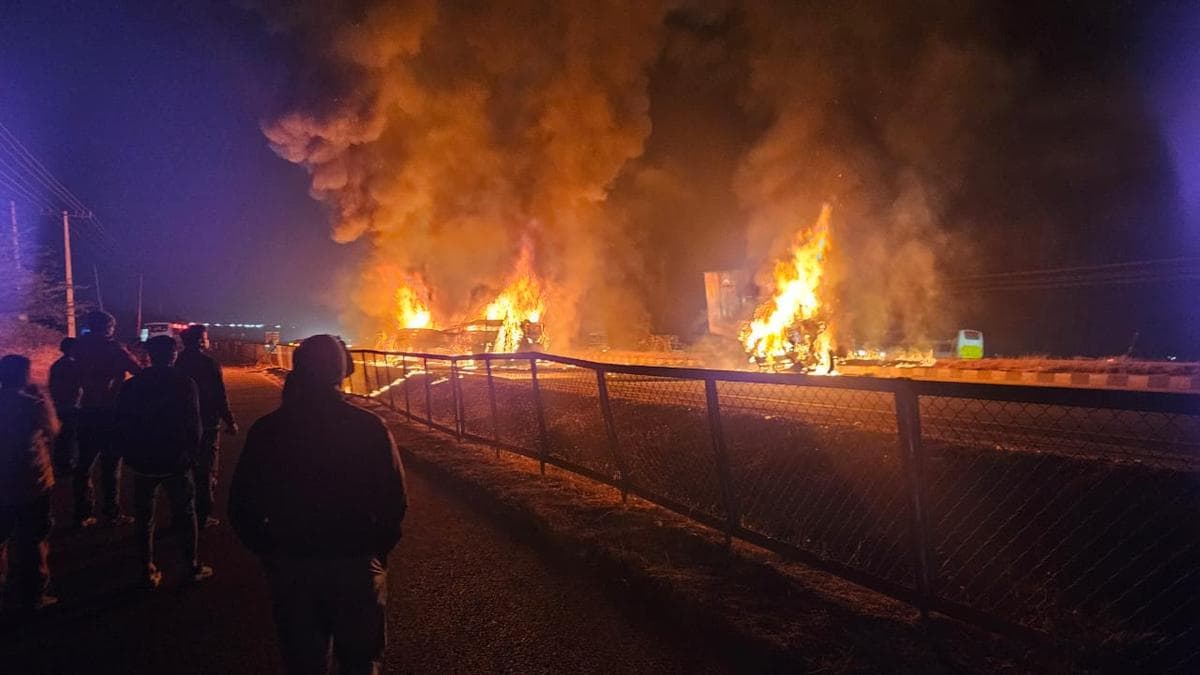
11 dead, many injured in Karnataka's Chitradurga after truck hits sleeper bus causing fire.
Summary
A tragic road accident in Chitradurga, Karnataka, resulted in 11 fatalities and several injuries when a truck collided with a private sleeper bus. The bus, travelling from Bengaluru to Gokarna via Shivamogga, caught fire post-collision. While a significant local event, such incidents primarily serve as general awareness for state-specific competitive exams rather than core national policy questions, highlighting road safety concerns.
Key Points
- 1A road accident in Chitradurga, Karnataka, led to the death of 11 individuals.
- 2The incident involved a collision between a truck and a private sleeper bus.
- 3The private bus was en route from Bengaluru to Gokarna, passing through Shivamogga.
- 4The collision occurred when the truck hit the bus from behind, causing the bus to be engulfed in flames.
- 5Several other passengers sustained injuries in the tragic accident.
In-Depth Analysis
The tragic road accident in Chitradurga, Karnataka, which claimed 11 lives and left several injured, serves as a grim reminder of India's persistent challenges in road safety. While seemingly a localized incident, it encapsulates broader systemic issues that plague the nation's transportation infrastructure and regulatory framework. Understanding such events for competitive exams requires looking beyond the immediate tragedy to the underlying causes, policy responses, and their societal implications.
India records an alarmingly high number of road accidents and fatalities globally. According to the Ministry of Road Transport and Highways (MoRTH) report 'Road Accidents in India - 2022', over 1.68 lakh people lost their lives in road crashes in 2022, with over 4.6 lakh accidents. This translates to an average of 462 deaths per day. These statistics highlight a public health crisis that far exceeds the impact of many diseases. The Chitradurga incident, where a truck collided with a private sleeper bus from behind, leading to a fire, points to common causal factors: driver error (potentially fatigue or distraction), vehicle fitness (especially for older vehicles or those carrying flammable materials), and inadequate road design or signage.
Several key stakeholders are involved in the aftermath and prevention of such incidents. The immediate stakeholders include the **victims and their families**, who bear the brunt of the tragedy, facing emotional trauma, financial hardship, and loss of livelihood. The **private bus and truck operators** are crucial, as their adherence to safety norms, maintenance schedules, and driver employment practices directly impact road safety. Law enforcement agencies, particularly the **Karnataka Police**, are responsible for investigation, accident response, and enforcing traffic laws. The **State Transport Department** plays a vital role in vehicle registration, licensing drivers, and ensuring compliance with the Motor Vehicles Act. Furthermore, agencies like the **National Highways Authority of India (NHAI)** are responsible for designing, constructing, and maintaining national highways, where a significant portion of these accidents occur. Finally, the **Ministry of Road Transport and Highways (MoRTH)** at the central level formulates national policies and acts like the Motor Vehicles Act.
This incident matters significantly for India due to its profound human, economic, and social costs. The loss of young, productive lives impacts families and the national economy through lost productivity. The economic cost of road crashes in India is estimated to be between 3-5% of GDP annually, a staggering figure that impedes development. Socially, such accidents erode public trust in transportation systems and raise questions about the efficacy of governance. Historically, road safety legislation in India has evolved from the Motor Vehicles Act of 1939 to the more comprehensive Motor Vehicles Act of 1988, which was significantly amended in 2019. The **Motor Vehicles (Amendment) Act, 2019**, introduced stringent penalties for traffic violations, provisions for cashless treatment for accident victims, mandatory recall of defective vehicles, and enhanced safety standards for vehicles and roads. This amendment was a landmark step to address India's poor road safety record.
From a constitutional perspective, the right to life, enshrined in **Article 21** of the Indian Constitution, implicitly includes the right to a safe environment and safe public spaces, including roads. The state's failure to ensure road safety can be seen as a violation of this fundamental right. Road transport falls under the **Concurrent List (Entry 35 of List III)** of the Seventh Schedule, allowing both the Parliament and state legislatures to enact laws. This dual jurisdiction necessitates coordinated efforts for effective policy implementation. The National Road Safety Policy, launched in 2010, outlines various measures including education, engineering (roads and vehicles), enforcement, and emergency care.
The future implications of such accidents underscore the urgent need for a multi-pronged approach. This includes stricter enforcement of traffic laws, investing in advanced road safety technologies (like Intelligent Transport Systems, speed cameras, and vehicle telematics), improving driver training and licensing processes (including addressing driver fatigue), enhancing vehicle fitness standards, and promoting public awareness campaigns. The concept of 'Vision Zero', aiming for zero road fatalities, is gaining traction globally and requires a concerted effort from all stakeholders. Furthermore, improving post-crash care and emergency medical services, often lacking in remote areas, is critical to reducing fatalities. The Chitradurga accident is not an isolated event but a call to action for a nation striving for development while grappling with the preventable loss of precious lives on its roads.
Exam Tips
**General Studies (Paper I, II, III):** This topic falls under Infrastructure (GS-III), Governance/Social Justice (GS-II), and sometimes even Geography (GS-I) in terms of transport networks. Focus on government policies, acts, and their impact.
**Related Topics to Study:** Thoroughly understand the Motor Vehicles (Amendment) Act, 2019, including its key provisions, penalties, and new initiatives like the Good Samaritan Law and automated testing. Also, study government schemes like Bharatmala Pariyojana and National Highway development, and how they incorporate safety measures.
**Common Question Patterns:** Expect questions on the causes of road accidents in India, government measures to improve road safety, challenges in implementing road safety policies, the role of technology (e.g., ITS) in accident prevention, and the constitutional/legal framework surrounding road transport. Data-based questions on India's road accident statistics are also common.
Related Topics to Study
Full Article
The private bus was heading to Gokarna from Bengaluru via Shivamogga, when it was engulfed in flames after the truck collided with it from behind