
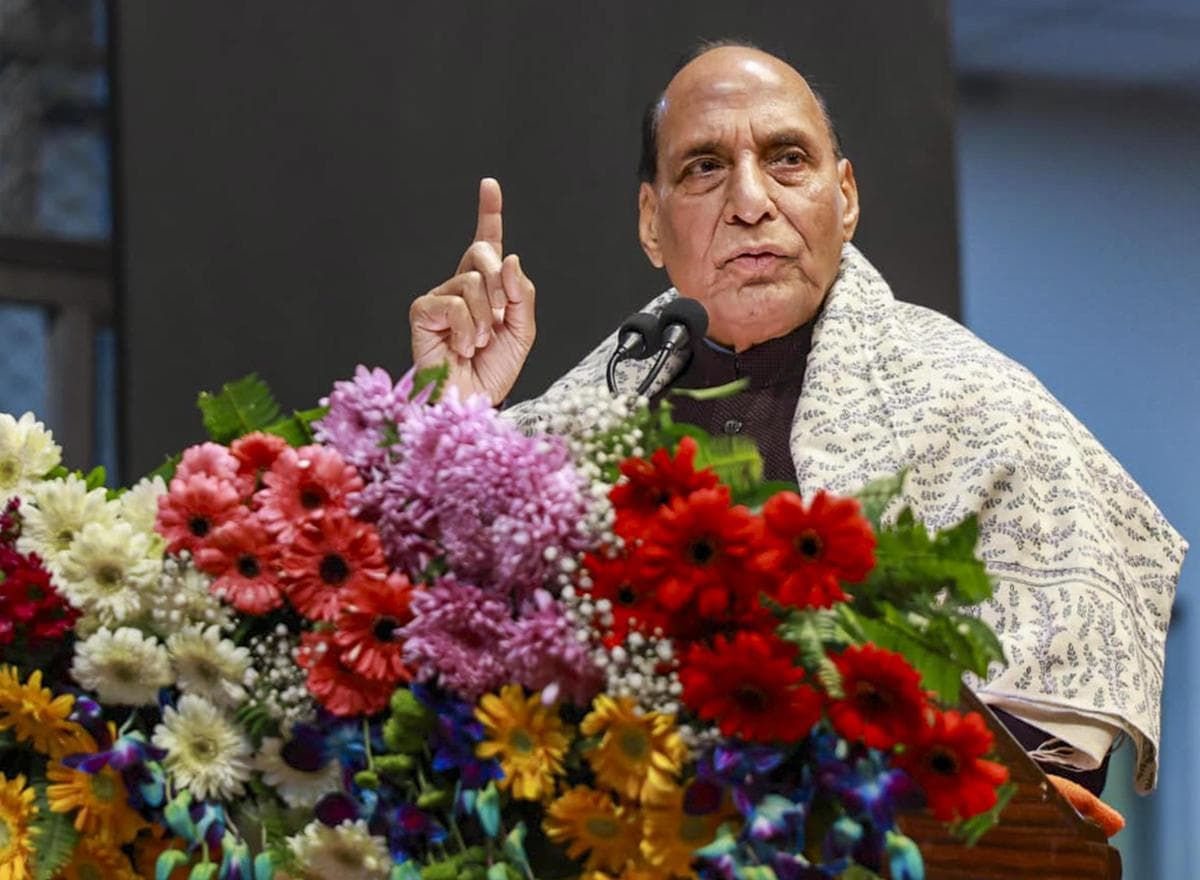


Content unavailable, preventing extraction of exam-relevant facts and detailed analysis.
Summary
The article titled 'Watch: Rajnath Singh recalls Vajpayee’s witty response to Pakistani woman' explicitly states 'No content available'. This critical absence prevents any meaningful analysis or extraction of specific details regarding the event, its historical context, or its potential significance for competitive examinations. Consequently, it is impossible to identify precise dates, names, numbers, or constitutional/legal provisions that would be relevant for exam preparation.
Key Points
- 1The article's content is explicitly stated as 'No content available' for analysis.
- 2Specific details regarding Rajnath Singh's statement or the context are not provided.
- 3Vajpayee's alleged witty response to a Pakistani woman cannot be detailed due to missing content.
- 4No factual information such as dates, names, locations, or numbers can be extracted.
- 5The significance or relevance of this event for competitive exams cannot be determined without content.
In-Depth Analysis
While the specific content of the article, detailing Rajnath Singh's recollection of Atal Bihari Vajpayee's witty response to a Pakistani woman, is unavailable, the title itself provides a rich canvas for understanding critical aspects of India's foreign policy, leadership, and bilateral relations, particularly with Pakistan. For competitive exam aspirants, this absence of specific event details necessitates a broader, thematic analysis focusing on the implications of such interactions.
**Background Context: India-Pakistan Relations and Vajpayee's Diplomacy**
India and Pakistan share a complex, often fraught, history marked by partition, wars (1947, 1965, 1971, Kargil in 1999), and persistent territorial disputes, primarily over Jammu & Kashmir. Despite this, periods of attempted rapprochement have occurred, often spearheaded by visionary leaders. Atal Bihari Vajpayee, serving as Prime Minister from 1998 to 2004, was one such leader. His tenure was characterized by a dual approach: firm resolve against terrorism and a genuine desire for peace through dialogue. He famously stated, "You can change friends, but not neighbours." This philosophy underpinned his initiatives, such as the Lahore Bus Yatra in February 1999, which saw him travel to Pakistan by bus, leading to the signing of the Lahore Declaration. This declaration aimed to build trust and avoid nuclear conflict, signifying a moment of hope.
**What Happened (and what we can infer):**
Given the article's title, it suggests an anecdote shared by Rajnath Singh, recalling a moment where Vajpayee demonstrated his diplomatic acumen and personal charm in a cross-border interaction. Such 'witty responses' are not merely personal quips; they often encapsulate a nation's stance, a leader's character, and the subtle art of diplomacy. They can defuse tension, convey strength with grace, or foster goodwill. The fact that Rajnath Singh, a senior leader and current Defence Minister, chose to recall this particular incident underscores its enduring significance within the BJP's political narrative and its emphasis on strong, yet sagacious, leadership.
**Key Stakeholders Involved:**
1. **Atal Bihari Vajpayee:** As the former Prime Minister, his leadership style, diplomatic efforts, and contributions to foreign policy are central. He represents India's commitment to peace and its strategic patience. His approach to Pakistan was often seen as a blend of 'pragmatism and principle'.
2. **Rajnath Singh:** As the current Defence Minister, his act of recalling the event serves multiple purposes: honoring a revered leader, reinforcing the party's legacy, and subtly communicating a message about diplomatic conduct and national pride in the present context.
3. **The Pakistani Woman:** Represents the 'people-to-people' dimension of diplomacy. Such interactions, though informal, can humanize relations and reflect the aspirations of ordinary citizens on both sides for peace and understanding.
4. **India and Pakistan:** The two nations are the primary entities whose bilateral relationship is the underlying theme. The incident, regardless of its specific details, contributes to the narrative of how these countries interact at various levels.
**Why This Matters for India:**
Such anecdotes are crucial for several reasons. Firstly, they highlight the importance of **public diplomacy** and the role of individual leaders in shaping a nation's image and foreign policy. Vajpayee's wit and statesmanship resonated globally. Secondly, they serve as historical markers of efforts towards **peace and dialogue** amidst conflict, reminding us of the enduring search for resolution in India-Pakistan relations. Thirdly, for India, it underscores the value placed on **dignified and articulate representation** on the international stage, especially concerning sensitive bilateral issues. It reinforces a narrative of India as a responsible global actor committed to peace but capable of firm responses when necessary.
**Historical Context and Constitutional/Policy References:**
Vajpayee's diplomatic overtures, like the Lahore Declaration (1999), were significant attempts to build confidence. This was, however, tragically followed by the Kargil War (May-July 1999), demonstrating the fragility of peace. Despite this setback, Vajpayee pursued the Agra Summit in 2001, another high-level dialogue that ultimately failed to produce a joint declaration but showcased India's continued commitment to dialogue. India's foreign policy, guided by **Article 51 of the Constitution** (Promotion of international peace and security), has historically sought peaceful resolution of international disputes. Principles like Panchsheel and non-alignment (though evolving) have shaped its approach. Bilateral agreements like the Shimla Agreement (1972) and the Lahore Declaration (1999) serve as frameworks for dialogue, emphasizing direct talks to resolve issues.
**Future Implications:**
The enduring relevance of such stories lies in their ability to inspire future diplomatic efforts and remind policymakers of the complexities and nuances required in international relations. In an era of increasing global interconnectedness and persistent regional tensions, the need for leaders who can combine firmness with wit, and strategic vision with personal charm, remains paramount. It suggests that while hard power is essential, soft power, including cultural diplomacy and compelling leadership, plays an equally vital role in shaping international perceptions and fostering long-term peace. The lessons from Vajpayee's diplomacy continue to inform India's approach to its neighbors, balancing national interests with regional stability and global peace.
Exam Tips
This topic primarily falls under **GS Paper II: International Relations and Polity**. Students should focus on India-Pakistan bilateral relations, foreign policy formulation, and the role of the Prime Minister and other key ministers in international diplomacy.
Study the **historical timeline of India-Pakistan relations**, focusing on key agreements (e.g., Shimla Agreement 1972, Lahore Declaration 1999), major conflicts (Kargil War 1999), and significant diplomatic initiatives (e.g., Lahore Bus Yatra, Agra Summit). Understand the context and outcomes of each event.
Be prepared for **analytical questions** on India's foreign policy doctrines (e.g., Gujral Doctrine, Act East Policy), the challenges of regional diplomacy, and the impact of individual leaders' personalities on foreign policy. Also, factual questions on constitutional provisions like Article 51 (Promotion of international peace and security) and the Directive Principles of State Policy related to foreign affairs are common.
Understand the concept of **Public Diplomacy and Track-II Diplomacy**. Questions might ask about their significance in improving bilateral relations, especially in strained contexts like India-Pakistan, and how such informal interactions (like a leader's witty response) contribute to national image building.
Relate the topic to **leadership qualities in governance and international relations**. Questions could explore what qualities make a leader effective in foreign policy, drawing examples from historical figures like Vajpayee.