


Relevant for Exams
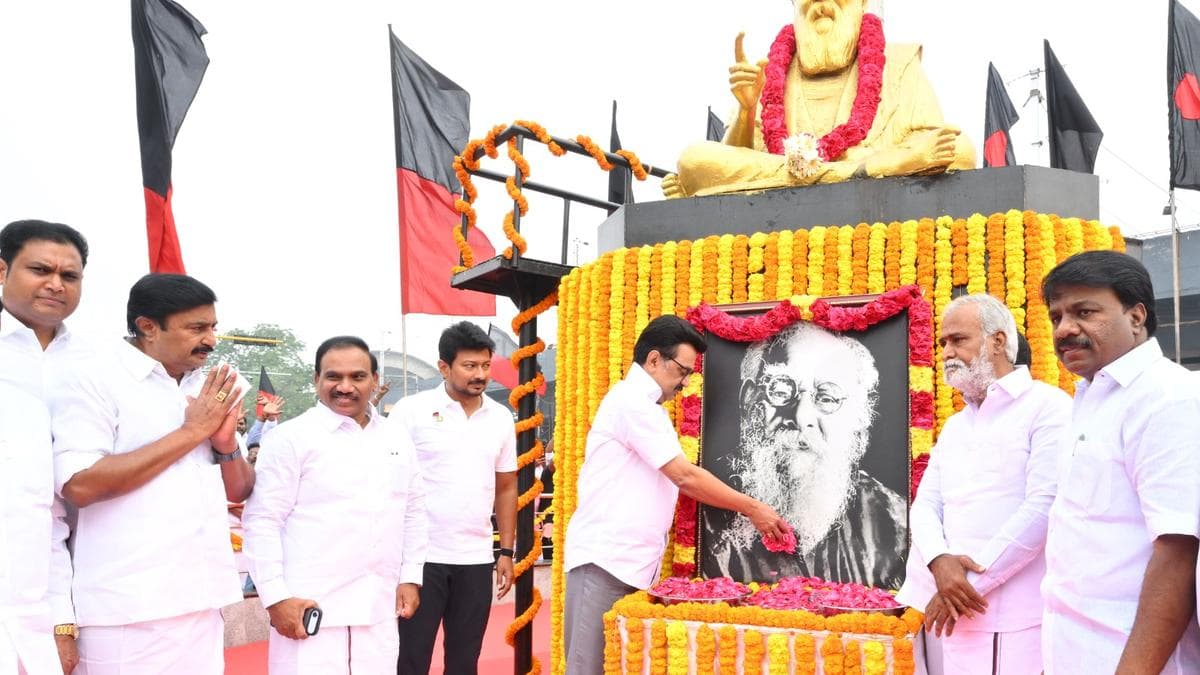
T.N. CM Stalin pays tribute to social reformer Periyar on his death anniversary, highlighting his legacy.
Summary
T.N. CM M.K. Stalin paid tribute to social reformer Periyar E.V. Ramasamy on his death anniversary. This event underscores Periyar's enduring legacy in advocating for social justice, rationalism, and anti-caste principles, particularly in Tamil Nadu. For competitive exams, understanding Periyar's contributions to the Self-Respect Movement and Dravidian politics is crucial for questions on modern Indian history and socio-political movements.
Key Points
- 1Periyar E.V. Ramasamy, a prominent social reformer and politician, passed away on December 24, 1973.
- 2He is widely known as the 'Father of the Dravidian Movement' and founder of the Self-Respect Movement.
- 3Periyar advocated for social equality, rationalism, self-respect, and women's rights, challenging caste hierarchies and religious dogma.
- 4His ideology significantly shaped Tamil Nadu's political landscape and social justice policies.
- 5M.K. Stalin, the current Chief Minister of Tamil Nadu, belongs to the Dravida Munnetra Kazhagam (DMK) party, which traces its ideological roots to Periyar's movement.
In-Depth Analysis
The tribute paid by Tamil Nadu Chief Minister M.K. Stalin to Periyar E.V. Ramasamy on his death anniversary on December 24, 1973, is not merely a ceremonial act; it's a profound acknowledgment of a figure whose ideology continues to shape the socio-political fabric of Tamil Nadu and holds significant lessons for India as a whole. Periyar, often hailed as the 'Father of the Dravidian Movement', was a radical social reformer who challenged the entrenched caste system, religious dogma, and patriarchal norms of early 20th-century India.
**Background Context and Historical Roots:**
To understand Periyar's impact, one must delve into the social landscape of the Madras Presidency during the British Raj. This period was marked by stark inequalities, particularly the dominance of Brahmins in education, administration, and public life, disproportionate to their population. Non-Brahmin communities, despite their numerical strength, faced systemic discrimination and limited opportunities. This led to the emergence of non-Brahmin movements, most notably the South Indian Liberal Federation, popularly known as the Justice Party, founded in 1916. Periyar initially joined the Indian National Congress but grew disillusioned with its perceived Brahminical dominance and its failure to adequately address caste issues. His pivotal moment came in 1925 at the Kanchipuram session of the Congress, where his resolution advocating for communal representation in education and employment was rejected. This led him to leave the Congress and dedicate himself to the cause of social justice.
**The Rise of the Self-Respect Movement and Periyar's Ideology:**
In 1925, Periyar launched the Self-Respect Movement, a revolutionary social reform agenda that advocated for a society where individuals could live with dignity, free from the shackles of caste, religion, and superstition. His core tenets included rationalism, self-respect, women's rights, and anti-casteism. He fiercely critiqued Hinduism, particularly its caste hierarchy, and promoted atheism and rational thought. Periyar championed self-respect marriages, simplified Tamil, and challenged the subjugation of women, advocating for their education, property rights, and freedom to choose their partners. His movement gained significant traction, especially among the backward classes and Dalits, offering an alternative vision of society.
**Key Stakeholders and Their Roles:**
Periyar E.V. Ramasamy himself was the central figure, a charismatic leader and prolific writer who articulated his radical ideas through speeches, journals like 'Kudi Arasu' and 'Viduthalai', and public debates. The **Self-Respect Movement** and later the **Dravidar Kazhagam (DK)**, which he founded in 1944, served as platforms for his ideology. The **Justice Party**, though initially a political vehicle, eventually merged with the DK, solidifying the non-Brahmin political consciousness. Today, the **Dravida Munnetra Kazhagam (DMK)**, led by M.K. Stalin, and its offshoot, the All India Anna Dravida Munnetra Kazhagam (AIADMK), are direct inheritors of Periyar's legacy, albeit with adaptations. These parties have dominated Tamil Nadu politics for over five decades, consistently implementing policies rooted in social justice and regional autonomy. The **people of Tamil Nadu**, particularly the marginalized communities, are the direct beneficiaries and continued adherents of Periyar's vision.
**Significance for India and Constitutional Implications:**
Periyar's movement profoundly shaped not just Tamil Nadu but also influenced the broader discourse on social justice in India. His relentless advocacy for reservations for backward classes directly contributed to the early constitutional debates in independent India. The *Champakam Dorairajan v. State of Madras* case (1951), arising from a Madras government order on communal reservation, led to the **First Constitutional Amendment Act, 1951**. This amendment introduced **Article 15(4)**, enabling the state to make special provisions for the advancement of any socially and educationally backward classes of citizens or for the Scheduled Castes and the Scheduled Tribes. Similarly, **Article 16(4)** allows for reservations in public employment. These articles form the bedrock of India's affirmative action policies, directly influenced by the struggles spearheaded by Periyar and his contemporaries. Tamil Nadu's 69% reservation policy, upheld by the Supreme Court in *Indra Sawhney & Others v. Union of India* (1992) and later placed under the Ninth Schedule, is a testament to the enduring impact of the Dravidian movement's commitment to social equity. Periyar's emphasis on rationalism also contributed to the secular fabric of Indian society, challenging religious fundamentalism.
**Future Implications and Broader Themes:**
The legacy of Periyar continues to be relevant in contemporary India, especially in debates surrounding caste census, sub-categorization of OBCs, and the push for greater federal autonomy. His emphasis on regional identity and language rights continues to resonate in state-centre relations. While Periyar's radical views on religion and language have been tempered by mainstream political parties, his core principles of social justice, anti-casteism, and gender equality remain foundational to Tamil Nadu's politics and public policy. The ongoing demand for a nationwide caste census, for instance, finds its ideological roots in the kind of data-driven advocacy for representation that Periyar championed. His life and movement offer a crucial case study in grassroots social reform, political mobilization, and the complex interplay between caste, religion, and power in a diverse democracy like India.
Exam Tips
This topic falls under 'Modern Indian History' (Social and Religious Reform Movements, Post-Independence Consolidation) and 'Indian Polity' (Constitutional Amendments, Fundamental Rights, Reservation Policy, Federalism).
Study Periyar alongside other social reformers like Jyotirao Phule and B.R. Ambedkar to understand the diverse trajectories of anti-caste movements across India. Also, link his work to the Justice Party and the formation of the DMK.
Common question patterns include: direct questions on Periyar's ideology and contributions, the impact of the Self-Respect Movement, the link between the Dravidian Movement and constitutional amendments (e.g., Article 15(4)), and the evolution of reservation policy in India. Expect both factual and analytical questions.
Pay attention to specific dates (e.g., 1925 for Self-Respect Movement, 1944 for Dravidar Kazhagam, 1951 for First Amendment) and key cases (Champakam Dorairajan, Indra Sawhney).
Understand the difference between Periyar's Dravidar Kazhagam (DK) and the political party Dravida Munnetra Kazhagam (DMK) and their ideological evolution.