



Relevant for Exams
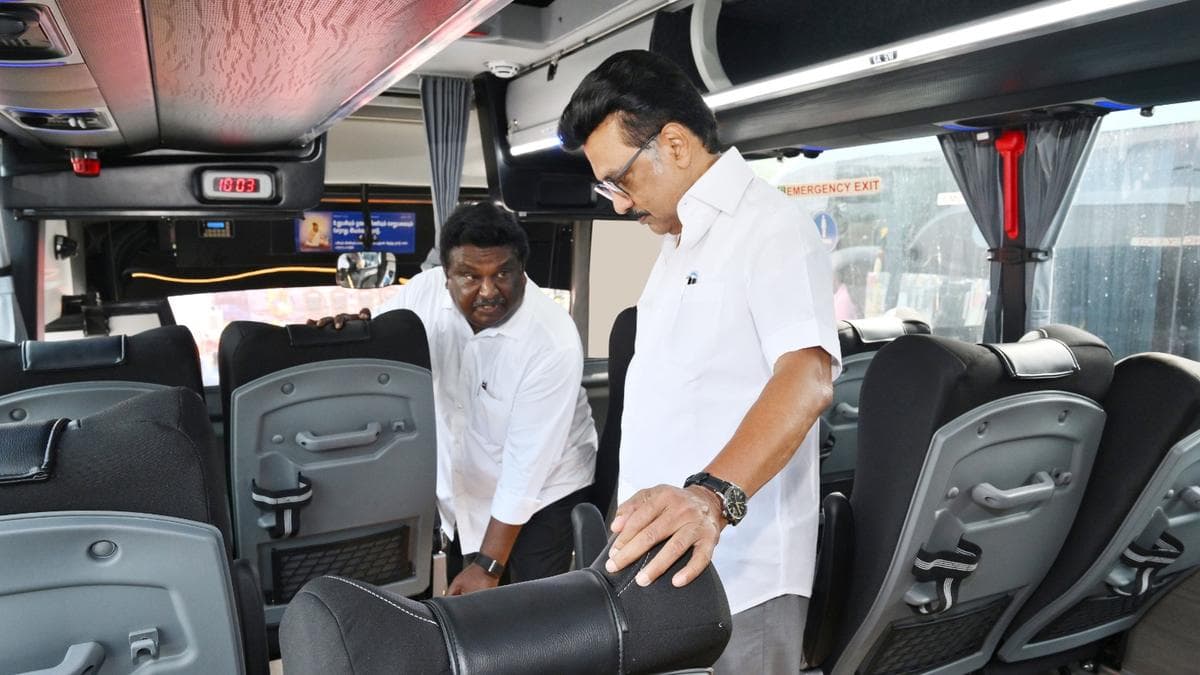
T.N. CM Stalin flags off 20 new ₹34.30 crore multi-axle AC buses for SETC.
Summary
Tamil Nadu Chief Minister M.K. Stalin flagged off 20 new multi-axle air-conditioned buses for the State Express Transport Corporation (SETC). Procured at a cost of ₹34.30 crore, these buses aim to enhance public transportation and passenger comfort across various routes in Tamil Nadu. This development is significant for state-level competitive exams, focusing on infrastructure projects and government initiatives.
Key Points
- 1Tamil Nadu Chief Minister M.K. Stalin flagged off 20 multi-axle air-conditioned buses.
- 2The buses were procured at a total cost of ₹34.30 crore.
- 3Each new bus is equipped with comfortable seating arrangements for 51 passengers.
- 4The buses will be operated by the Tamil Nadu Transport Department.
- 5The initiative aims to enhance connectivity on various routes across Tamil Nadu.
In-Depth Analysis
The flagging off of 20 new multi-axle air-conditioned buses by Tamil Nadu Chief Minister M.K. Stalin for the State Express Transport Corporation (SETC) marks a significant step in the state's ongoing efforts to modernize and enhance its public transportation infrastructure. This initiative, costing ₹34.30 crore, goes beyond merely adding new vehicles; it reflects a broader commitment to improving passenger comfort, connectivity, and the overall efficiency of public transit, which is crucial for a rapidly urbanizing and economically vibrant state like Tamil Nadu.
**Background Context and the Need for Modernization:**
India's public transportation system faces immense pressure from a growing population, increasing urbanization, and the associated demands for efficient, safe, and comfortable travel. State Road Transport Corporations (SRTCs) have historically been the backbone of inter-city and intra-state travel, particularly for the common person. However, many SRTCs, including some in Tamil Nadu, have grappled with aging fleets, financial constraints, and the need to upgrade services to meet contemporary passenger expectations. The COVID-19 pandemic further highlighted the importance of robust and reliable public transport, even as it posed unprecedented challenges. This latest procurement by the Tamil Nadu government can be seen as a direct response to these evolving needs, aiming to provide a premium travel experience that can compete with private operators and encourage a modal shift from personal vehicles to public transport.
**Key Stakeholders Involved:**
Several key players are central to this development. Firstly, the **Tamil Nadu Government**, led by Chief Minister M.K. Stalin, is the primary policy maker and financier. Its vision for improved public services and infrastructure drives such initiatives. The **Tamil Nadu Transport Department** and the **State Express Transport Corporation (SETC)** are the implementing agencies, responsible for the procurement, operation, and maintenance of these buses. SETC specifically manages long-distance routes within and outside Tamil Nadu. **Citizens and commuters** are the ultimate beneficiaries, directly experiencing the improved comfort and connectivity. Furthermore, **bus manufacturers** play a crucial economic role, providing the advanced vehicles and contributing to industrial growth within the automotive sector. This network of stakeholders ensures the successful conceptualization, execution, and utilization of public assets.
**Significance for Tamil Nadu and India:**
This initiative holds multifaceted significance. For Tamil Nadu, it means enhanced connectivity across various routes, potentially boosting economic activities by facilitating easier movement of labor, goods, and tourists. Improved public transport can reduce travel times, lower logistics costs, and provide reliable access to educational institutions, healthcare facilities, and employment centers, especially for those in semi-urban and rural areas. Socially, it promotes equity by making comfortable travel accessible to a wider demographic, reducing dependence on more expensive private transport options. Economically, investment in state-owned enterprises like SETC can lead to job creation, both directly (drivers, conductors, maintenance staff) and indirectly (manufacturing, supply chain). From an environmental perspective, encouraging a shift to public transport, even if diesel-powered initially, can help reduce overall traffic congestion and per-capita emissions compared to individual private vehicles. This aligns with broader national goals of sustainable urban development and infrastructure growth, as envisioned in policies like the National Urban Transport Policy, 2006, which emphasizes the need for efficient, safe, and affordable public transport.
**Historical and Constitutional Context:**
Public transport in India has a rich history, with state transport undertakings (STUs) being established post-independence to provide essential services, often nationalizing private routes for better public control and reach. The Motor Vehicles Act, 1988, is the primary legislation governing road transport in India, setting standards for vehicle registration, driver licensing, and operational permits, directly impacting how STUs function. Constitutionally, the provision of public transport falls largely within the purview of state governments. The **Seventh Schedule** of the Indian Constitution places 'communications' (including roads and bridges) and 'mechanically propelled vehicles' (concurrent list) under the legislative competence of states, with the Union also having a role. More importantly, the **Directive Principles of State Policy (DPSP)**, particularly **Article 38** (promoting the welfare of the people), **Article 39** (ensuring that the ownership and control of the material resources of the community are so distributed as best to subserve the common good), and **Article 47** (raising the standard of living and improving public health), serve as guiding principles for such state-led welfare initiatives. These articles underscore the state's responsibility to provide essential services and improve the quality of life for its citizens.
**Future Implications:**
Looking ahead, this move by Tamil Nadu could pave the way for further modernization across its transport fleet, potentially including a greater push towards electric buses, aligning with India's FAME-II scheme and climate goals. The focus on passenger comfort might set a new benchmark for other state transport corporations. Furthermore, improved inter-district and inter-state connectivity through SETC could foster greater regional integration and boost tourism. The state might explore Public-Private Partnerships (PPPs) for future procurements and operational efficiencies, a model increasingly adopted in various infrastructure projects across India. Ultimately, such investments are crucial for building resilient, efficient, and inclusive public transport systems that are vital for India's continued growth and development in the 21st century.
Exam Tips
This topic falls under 'Indian Polity & Governance' (State Government, Public Administration, Social Sector Initiatives) and 'Indian Economy' (Infrastructure Development, State Finances) sections of competitive exam syllabi. It's also relevant for 'Current Affairs' focusing on state-specific development projects.
Study related topics such as the structure and functions of State Transport Undertakings (STUs), the role of Directive Principles of State Policy (DPSP) in state governance, key provisions of the Motor Vehicles Act, 1988, and government policies aimed at infrastructure development and sustainable transport (e.g., National Urban Transport Policy, FAME India Scheme).
Common question patterns include factual questions (e.g., 'Who flagged off the buses?', 'What was the approximate cost?'), analytical questions (e.g., 'Discuss the socio-economic impact of such initiatives on a state's development'), and policy-based questions (e.g., 'How do such projects align with the DPSP in the Indian Constitution?'). Be prepared for both direct and inferential questions.
Related Topics to Study
Full Article
The buses, procured at a cost of ₹34.30 crore, are equipped with comfortable seating arrangements for 51 passengers each, and will be operated by the Tamil Nadu Transport Department on various routes across the State