


Relevant for Exams
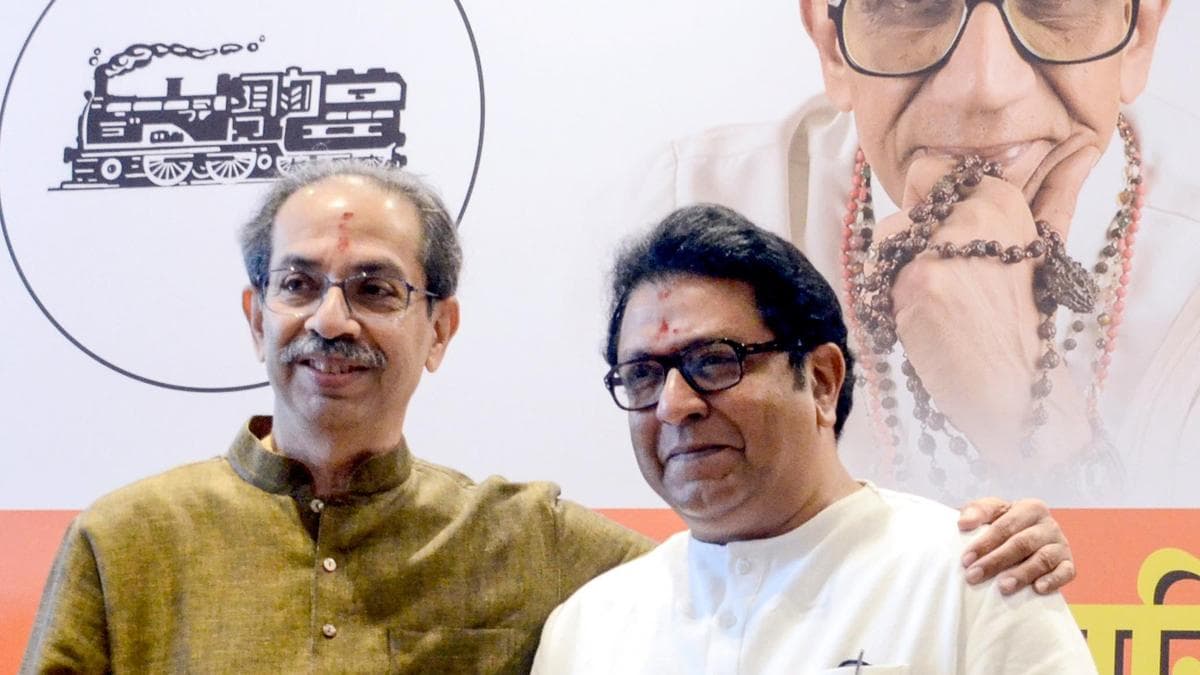
Thackeray cousins unite in Mumbai, invoking 'Prabodhankar' for 'Marathi manoos' identity.
Summary
The Thackeray cousins, Uddhav and Raj, recently united in Mumbai, invoking their grandfather 'Prabodhankar' Thackeray and their fathers to underscore their family's legacy of fighting for the 'Marathi manoos'. This political convergence highlights a renewed focus on regional identity politics in Maharashtra, asserting that the Marathi identity is currently under threat. For competitive exams, knowing 'Prabodhankar' Thackeray's role as a social reformist and the concept of 'Marathi manoos' is relevant for State PSCs and General Knowledge.
Key Points
- 1The political event involved the coming together of the 'Thackeray cousins' in Mumbai, referring to Uddhav Thackeray and Raj Thackeray.
- 2They specifically invoked their grandfather, social reformist 'Prabodhankar' Thackeray.
- 3The cousins also referred to their respective fathers, Bal Thackeray and Shrikant Thackeray (implied), to emphasize family lineage.
- 4The central theme of their address was the historical fight for the 'Marathi manoos' (Marathi people).
- 5They highlighted a perceived threat to the 'Marathi manoos' identity in Mumbai and Maharashtra.
In-Depth Analysis
The recent political rapprochement between Thackeray cousins, Uddhav Thackeray and Raj Thackeray, in Mumbai marks a significant development in Maharashtra's political landscape, signaling a potential resurgence of regional identity politics. This convergence, where they invoked their grandfather ‘Prabodhankar’ Thackeray and their respective fathers (Bal Thackeray and Shrikant Thackeray), underscores a powerful appeal to family legacy and the enduring ideology of ‘Marathi manoos’ (Marathi people).
**Background Context and Historical Roots:**
To understand this event, one must delve into the history of Maharashtra and the Shiv Sena. The state of Maharashtra itself was formed on May 1, 1960, after the Samyukta Maharashtra Movement, a fierce linguistic agitation demanding a separate Marathi-speaking state with Mumbai as its capital. In this backdrop, Bal Thackeray, son of social reformer Keshav Sitaram Thackeray (popularly known as ‘Prabodhankar’ Thackeray), founded the Shiv Sena in 1966. Prabodhankar Thackeray was a prominent social reformer, writer, and journalist who championed anti-caste movements, advocated for a united Maharashtra, and promoted Marathi language and culture. Bal Thackeray built the Shiv Sena on the 'sons of the soil' ideology, initially targeting South Indian migrants in Mumbai, whom he accused of taking away jobs from Marathis. Over time, the party expanded its base and later adopted a strong Hindutva plank in the 1980s, forming an alliance with the Bharatiya Janata Party (BJP).
The Thackeray family's political narrative is deeply intertwined with the Marathi identity. Raj Thackeray, Bal Thackeray's nephew, founded the Maharashtra Navnirman Sena (MNS) in 2006 after disagreements with Uddhav Thackeray over leadership within the Shiv Sena. The MNS also adopted a similar 'Marathi manoos' and nativist stance, often competing with the Shiv Sena for the same vote bank. The recent political upheaval in Maharashtra, which saw the Shiv Sena split in 2022 leading to the collapse of the Maha Vikas Aghadi (MVA) government and the formation of a new government with Eknath Shinde as CM supported by BJP, has further complicated the political scenario, leaving Uddhav Thackeray's faction (Shiv Sena UBT) in a challenging position.
**What Happened and Key Stakeholders:**
The coming together of Uddhav and Raj Thackeray, despite years of political estrangement, is a strategic move. The key stakeholders are: Uddhav Thackeray (leader of Shiv Sena UBT), Raj Thackeray (leader of MNS), and the larger 'Marathi manoos' community they seek to represent. By invoking ‘Prabodhankar’ Thackeray, they aim to tap into a legacy of social reform and Marathi pride that predates the Shiv Sena's more controversial aspects. Their fathers, Bal Thackeray and Shrikant Thackeray, represent the direct lineage of political leadership and cultural advocacy. The central message is a perceived threat to Marathi identity and culture in Mumbai, a cosmopolitan city that has seen significant migration from across India.
**Significance for India and Constitutional Context:**
This renewed emphasis on regional identity carries significant implications for India. It highlights the persistent challenge of regionalism and sub-nationalism within the broader framework of national unity. While the Indian Constitution guarantees freedom of movement and residence (Article 19(1)(d) and (e)) and freedom to practice any profession (Article 19(1)(g)) throughout the territory of India, nativist movements often create an environment that implicitly challenges these fundamental rights for non-locals. Although direct discrimination based on place of birth is prohibited under Article 15, the 'sons of the soil' rhetoric can lead to social tensions and economic barriers for migrants. Such movements can impact investment, labor mobility, and the cosmopolitan fabric of major economic hubs like Mumbai.
**Broader Themes and Future Implications:**
The Thackeray cousins' reunion speaks to broader themes of federalism, identity politics, and the evolving nature of India's multi-party democracy. In a diverse country like India, balancing regional aspirations with national integration is a continuous challenge. This political development could lead to a realignment of political forces in Maharashtra, potentially impacting the upcoming Lok Sabha and State Assembly elections. It could also force the ruling BJP-Shiv Sena (Shinde faction) alliance to recalibrate its strategy, especially if the 'Marathi manoos' narrative gains traction. The future could see a more aggressive push for policies favoring locals in jobs and housing, potentially leading to social friction and economic stagnation if not managed carefully. The invoking of Prabodhankar Thackeray also subtly attempts to align the movement with a more progressive, social reformist image, perhaps to broaden its appeal beyond its traditional Hindutva base, even as the core 'Marathi manoos' agenda remains. This move underscores the enduring power of regional identity and dynastic politics in India's complex electoral landscape.
Exam Tips
This topic falls under Indian Polity (Federalism, Regionalism, Political Parties), Indian History (Post-Independence, Social Reform Movements), and Current Affairs. Pay attention to the historical background of Shiv Sena and MNS.
Study the Samyukta Maharashtra Movement, linguistic reorganization of states, and the concept of 'sons of the soil' doctrine in detail. Understand the constitutional provisions related to freedom of movement, residence, and non-discrimination (Articles 15, 19).
Expect questions on 'Prabodhankar' Thackeray's contributions as a social reformer, the history and ideology of Shiv Sena/MNS, the role of regional parties in Indian federalism, and the challenges posed by nativism to national integration and economic development. Analytical questions on the impact of such political realignments on state and national elections are common.
Related Topics to Study
Full Article
The Thackeray cousins invoked their grandfather and social reformist ‘Prabodhankar’ Thackeray along with their respective fathers, to emphasise on the lineage of the family that had fought for the Marathi manoos, stressing on how this was under threat again