



Relevant for Exams
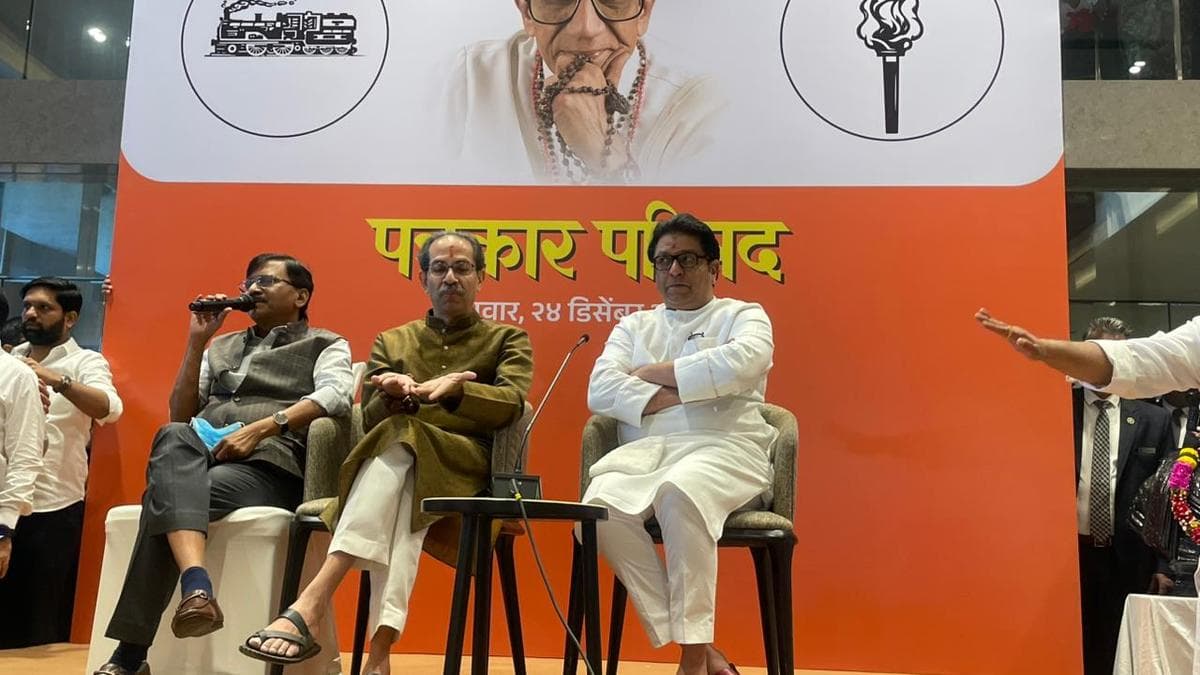
Shiv Sena (UBT) and MNS ally for Municipal polls, Uddhav Thackeray vows to protect Mumbai.
Summary
Shiv Sena (Uddhav Balasaheb Thackeray) and Maharashtra Navnirman Sena (MNS) have announced an alliance ahead of upcoming Municipal Corporation elections. This strategic partnership aims to consolidate regional political power, particularly in Mumbai, as indicated by Uddhav Thackeray's strong statement about protecting the city. For competitive exams, this highlights evolving political dynamics and alliances within Maharashtra's regional parties, relevant for state-level political awareness.
Key Points
- 1An alliance has been announced between Shiv Sena (Uddhav Balasaheb Thackeray) and Maharashtra Navnirman Sena (MNS).
- 2The alliance is formed specifically ahead of the Municipal Corporation elections.
- 3Uddhav Thackeray, leader of Shiv Sena (UBT), made a statement regarding protecting Mumbai.
- 4Thackeray's statement was: "We will finish off those who want to take away Mumbai."
- 5This political development signifies a new alignment among regional parties in Maharashtra, particularly focusing on Mumbai.
In-Depth Analysis
The announcement of an alliance between Shiv Sena (Uddhav Balasaheb Thackeray) and Maharashtra Navnirman Sena (MNS) ahead of the crucial Municipal Corporation elections signals a significant realignment in Maharashtra's political landscape. This unexpected partnership, underscored by Uddhav Thackeray's potent statement, "We will finish off those who want to take away Mumbai," encapsulates the deep-seated regional identity politics that often define electoral battles in the state, particularly in its economic capital.
To truly grasp the significance of this alliance, one must delve into the intricate history of the Shiv Sena and the family dynamics that shaped its trajectory. The original Shiv Sena, founded by Bal Thackeray in 1966, emerged as a potent force advocating for the rights of 'Marathi manoos' (Marathi people) in Mumbai, primarily against migrant populations. Its ideology was a blend of Marathi nationalism, Hindutva, and a strong regional identity. For decades, it dominated Mumbai's civic body, the Brihanmumbai Municipal Corporation (BMC), and held considerable sway in state politics.
The genesis of the MNS lies in a family split. Raj Thackeray, Bal Thackeray's nephew and a charismatic leader, parted ways with the Shiv Sena in 2006 to form the MNS, citing disillusionment with the party's direction under Uddhav Thackeray. This split fractured the Marathi vote bank and often led to direct electoral contests between the two parties, particularly in Mumbai and Thane. While MNS initially saw some success, its electoral performance waned over time. For years, the two Thackeray cousins were seen as bitter rivals, making this alliance a surprising turn of events.
The immediate background to this alliance is the dramatic political upheaval in Maharashtra in 2022. The Shiv Sena, then led by Uddhav Thackeray, had formed an unlikely Maha Vikas Aghadi (MVA) government with the Nationalist Congress Party (NCP) and the Indian National Congress (INC) after breaking its decades-old alliance with the Bharatiya Janata Party (BJP) in 2019. However, in June 2022, a rebellion led by Eknath Shinde, a prominent Shiv Sena leader, resulted in the collapse of the MVA government. Shinde, with the support of the BJP, formed a new government, claiming to be the 'real' Shiv Sena. This led to a prolonged legal and political battle over the party name and symbol, eventually decided by the Election Commission of India in favor of the Shinde faction, leaving Uddhav Thackeray's group as Shiv Sena (Uddhav Balasaheb Thackeray) with a new symbol.
Key stakeholders in this new alliance are, first and foremost, Uddhav Thackeray and Raj Thackeray. For Uddhav Thackeray's Shiv Sena (UBT), this alliance is a strategic move to consolidate the Marathi vote bank that was traditionally loyal to the undivided Shiv Sena. After losing the party name and symbol, and facing a formidable challenge from the BJP-Shinde Sena combine, securing Raj Thackeray's MNS support offers a much-needed boost, particularly in Mumbai's civic polls. For Raj Thackeray's MNS, which has struggled to translate its initial popularity into consistent electoral victories, an alliance with Shiv Sena (UBT) provides relevance and a potential share of power, especially in the BMC. The BJP and the Eknath Shinde-led Shiv Sena are the primary targets of this alliance, as they represent the current ruling dispensation in the state and are seen as aiming to diminish the influence of the original Shiv Sena's legacy in Mumbai.
This development holds significant implications for India's federal structure and the dynamics of regional politics. Mumbai, as India's financial capital, holds immense economic and symbolic importance. Control over the BMC, with its massive budget, is highly coveted. The "taking away Mumbai" rhetoric reflects fears of centralizing tendencies or cultural dilution, a common theme in regional political discourse. This alliance, therefore, is not just about local elections; it's about asserting regional identity and political autonomy in a state vital to India's economy. It also highlights the fluid nature of political alliances and rivalries in India, where ideological differences can sometimes be set aside for electoral expediency, especially when faced with a dominant national party like the BJP.
From a constitutional perspective, the functioning of Municipal Corporations is governed by the **74th Constitutional Amendment Act, 1992**, which granted constitutional status to Urban Local Bodies (ULBs). This amendment mandates the establishment of such bodies, defines their powers, and ensures regular elections. The upcoming Municipal Corporation elections are a direct outcome of this constitutional provision. Furthermore, the previous splits and realignments within Shiv Sena bring into focus the **Tenth Schedule of the Indian Constitution**, commonly known as the Anti-defection Law. While primarily applicable to legislative bodies (MPs and MLAs), the principles of party splits and recognition by the Election Commission of India are central to understanding the current status of the Shiv Sena factions. The ECI's role in allocating party symbols and adjudicating disputes between factions is crucial here.
Looking ahead, this alliance could reshape the political landscape of Maharashtra. A successful outing in the Municipal Corporation elections would provide a significant morale boost and political leverage to the Shiv Sena (UBT) and MNS, potentially influencing future alliances for the State Assembly elections and even the Lok Sabha elections. It underscores the continued relevance of regional parties and identity politics in Indian democracy. Conversely, a poor performance might lead to further introspection and realignments. The alliance also raises questions about the long-term viability of the BJP-Shinde Sena partnership if the combined Thackeray force proves formidable. It signifies a potential consolidation of Marathi regionalist sentiment against perceived external threats, whether from national parties or other regional groups, emphasizing the enduring power of local identity in the Indian political narrative.
Exam Tips
This topic falls under 'Indian Polity and Governance' (GS Paper II for UPSC) and 'Current Events of National Importance'. Focus on the structure and functioning of Urban Local Bodies (ULBs) as per the 74th Constitutional Amendment Act.
Study the history of Shiv Sena, the formation of MNS, and the recent splits within the Shiv Sena in detail. Understand the role of the Election Commission of India (ECI) in party recognition and symbol allocation. Also, review the Tenth Schedule (Anti-defection Law) of the Constitution.
Common question patterns include: 'Discuss the significance of regional parties in India's federal structure', 'Analyze the impact of political realignments on urban governance', or 'Explain the constitutional provisions related to Municipal Corporations and the role of the ECI in party disputes'.
Related Topics to Study
Full Article
We will finish off those who want to take away Mumbai: Uddhav Thackeray