


Relevant for Exams
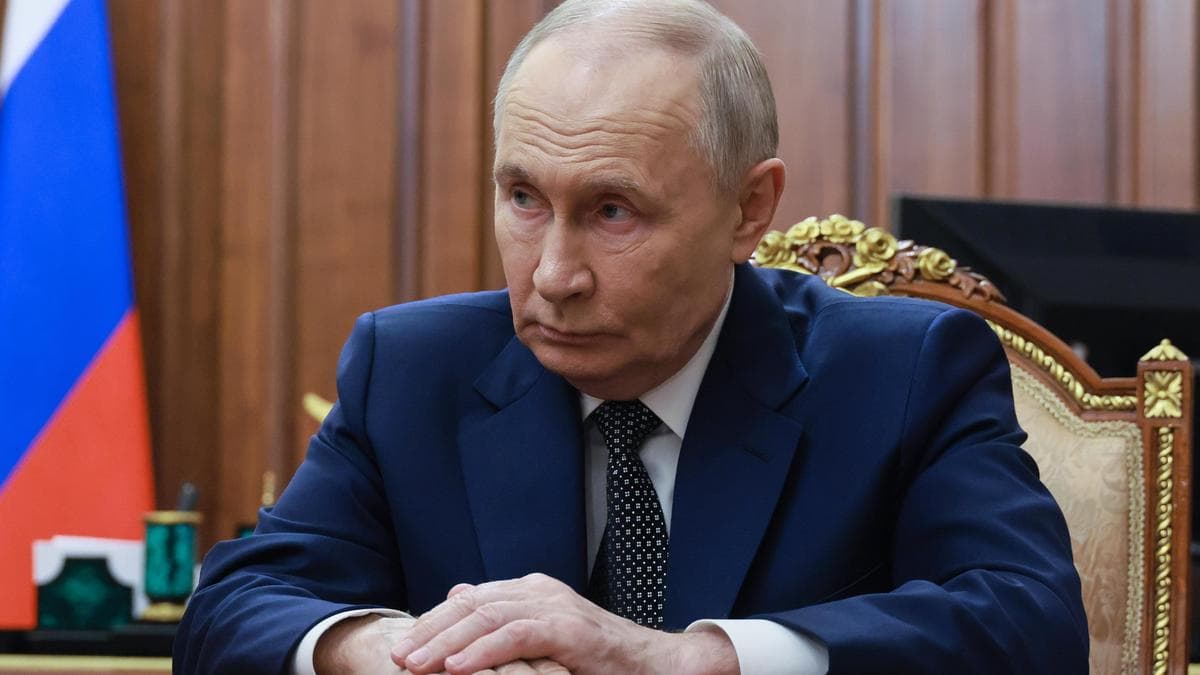
Putin briefed on U.S. Ukraine peace plan proposals, Kremlin confirms ongoing diplomatic talks.
Summary
Russian President Vladimir Putin has been briefed on the U.S. proposals for a Ukraine peace plan, as confirmed by the Kremlin spokesman. This development signifies ongoing, albeit indirect, diplomatic communication between the two major powers regarding the protracted conflict. For competitive exams, this highlights the continued international efforts to resolve the Ukraine crisis and the roles of key global actors in geopolitical stability.
Key Points
- 1Russian President Vladimir Putin was briefed on the United States' proposals for a Ukraine peace plan.
- 2The information was officially confirmed by the Kremlin spokesman.
- 3The discussions center on finding a resolution to the ongoing conflict in Ukraine.
- 4The Kremlin stated that Russia's main parameters for its position are well known to the U.S. side.
- 5This indicates continued diplomatic engagement between the U.S. and Russia concerning the Ukraine conflict.
In-Depth Analysis
The ongoing conflict between Russia and Ukraine, which escalated significantly with Russia's full-scale invasion in February 2022, remains a focal point of international diplomacy. The recent confirmation by the Kremlin spokesman that Russian President Vladimir Putin has been briefed on U.S. proposals for a Ukraine peace plan signifies a crucial, albeit indirect, diplomatic channel opening between the two major global powers. This development, while not indicating an immediate breakthrough, underscores the persistent international efforts to de-escalate the protracted conflict and hints at a potential, however distant, path towards resolution.
**The Genesis of Conflict: A Historical Overview**
To truly grasp the significance of these peace proposals, one must understand the deep-rooted historical and geopolitical tensions. The conflict is not merely a recent phenomenon but a culmination of decades of complex relations between Russia and Ukraine, intertwined with the broader post-Cold War European security architecture. Following the dissolution of the Soviet Union in 1991, Ukraine declared independence, gradually orienting itself towards the West, much to Russia's strategic discomfort. Key flashpoints include the 2004 Orange Revolution and the 2014 Euromaidan Revolution, which saw pro-Western governments come to power in Kyiv. Russia viewed NATO's eastward expansion as a direct threat to its security interests, despite NATO's insistence that it is a defensive alliance. In 2014, Russia annexed Crimea following a controversial referendum and supported separatists in the Donbas region, leading to a protracted conflict that preceded the 2022 full-scale invasion. The Minsk Agreements (Minsk I in 2014 and Minsk II in 2015), brokered by France and Germany, aimed to establish a ceasefire and a political settlement for Donbas, but ultimately failed to achieve lasting peace.
**The Diplomatic Dance: What the News Signifies**
That Putin has been briefed on U.S. proposals, even if indirectly, indicates that both sides recognize the need for a political off-ramp, despite their maximalist public positions. The Kremlin's statement that "All the main parameters of the Russian side's position are well known to our colleagues from the United States" suggests that Russia is reiterating its core demands, which historically have included guarantees against NATO expansion, recognition of Crimea as Russian territory, and neutrality for Ukraine. The U.S. proposals, while undisclosed, likely aim to find common ground or at least establish a framework for future negotiations, possibly involving a ceasefire, withdrawal of troops, and security guarantees for Ukraine.
**Key Global Players and Their Stakes**
Major stakeholders include **Russia**, aiming to secure its perceived geopolitical interests and prevent Ukraine's full integration into Western alliances; **Ukraine**, fighting for its sovereignty, territorial integrity, and the right to self-determination; the **United States** and **NATO**, committed to supporting Ukraine's defense and upholding international law against aggression; and the **European Union**, grappling with refugee crises, energy security challenges, and the broader implications for European stability. International organizations like the **United Nations** have consistently called for a peaceful resolution, emphasizing humanitarian concerns and adherence to international law.
**India's Delicate Balancing Act**
For India, the Ukraine conflict has presented a significant foreign policy challenge. India has maintained a position of strategic autonomy, refraining from explicitly condemning Russia while simultaneously calling for respect for sovereignty and territorial integrity and advocating for dialogue and diplomacy. This stance is rooted in India's historical ties with Russia, especially its reliance on Russian military hardware and energy supplies, alongside its growing strategic partnership with the U.S. and the West. Economically, the conflict has impacted global supply chains, leading to increased crude oil and fertilizer prices, directly affecting India's economy and food security. India's approach reflects its commitment to a multi-polar world order and its ability to navigate complex geopolitical landscapes without being drawn into bloc politics. This aligns with the principles enshrined in **Article 51 of the Indian Constitution**, a Directive Principle of State Policy, which mandates the State to "promote international peace and security; maintain just and honourable relations between nations; foster respect for international law and treaty obligations... and encourage settlement of international disputes by arbitration." India's engagement in multilateral forums like BRICS, SCO, and G20 has also been influenced, as it seeks to play a constructive role in global governance.
**Future Trajectories and Global Ramifications**
The future implications of these diplomatic overtures are uncertain. While a direct negotiation between Russia and Ukraine, possibly facilitated by international mediators, remains the ultimate goal, the gap between their demands is vast. The U.S. proposals could serve as a preliminary step, testing the waters for potential concessions or a framework for de-escalation. A prolonged conflict would continue to destabilize global energy markets, exacerbate humanitarian crises, and strain international relations. A negotiated peace, however challenging, would be a significant step towards restoring international law and fostering a more stable global order. The outcome will profoundly shape the future of European security, the role of international institutions, and the dynamics of major power relations in the 21st century.
Exam Tips
This topic falls under GS Paper II (International Relations) for UPSC Civil Services Exam. Understand India's foreign policy principles like strategic autonomy, non-alignment, and their application in the context of global conflicts.
Study the historical context of the Russia-Ukraine conflict, including the dissolution of the USSR, NATO expansion, the 2014 annexation of Crimea, and the Minsk Agreements. Questions often test the chronology and underlying causes.
Be prepared for analytical questions on the impact of global events (like the Ukraine war) on India's economy (e.g., energy prices, inflation, trade), foreign policy choices, and defense procurements. Also, know the roles of key international organizations like the UN, NATO, EU.
Focus on the constitutional underpinnings of India's foreign policy, specifically Article 51, and how it guides India's approach to international peace and security. Be ready to link current events to these foundational principles.
Practice essay writing on topics related to global conflicts, India's role in a multi-polar world, and the challenges to international law and order. Structure your arguments with historical context, current developments, and future implications.
Related Topics to Study
Full Article
"All the main parameters of the Russian side's position are well known to our colleagues from the United States," says Kremlin spokesman