


Relevant for Exams
Protests at India-Bangladesh border in West Bengal over anti-Hindu situation; trade suspension threatened.
Summary
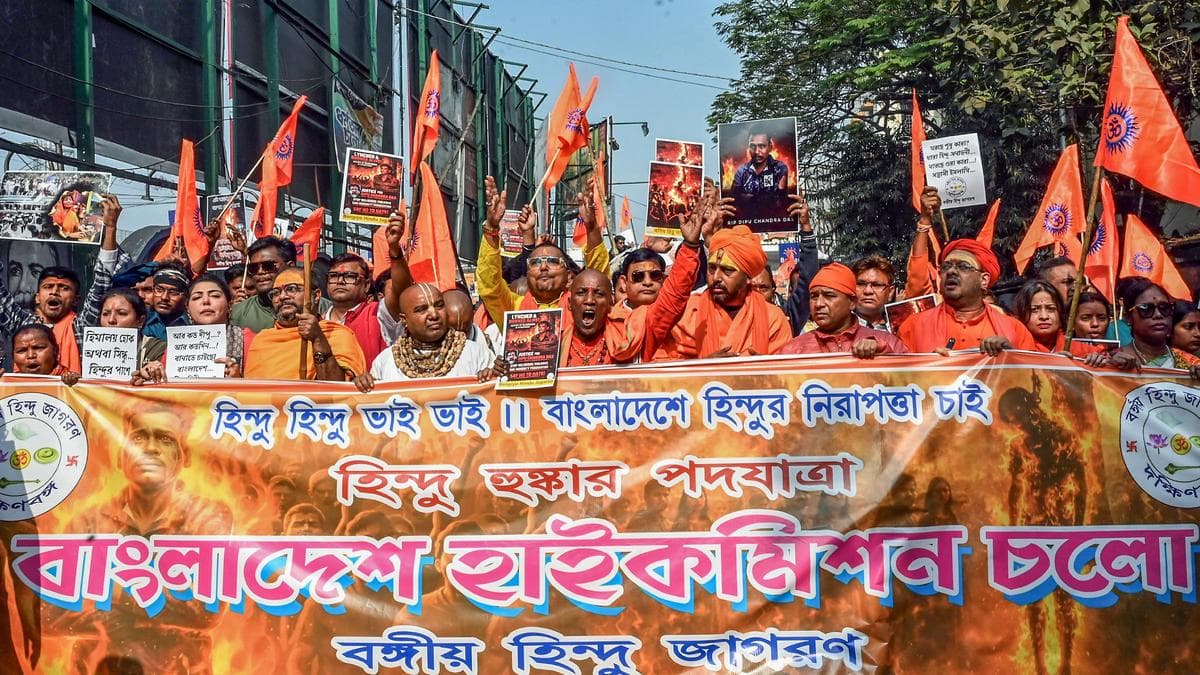
Protests occurred at land ports along the India-Bangladesh border in West Bengal. Agitators issued a warning to Bangladesh's Chief Adviser Mohammad Yunus, threatening to suspend trade if the alleged anti-Hindu situation in Bangladesh persists. This incident highlights the socio-political sensitivities impacting bilateral relations and cross-border trade, crucial for understanding regional dynamics in competitive exams.
Key Points
- 1Protests were held at land ports located along the Bangladesh border in West Bengal, India.
- 2The agitators issued a warning to Bangladesh's Chief Adviser, Mohammad Yunus.
- 3The primary reason for the protests was the alleged continuation of an anti-Hindu situation in Bangladesh.
- 4A key threat made by the agitators was the suspension of cross-border trade.
- 5The incident underscores the impact of socio-religious issues on India-Bangladesh bilateral trade and relations.
In-Depth Analysis
The recent protests at land ports along the India-Bangladesh border in West Bengal, threatening to suspend trade over alleged anti-Hindu situations in Bangladesh, bring to the forefront the intricate and often sensitive nature of India-Bangladesh bilateral relations. This incident is not merely a localized protest but a potent symbol of how socio-religious dynamics within one country can spill over and significantly impact diplomatic ties, economic cooperation, and domestic political narratives in another.
**Background Context: A Shared History, Complex Present**
India and Bangladesh share a unique relationship, deeply rooted in the 1971 Liberation War, where India played a crucial role in Bangladesh's independence. This shared history fostered a bond, but also left a legacy of complex issues, including border management, water sharing, and, critically, the plight of religious minorities. Bangladesh, a predominantly Muslim nation, has historically seen periods of communal tension, leading to concerns about the safety and rights of its Hindu minority. These concerns often resonate deeply in India, particularly in states like West Bengal, which share a long border and cultural ties with Bangladesh, and where a significant Bengali Hindu population resides. The demographic shifts post-Partition in 1947, and again after 1971, have further complicated the issue, leading to a constant vigil by various groups in India over the treatment of Hindus in Bangladesh. The political landscape in Bangladesh, currently under an interim government led by Chief Adviser Mohammad Yunus ahead of upcoming elections, adds another layer of sensitivity, as minority issues often become politicized during electoral cycles.
**The Immediate Trigger and Protests**
What happened was a direct response by agitators, likely from Hindu organizations and local communities in West Bengal, to reports or perceptions of an 'anti-Hindu situation' in Bangladesh. These protests specifically targeted land ports, crucial conduits for cross-border trade, and issued a direct warning to Chief Adviser Mohammad Yunus. The threat of suspending trade is a powerful tactic, as it directly impacts the economic interests of both nations, particularly the border regions. Land ports like Petrapole-Benapole are vital for the movement of goods, and any disruption can cause significant financial losses and supply chain issues.
**Key Stakeholders and Their Interplay**
Several key stakeholders are involved. Firstly, the **Agitators** in West Bengal, driven by religious solidarity and often supported by political parties that champion Hindu causes, aim to exert pressure on both the Indian and Bangladeshi governments. Secondly, the **Indian Government** (both central and the West Bengal state government) faces a delicate balancing act: upholding diplomatic relations with a crucial neighbour under its "Neighbourhood First" policy, while also addressing domestic concerns and the sentiments of its own citizens. Thirdly, the **Bangladesh Government** (currently the interim administration under Mohammad Yunus) is under scrutiny to ensure the safety and rights of its minority communities, maintain internal stability, and protect its international image, especially with impending elections. Lastly, the **Traders and Business Communities** on both sides are significant stakeholders, as they bear the direct economic brunt of any trade disruptions, advocating for stability and smooth commercial operations.
**Significance for India: A Multi-faceted Impact**
This incident holds profound significance for India. **Diplomatically**, it strains a vital bilateral relationship, potentially complicating ongoing discussions on connectivity, trade, and regional security. Bangladesh is a cornerstone of India's "Neighbourhood First" and "Act East" policies. **Economically**, the threat to suspend trade directly impacts India's exports to Bangladesh, which stood at over $12 billion in FY 2022-23, making Bangladesh India's largest trade partner in South Asia. West Bengal, in particular, relies heavily on this cross-border commerce. **Socially and Politically**, the issue resonates deeply within India, especially in West Bengal, where identity politics and concerns for Bengali Hindus are potent electoral factors. Such incidents fuel narratives around minority protection and can be leveraged by political parties. The issue also links to India's **Citizenship Amendment Act (CAA) 2019**, which seeks to provide citizenship to persecuted religious minorities (including Hindus) from Bangladesh, Pakistan, and Afghanistan, underscoring India's stated concern for these communities.
**Constitutional and Policy Dimensions**
While direct constitutional articles governing foreign policy are limited, the spirit of India's democratic and secular constitution (e.g., **Preamble**, **Article 25-28** on religious freedom) inherently guides its approach to minority issues, both domestically and internationally. The fundamental right to protest peacefully in India is enshrined in **Article 19(1)(a)** and **19(1)(b)**. Crucially, India's foreign policy doctrines like the **"Neighbourhood First" policy** emphasize strengthening ties with contiguous countries. This policy, championed by the current government, prioritizes diplomatic engagement, economic cooperation, and cultural exchanges. Any disruption, therefore, challenges the efficacy of this policy. The **Look East/Act East Policy** also positions Bangladesh as a critical land bridge to Southeast Asia, making stable relations paramount for India's broader strategic goals.
**Future Implications: A Test of Diplomacy and Stability**
The immediate future will likely see diplomatic efforts to de-escalate tensions. The Indian government will need to engage with its Bangladeshi counterpart to ensure the safety of minorities and manage the domestic pressure from agitators. For Bangladesh, the incident highlights the challenge of maintaining communal harmony and ensuring minority rights, especially in a pre-election period. Any perceived failure could impact its international standing and internal stability. Long-term implications include the potential for recurring disruptions if the underlying issues of minority persecution are not addressed effectively. This incident serves as a stark reminder that while economic and strategic interests drive bilateral relations, humanitarian and socio-religious concerns can significantly influence their trajectory, demanding nuanced and proactive diplomacy from both nations to foster a truly stable and prosperous partnership.
Exam Tips
This topic falls under GS Paper-II (International Relations, Indian Polity – Federalism, Fundamental Rights) and GS Paper-III (Indian Economy – Trade, Border Management) for UPSC. For SSC, Railway, and State PSCs, focus on India-Bangladesh relations, key border points, and major trade commodities.
When studying, link this incident to India's 'Neighbourhood First' policy, the Citizenship Amendment Act (CAA) 2019, and the broader issue of minority rights in South Asia. Understand the historical context of India-Bangladesh relations and the role of West Bengal as a border state.
Common question patterns include analytical questions on the impact of domestic issues on foreign policy, the economic implications of border disputes/protests, and the challenges to India's regional diplomacy. Be prepared to discuss the role of non-state actors in influencing bilateral ties.
Related Topics to Study
Full Article
Agitators warn chief adviser Mohammad Yunus that trade will be suspended if anti-Hindu situation in Bangladesh continues