



Relevant for Exams
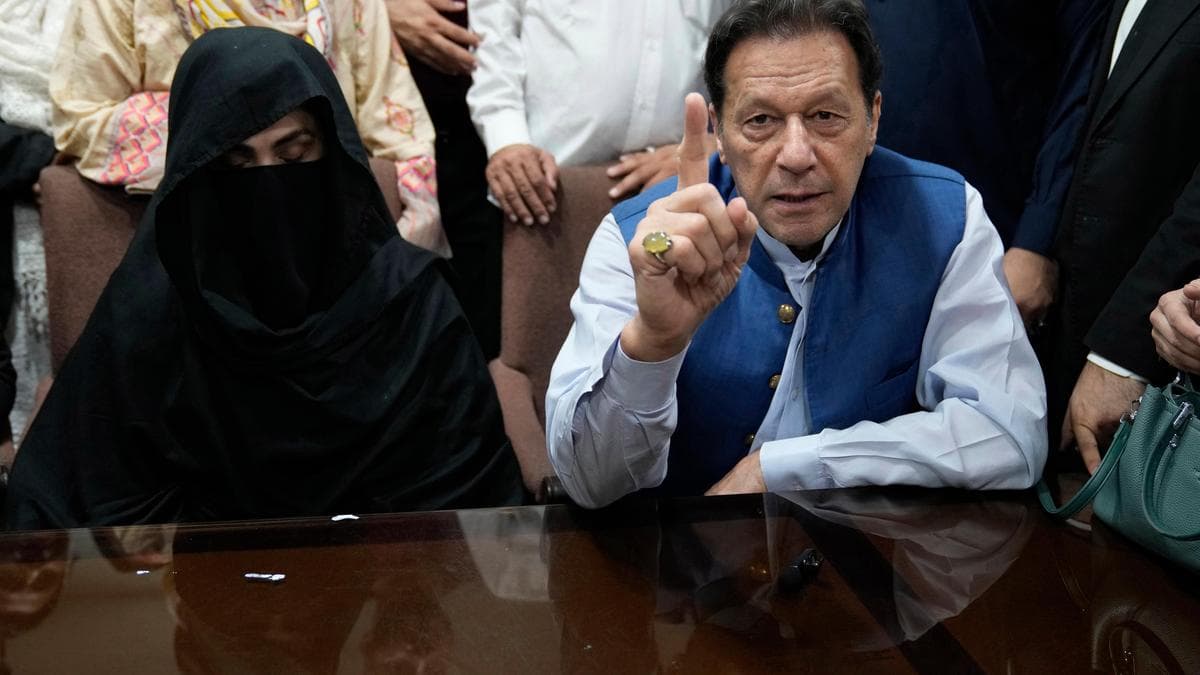
Pakistan court extends interim bail for ex-PM Imran Khan and wife in May 9 violence cases.
Summary
A Pakistan court has extended the interim bail for former Prime Minister Imran Khan and his wife Bushra Bibi in the "May 9 cases." These cases stem from widespread violence and vandalism by Khan's supporters in 2023, following his arrest in Islamabad. This event underscores the ongoing political instability in Pakistan, a crucial aspect for competitive exams focusing on international relations and India's neighborhood policy.
Key Points
- 1Former Pakistan Prime Minister Imran Khan and his wife Bushra Bibi received an extension of interim bail.
- 2The bail extension is related to the "May 9 cases" in Pakistan.
- 3The May 9 cases involve widespread violence and vandalism by Imran Khan's supporters.
- 4These incidents of violence occurred in 2023 following Imran Khan's arrest.
- 5The violence on May 9, 2023, took place in Islamabad, Pakistan.
In-Depth Analysis
The extension of interim bail for former Pakistan Prime Minister Imran Khan and his wife Bushra Bibi in the "May 9 cases" is more than just a legal formality; it's a critical indicator of the deep-seated political instability and ongoing power struggle within Pakistan. For competitive exam aspirants, understanding this event requires a grasp of Pakistan's complex political landscape, its implications for regional stability, and how India navigates its foreign policy in such a volatile neighborhood.
**Background Context: A Nation on Edge**
Imran Khan, a charismatic cricketer-turned-politician, ascended to power in 2018 on an anti-corruption platform, promising a 'Naya Pakistan' (New Pakistan). His tenure was marked by a delicate balance with the powerful military establishment, which is widely believed to have facilitated his rise. However, this relationship soured over time, particularly following disagreements over key appointments and policies. In April 2022, Khan was ousted through a no-confidence motion, a first in Pakistan's history, which he vehemently claimed was a foreign-backed conspiracy orchestrated by the then-opposition and elements within the establishment. This narrative resonated deeply with his massive support base, leading to widespread protests and a significant deterioration of civil-military relations.
**What Happened on May 9, 2023: The Day of Unrest**
On May 9, 2023, Imran Khan was dramatically arrested by paramilitary Rangers from the Islamabad High Court premises in connection with a corruption case (the Al-Qadir Trust case). This arrest ignited an unprecedented wave of violent protests across Pakistan. Khan's supporters, primarily from his Pakistan Tehreek-e-Insaf (PTI) party, took to the streets, clashing with law enforcement, vandalizing public and private property, and, significantly, targeting military installations. The Corps Commander's house in Lahore, a symbol of military authority, was ransacked and set ablaze, and the gates of the General Headquarters (GHQ) in Rawalpindi were attacked. This direct assault on military symbols was an unprecedented challenge to the establishment's authority, leading to a swift and severe crackdown by the state.
**Key Stakeholders and Their Roles**
1. **Imran Khan and PTI**: At the heart of the crisis, Khan remains a popular figure whose narrative of victimhood and anti-establishment stance mobilizes millions. His party, PTI, faces an existential threat, with many leaders and workers arrested or forced to leave politics. The ongoing legal battles, including the May 9 cases, are central to his political survival.
2. **Pakistan Army**: The most powerful institution in Pakistan, the Army views the May 9 incidents as an unforgivable affront. It has asserted its dominance, leading the crackdown, demanding accountability for those involved, and signaling its intent to maintain control over the political narrative. The Army Act and Official Secrets Act have been invoked to try civilians accused of attacking military installations, drawing criticism from human rights groups.
3. **Pakistan Judiciary**: The judiciary plays a crucial, albeit often contested, role. While it has granted Khan relief in some cases, including the interim bail extensions, it also faces pressure from the state. Its pronouncements significantly impact the political trajectory and the balance of power.
4. **Current Government (PML-N/PPP Coalition)**: Led by Prime Minister Shehbaz Sharif, this coalition government has been focused on stabilizing the economy and prosecuting Khan and his supporters. They represent the traditional political elite, often seen as aligned with the military establishment, and are keen to curb Khan's political influence.
**Why This Matters for India: A Neighbor's Instability**
Pakistan's internal turmoil has significant ramifications for India. Firstly, **regional stability** is paramount. A nuclear-armed neighbor experiencing severe political and economic instability is always a concern. Such instability can fuel radicalization, potentially leading to increased cross-border terrorism or security challenges along the Line of Control (LoC). Secondly, it impacts **India's foreign policy**, particularly its 'Neighborhood First' policy. While India maintains a policy of non-interference in Pakistan's internal affairs, continuous volatility makes meaningful engagement difficult and hinders any prospects for normalization of relations. Thirdly, a weakened and internally focused Pakistan might be less predictable in its foreign policy actions, especially concerning India. The contrast between India's robust democratic institutions and Pakistan's recurring civil-military imbalances further highlights the importance of democratic resilience for regional peace.
**Historical Context and Future Implications**
Pakistan has a history of military interventions and periods of political instability, with the military often playing the role of kingmaker or direct ruler (e.g., General Ayub Khan in 1958, General Zia-ul-Haq in 1977, General Pervez Musharraf in 1999). The May 9 events represent a new low in civil-military relations, where the military itself became a direct target of public anger. This could lead to a further entrenchment of military influence in politics, potentially stifling democratic processes and civilian supremacy. Future implications include a highly polarized political landscape, potentially contentious general elections, and continued legal challenges for Imran Khan. For India, this means a prolonged period of uncertainty on its western border, necessitating continued vigilance and a robust security posture. The ability of Pakistan to manage its internal divisions and uphold the rule of law will be crucial for its own future and for the broader South Asian region.
**Related Constitutional Articles, Acts, or Policies**
While the events primarily concern Pakistan's internal legal and political framework (like the Pakistan Army Act of 1952, Official Secrets Act, and various anti-terrorism laws), India's foreign policy is inherently linked. India's **'Neighborhood First' policy** (a key component of its foreign policy) emphasizes peaceful and collaborative ties with its neighbors. Instability in Pakistan directly challenges the effectiveness of this policy. Furthermore, India's commitment to **democratic values** and the **rule of law** as enshrined in its own Constitution (e.g., Article 14, 19, 21 promoting fundamental rights and due process) stands in stark contrast to the challenges faced by democratic institutions in Pakistan, making it a point of comparative study for aspirants.
Exam Tips
**UPSC GS Paper 2 (International Relations & Polity):** This topic falls under India and its neighborhood relations, as well as the comparison of the Indian constitutional scheme with that of other countries. Focus on the impact of Pakistan's internal politics on India's security and foreign policy.
**Related Topics to Study:** Understand the historical trajectory of civil-military relations in Pakistan, India's 'Neighborhood First' policy, the role of institutions (judiciary, executive, military) in a democracy, and the challenges to democratic governance in South Asia.
**Common Question Patterns:** Expect questions on the causes and consequences of political instability in Pakistan, its implications for India's national security, challenges to India's foreign policy, and comparative analysis of democratic resilience in India vs. Pakistan. Map the events chronologically and understand the motivations of key actors.
Related Topics to Study
Full Article
The May 9 cases are related to violence by former PM Imran Khan's supporters who resorted to vandalism in 2023 after his arrest in Islamabad