


Relevant for Exams
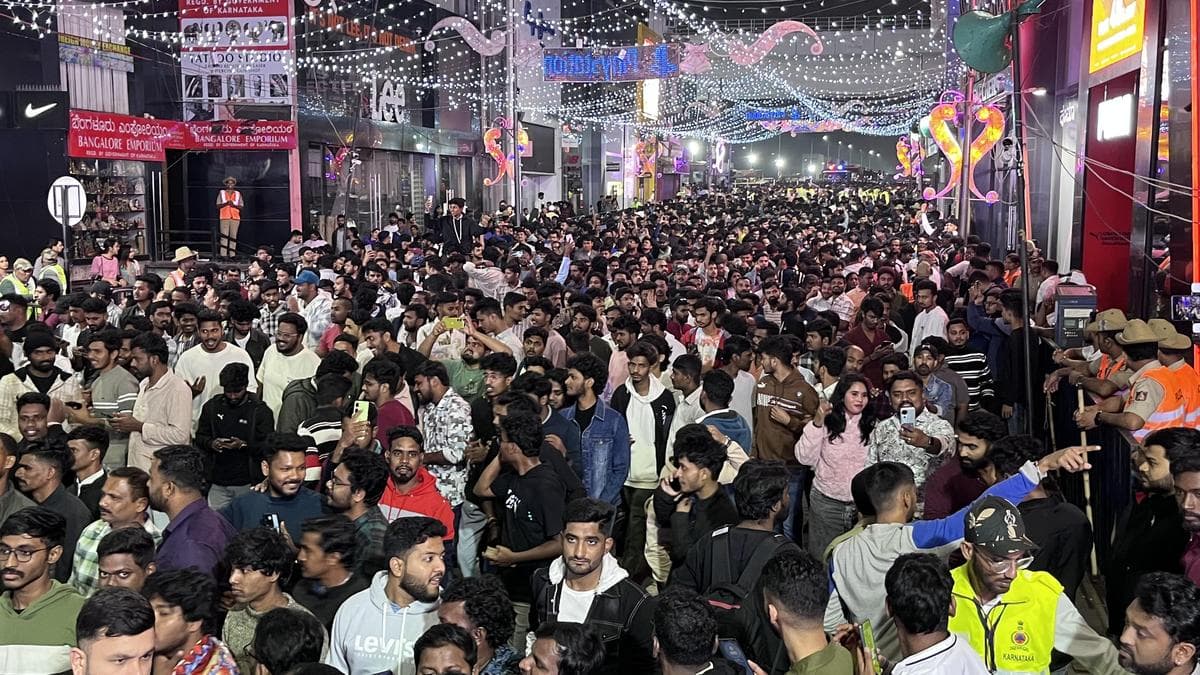
Bengaluru Police restricts New Year entry to M.G. Road, Brigade Road for crowd management.
Summary
The Bengaluru Police Commissioner has announced restrictions on unrestricted entry to M.G. Road and Brigade Road for New Year celebrations. This measure is implemented to manage large crowds and ensure public safety during the festive period. For competitive exams, this highlights the role of city police in maintaining law and order and crowd control during major public events.
Key Points
- 1The Bengaluru Police Commissioner issued orders regarding New Year celebrations.
- 2Restrictions are imposed on unrestricted entry to M.G. Road.
- 3Similar restrictions also apply to Brigade Road.
- 4The measures are specifically for the New Year period.
- 5This decision falls under the jurisdiction of local law enforcement in Bengaluru.
In-Depth Analysis
The Bengaluru Police Commissioner's announcement regarding restrictions on unrestricted entry to M.G. Road and Brigade Road for New Year celebrations is a recurring yet significant event that encapsulates critical aspects of urban governance, public safety, and the delicate balance between individual liberties and collective order in India. This annual measure, though localized to Bengaluru's prominent commercial and entertainment hubs, serves as a microcosm for challenges faced by metropolitan cities across the nation during large-scale public gatherings.
**Background Context and Historical Perspective:**
Bengaluru, often dubbed the "Silicon Valley of India," is known for its vibrant nightlife and energetic public spaces. M.G. Road and Brigade Road, in particular, are iconic destinations that attract hundreds of thousands of revelers for New Year's Eve celebrations. However, this festive enthusiasm has historically presented significant law and order challenges. Over the years, incidents ranging from severe traffic congestion and stampede-like situations to disturbing reports of mass molestation, particularly highlighted during the New Year's Eve of 2016-17, compelled authorities to re-evaluate and stiffen crowd control measures. These past events underscore the imperative for proactive policing and pre-emptive restrictions to prevent a recurrence of chaos and ensure public safety.
**What Happened:**
The Bengaluru Police Commissioner's order signifies a strategic move to regulate the flow of people into these high-density areas. While the exact nature of "unrestricted entry" might vary slightly each year, it generally entails measures such as: setting up barricades and checkpoints, designating specific entry and exit points, restricting vehicular movement (often entirely banning it) on these roads from late evening, deploying a massive police contingent, and utilizing surveillance technology like CCTV cameras. The aim is not to ban celebrations but to manage the crowd density, prevent untoward incidents, and facilitate quick emergency responses, thereby ensuring a safer environment for everyone.
**Key Stakeholders Involved:**
Several key stakeholders are directly impacted and involved in this decision and its implementation. The **Bengaluru City Police**, led by the Police Commissioner, is the primary authority responsible for maintaining law and order, crowd management, and enforcement of these restrictions. The **Karnataka State Government**, particularly its Home Department, provides the overarching policy framework and resources. **Local businesses** on M.G. Road and Brigade Road, including restaurants, pubs, and retail outlets, are significantly affected, as these restrictions can alter customer footfall and business operations during a peak commercial period. However, enhanced safety can also prevent damage and ensure long-term viability. **Citizens and revelers** are directly impacted by the limitations on their movement and assembly, although the measures are designed for their safety. Finally, **emergency services** (ambulances, fire services) are crucial support stakeholders, requiring clear access routes and coordination with police.
**Why This Matters for India:**
This local event holds broader significance for India. Firstly, it highlights the pressing challenges of **urban governance** in rapidly expanding metropolitan areas. Managing massive public gatherings in densely populated cities is a recurring issue for administrations nationwide. Secondly, it underscores the critical importance of **public safety and security**, especially in an era where urban spaces are increasingly vulnerable. Thirdly, it brings to the fore the constitutional debate surrounding **fundamental rights versus reasonable restrictions**. While citizens have the fundamental rights to freedom of movement (Article 19(1)(d)) and assembly (Article 19(1)(b)), these rights are not absolute. Article 19(2) allows for "reasonable restrictions" in the interest of public order, morality, and the sovereignty and integrity of India. The police action falls squarely within this constitutional provision, prioritizing collective safety over individual unrestricted access.
**Constitutional Articles and Policies:**
Beyond Article 19, the legal framework empowering such actions is rooted in the **Seventh Schedule of the Indian Constitution**, where 'Public Order' and 'Police' are subjects under the State List (Entries 1 and 2). This grants state governments and their police forces the authority to legislate and act on these matters. The **Karnataka Police Act, 1963** (or the respective State Police Acts across India), provides specific powers to police officers for regulating traffic, public assemblies, and maintaining peace. Sections of the **Code of Criminal Procedure (CrPC)**, particularly Section 144 (power to issue order in urgent cases of nuisance or apprehended danger), although not always directly invoked for New Year, embody the preventive spirit behind such restrictions.
**Future Implications:**
The continued imposition of such restrictions signals a growing trend towards more structured and controlled public celebrations in urban centers. Future implications include: increased integration of **smart city technologies** like AI-powered surveillance and data analytics for crowd prediction and management; potential for creating **designated public celebration zones** to divert crowds from commercial hubs; and a continuous evolution of **police reforms** focusing on community policing, sensitivity training, and technology adoption. The debate between ensuring public safety and upholding individual freedoms will persist, prompting authorities to seek innovative solutions that balance both aspects effectively.
In essence, the Bengaluru New Year restrictions are not merely a local administrative decision but a reflection of India's ongoing struggle and adaptation to the complexities of urban life, public order, and constitutional governance in the 21st century.
Exam Tips
This topic primarily falls under 'Indian Polity & Governance' and 'Internal Security' sections of the UPSC Civil Services Exam (Prelims & Mains GS-II, GS-III), State PSCs, and SSC exams. Focus on the constitutional provisions related to Fundamental Rights and the powers of the police and state government.
Study related topics such as Article 19 (Freedom of Speech, Assembly, Movement), Article 21 (Right to Life and Personal Liberty), the Seventh Schedule (State List - Public Order, Police), Police Acts (e.g., Police Act, 1861, or specific state acts), and Section 144 of CrPC. Understand the concept of 'reasonable restrictions'.
Common question patterns include: MCQs on specific articles/sections empowering law enforcement; analytical questions in Mains on balancing fundamental rights with public order; case studies on crowd management and urban policing; and questions on the role of state vs. central government in law and order.