



Relevant for Exams
Rajasthan's 'Save Aravalli Hills' stir creates political flashpoint, testing BJP & Congress.
Summary
The title indicates a 'Save Aravalli Hills' movement in Rajasthan, creating a political flashpoint for both BJP and Congress. This highlights ongoing environmental concerns regarding the Aravalli range, crucial for biodiversity and water security in the region. For competitive exams, understanding the Aravallis' ecological significance, related environmental governance issues, and political implications is vital.
Key Points
- 1The 'Save Aravalli Hills' stir is an environmental movement originating in Rajasthan.
- 2The Aravalli Range is one of the oldest fold mountain ranges in India, extending approximately 692 km.
- 3The Aravallis act as a natural barrier, influencing climate patterns and groundwater recharge in Rajasthan and Haryana.
- 4Key threats to the Aravalli ecosystem often include illegal mining, deforestation, and unchecked construction.
- 5The movement highlights the political challenge for ruling parties (BJP, Congress) in balancing development with environmental protection.
In-Depth Analysis
The 'Save Aravalli Hills' stir in Rajasthan represents a critical environmental movement that has emerged as a significant political flashpoint, testing the commitment of both the Bharatiya Janata Party (BJP) and the Indian National Congress. This agitation underscores the escalating conflict between rapid developmental aspirations and ecological conservation in India, particularly concerning one of the country's oldest and most vital geographical features.
**Background Context and What Happened:**
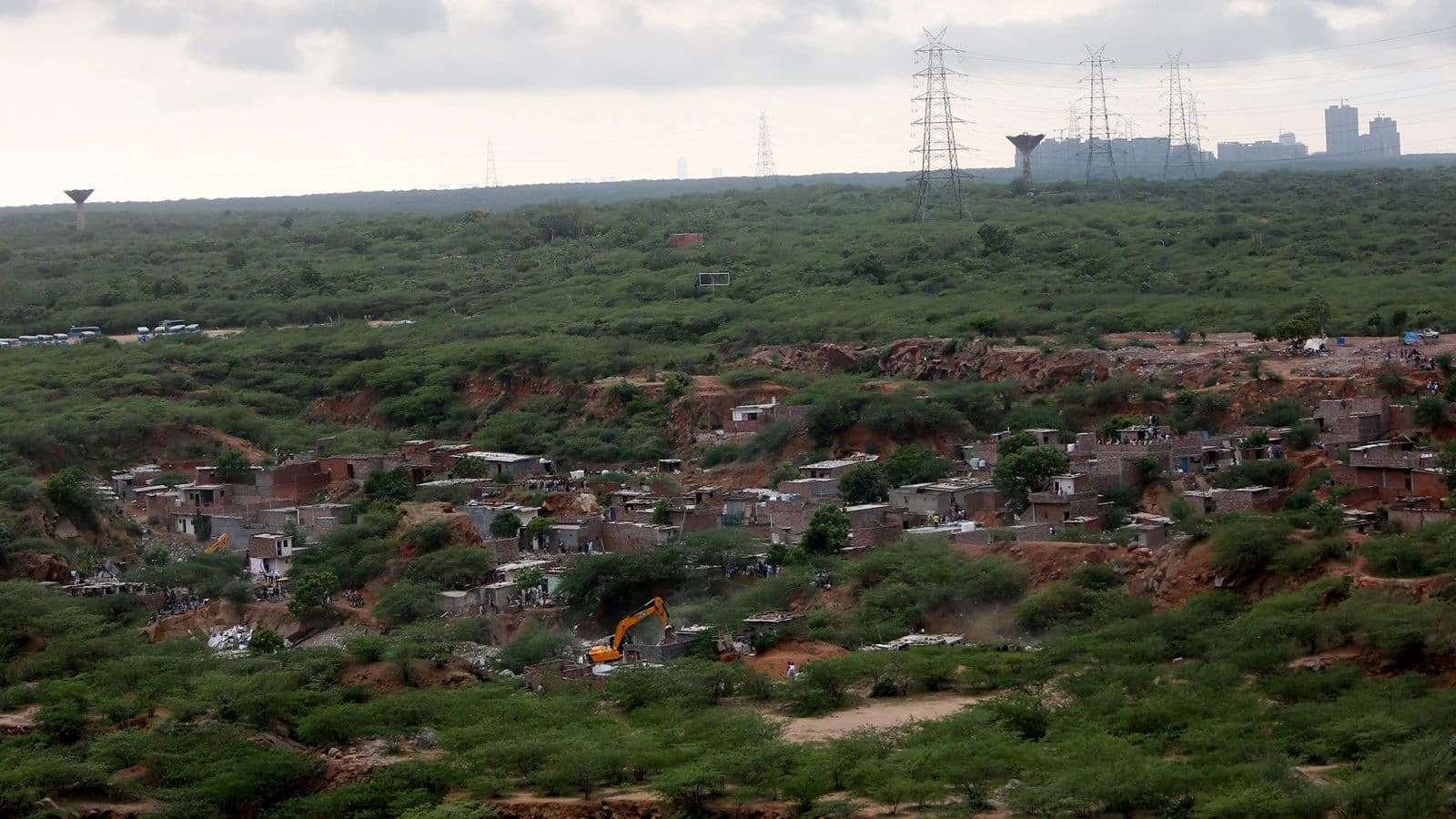
The Aravalli Range, stretching approximately 692 kilometers across Gujarat, Rajasthan, Haryana, and Delhi, is an ancient fold mountain system, predating the Himalayas. Geologically, it’s a relict of a much larger ancient mountain range. Ecologically, it serves as a critical green lung and water recharge zone for the semi-arid and arid regions of Rajasthan and Haryana. It acts as a natural barrier against the Thar Desert's eastward expansion, influences monsoon patterns, and is a crucial habitat for diverse flora and fauna, including leopards, hyenas, and various bird species. Over the past few decades, the Aravallis have faced relentless degradation due to unchecked urbanization, illegal mining, deforestation, and encroachment. The 'Save Aravalli Hills' movement gained momentum as local communities, environmental activists, and civil society organizations observed accelerated destruction, particularly in areas like Udaipur, Alwar, and Gurugram, leading to a severe impact on groundwater levels, biodiversity loss, and increased air pollution. The stir highlights a perceived lack of effective governance and enforcement of environmental regulations by successive state governments.
**Key Stakeholders Involved:**
Multiple stakeholders are intertwined in this complex issue. **Environmental Activists and NGOs** (e.g., Aravalli Bachao Andolan, Tarun Bharat Sangh) are at the forefront, raising awareness, documenting violations, and initiating legal action. **Local Communities**, including tribal populations, depend on the Aravallis for their livelihoods (minor forest produce, grazing) and water security, making them direct victims of degradation and active participants in the protests. **State Governments** (Rajasthan and Haryana, currently BJP and Congress respectively) are key decision-makers, balancing development pressures with conservation mandates. They face the challenge of revenue generation from mining versus environmental protection. **Mining Lobbies and Real Estate Developers** represent powerful economic interests, often pushing for relaxed regulations and permits for extraction and construction. The **Judiciary**, particularly the Supreme Court and National Green Tribunal (NGT), has played a crucial role, issuing landmark judgments and directives to curb illegal mining and protect the Aravallis, often acting on Public Interest Litigations (PILs). Finally, **Central Government Agencies** like the Ministry of Environment, Forest and Climate Change (MoEFCC) are responsible for framing national policies and regulations.
**Significance for India and Historical Context:**
The Aravalli Range's significance for India cannot be overstated. It is vital for the ecological security of North-Western India, influencing climate, hydrology, and biodiversity. Its degradation has direct implications for water scarcity, desertification, and air quality in major urban centers like Delhi-NCR. Historically, the Aravallis have been exploited since colonial times for their mineral wealth (marble, granite, quartzite). Post-independence, industrialization and urbanization intensified these pressures. The legal battles for Aravalli protection trace back to the early 2000s, with the Supreme Court in 2002 banning mining in a significant portion of the Aravallis. However, enforcement gaps and illegal activities persisted. This movement is a contemporary echo of India's long struggle with sustainable development, reminiscent of the Chipko Movement or the Narmada Bachao Andolan, highlighting the inherent tension between economic growth and environmental preservation.
**Related Constitutional Articles, Acts, and Policies:**
The protection of the environment in India is enshrined in its legal framework. **Article 48A** of the Directive Principles of State Policy mandates that 'The State shall endeavour to protect and improve the environment and to safeguard the forests and wild life of the country.' Furthermore, **Article 51A(g)** lists it as a Fundamental Duty of every citizen 'to protect and improve the natural environment including forests, lakes, rivers and wild life, and to have compassion for living creatures.' Key legislative instruments include the **Environment (Protection) Act, 1986**, which provides for the protection and improvement of the environment, and the **Forest (Conservation) Act, 1980**, which regulates the diversion of forest land for non-forest purposes. The **Mines and Minerals (Development and Regulation) Act, 1957**, along with state-specific mining rules, governs mineral extraction, often conflicting with environmental safeguards. The Supreme Court's pronouncements, particularly in cases like the **M.C. Mehta v. Union of India (1987 onwards)** related to environmental pollution and Aravalli mining, have been instrumental in shaping environmental jurisprudence. The **National Forest Policy, 1988**, also emphasizes maintaining environmental stability through forest preservation.
**Future Implications and Broader Themes:**
The 'Save Aravalli Hills' movement has significant future implications. It pushes for stronger environmental governance, stricter enforcement of existing laws, and greater accountability from state governments. The ongoing legal battles and public pressure could lead to more robust policies for sustainable mining, afforestation, and urban planning. This struggle highlights broader themes of sustainable development, federalism (inter-state cooperation for a shared ecological resource), public participation in environmental decision-making, and the challenges of balancing economic growth with ecological integrity. The outcome will not only determine the fate of the Aravallis but also set a precedent for similar environmental movements across India, influencing the nation's trajectory towards achieving its climate action goals and fulfilling its commitments under international agreements like the Sustainable Development Goals (SDGs), particularly SDG 15 (Life on Land) and SDG 6 (Clean Water and Sanitation). The political response to this stir will indicate the maturity of India's democratic institutions in prioritizing long-term ecological security over short-term economic gains.
Exam Tips
This topic falls under GS-I (Geography - Physical Geography, Environmental Geography) and GS-III (Environment & Ecology, Disaster Management) for UPSC. For State PSCs and SSC, it's relevant for General Studies (Geography, Environment).
Study the geological formation, ecological significance, and biodiversity of the Aravallis. Connect it with issues like desertification, water scarcity, and urban pollution (especially in Delhi-NCR).
Prepare questions on constitutional provisions (Articles 48A, 51A(g)), key environmental acts (Environment Protection Act, Forest Conservation Act), and major Supreme Court judgments related to environmental protection and mining. Expect questions on the role of judiciary and NGT.
Understand the 'development vs. environment' debate, public participation in environmental movements, and the concept of sustainable development in the Indian context. Case studies like the Aravalli movement are often used to test these concepts.
Practice map-based questions identifying the extent of the Aravalli Range and regions most affected by its degradation.