

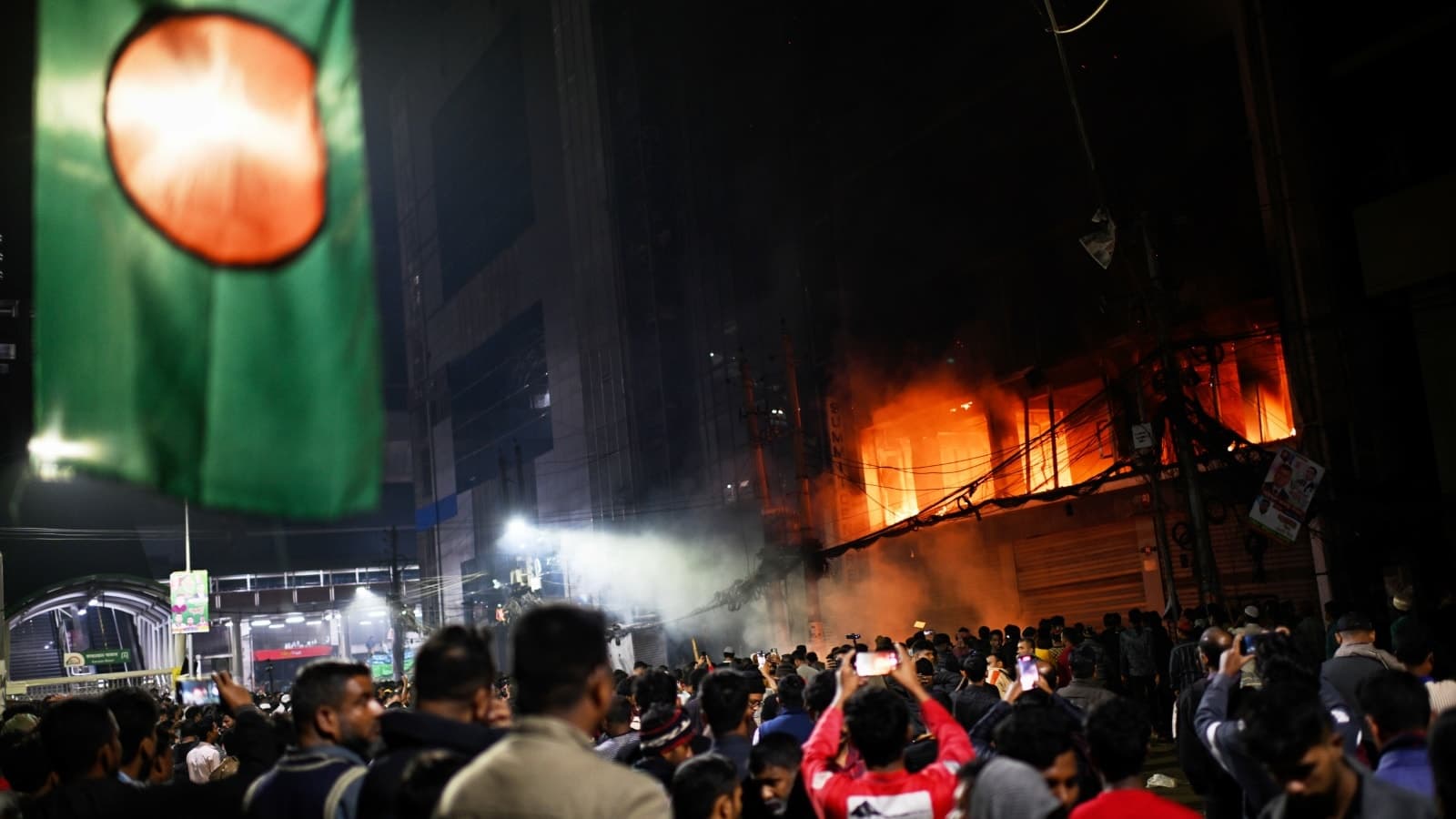


BJP in Jammu calls Bangladesh Hindu attacks a 'conspiracy'; no article content available.
Summary
The article title suggests the BJP in Jammu has labeled the unrest and attacks on Hindus in Bangladesh as a 'well-planned conspiracy'. However, no specific content is available to detail the context, specific incidents, or the basis of these allegations. Due to the absence of article content, no concrete facts, dates, names, or numbers can be extracted for competitive exam preparation, rendering the piece uninformative.
Key Points
- 1The news article title indicates a statement made by the BJP in Jammu.
- 2The statement concerns unrest and alleged attacks on Hindus in Bangladesh.
- 3The BJP characterized these events as a 'well-planned conspiracy'.
- 4No specific details regarding the alleged conspiracy, incidents, or timeline are provided in the article content.
- 5Due to the lack of content, no factual information relevant for competitive exams can be extracted.
In-Depth Analysis
The statement by the BJP in Jammu, labeling unrest and attacks on Hindus in Bangladesh as a 'well-planned conspiracy', brings to the forefront a complex and sensitive issue deeply rooted in the historical, political, and social fabric of the Indian subcontinent. While the provided article lacks specific details, the mere articulation of such a concern by a prominent Indian political party has significant implications for both domestic politics and bilateral relations with Bangladesh.
To understand the background, we must look at the historical trajectory of the region. The partition of British India in 1947 led to the creation of East Pakistan (now Bangladesh) as a Muslim-majority state. However, a significant Hindu minority remained in East Pakistan. The 1971 Liberation War of Bangladesh, supported by India, resulted in the emergence of an independent, secular Bangladesh. Yet, over the decades, the principle of secularism enshrined in its initial constitution (Article 12) has seen shifts, with Islam being declared the state religion in 1988, though secularism was later restored as a fundamental principle in 2011 (Article 2A, 8), albeit with Islam remaining the state religion (Article 2A). This constitutional ambiguity, combined with socio-political dynamics, has often been cited as a factor contributing to the vulnerability of minorities.
What often happens, and what the BJP's statement likely alludes to, is a recurring pattern of alleged communal violence and persecution targeting the Hindu minority in Bangladesh. These incidents frequently escalate during periods of political instability, national elections, or in the aftermath of specific religious or political events. Allegations range from land grabbing and forced conversions to physical assaults and destruction of religious sites. While the Bangladeshi government often denies these are widespread or state-sponsored, human rights organizations and minority groups have consistently raised concerns about their safety and security.
Key stakeholders involved in this narrative include, first and foremost, the **Bharatiya Janata Party (BJP)**. Their statement, particularly from the Jammu unit, resonates with their core ideology of protecting Hindu interests, both domestically and abroad. Such pronouncements can serve multiple purposes: consolidating their Hindu vote base in India, expressing solidarity with co-religionists, and putting diplomatic pressure on Bangladesh. The **Government of India**, led by the BJP, has a delicate diplomatic tightrope to walk. While it must address domestic concerns and the safety of minorities in neighbouring countries, it also needs to maintain strong, cordial relations with Bangladesh, a crucial partner in India's 'Neighbourhood First' policy and Act East policy. The **Government of Bangladesh** is a primary stakeholder, responsible for ensuring the safety and rights of all its citizens, including minorities. Any perceived failure to do so can strain its international image and bilateral ties. Finally, the **Hindu minority in Bangladesh** is the most vulnerable stakeholder, directly affected by these incidents and often caught in the crossfire of political and communal tensions.
This issue matters significantly for India for several reasons. Diplomatic relations with Bangladesh are vital for regional stability, counter-terrorism efforts, trade, and connectivity. Any perceived persecution of Hindus in Bangladesh often fuels domestic political discourse in India, particularly concerning issues like the Citizenship Amendment Act (CAA) 2019, which aims to provide a path to Indian citizenship for religiously persecuted minorities (including Hindus) from Pakistan, Bangladesh, and Afghanistan. This can lead to increased communal polarization within India and potentially trigger an influx of refugees, posing humanitarian and security challenges. India's Preamble to the Constitution declares it a secular republic, and while this primarily applies to its own citizens, the moral and political pressure to address the plight of co-religionists in neighbouring countries often weighs on its foreign policy decisions. Article 51 of the Indian Constitution, which mandates the state to promote international peace and security and foster respect for international law and treaty obligations, indirectly guides India's approach to such regional issues.
The historical context of partition and the 1971 war, which saw millions of refugees, including a large number of Hindus, migrate to India, continues to shape perceptions and anxieties. The memory of these events often resurfaces during discussions about minority rights in Bangladesh.
Looking ahead, the future implications are multi-faceted. Continued allegations of minority persecution could strain India-Bangladesh relations, potentially impacting economic projects, border management, and security cooperation. Domestically, such issues will likely remain a potent political tool, influencing electoral narratives and debates around citizenship and national identity. For Bangladesh, ensuring the safety and inclusion of its minorities is crucial for its own internal stability, democratic credentials, and international standing. India's approach will likely involve a combination of diplomatic engagement, humanitarian assistance where necessary, and continued emphasis on Bangladesh's responsibility to protect its citizens, all while balancing its strategic interests in the region. The delicate balance between humanitarian concerns, domestic political pressures, and foreign policy objectives will continue to define India's response to the situation of minorities in Bangladesh.
Exam Tips
This topic primarily falls under GS Paper-II (International Relations and Polity) for UPSC Civil Services Exam. Students should focus on India-Bangladesh bilateral relations, regional cooperation, and challenges to secularism in South Asia.
Study related topics like the Citizenship Amendment Act (CAA) 2019, National Register of Citizens (NRC), India's 'Neighbourhood First' policy, and the historical context of Partition and the 1971 Bangladesh Liberation War. Understand the constitutional provisions related to secularism (Preamble, Articles 25-28) and international relations (Article 51) in the Indian Constitution.
Common question patterns include analytical questions on the impact of domestic politics on foreign policy, challenges faced by religious minorities in South Asian countries, and the role of India in regional stability. Be prepared to discuss the diplomatic dilemmas India faces in balancing humanitarian concerns with strategic interests.
Pay attention to current events regarding communal incidents in Bangladesh and official statements from both Indian and Bangladeshi governments. Understand the perspectives of various stakeholders, including political parties, human rights organizations, and the affected communities.
Practice essay writing on themes like 'Secularism in a diverse subcontinent' or 'Challenges to India's Neighbourhood First policy' using this context as an example.